
Meet the board steering SouthSounds 2017 in downtown Mobile
The newly formed SouthSounds board of directors explains why the downtown Mobile music festival matters and shares their must-see bands for 2017.
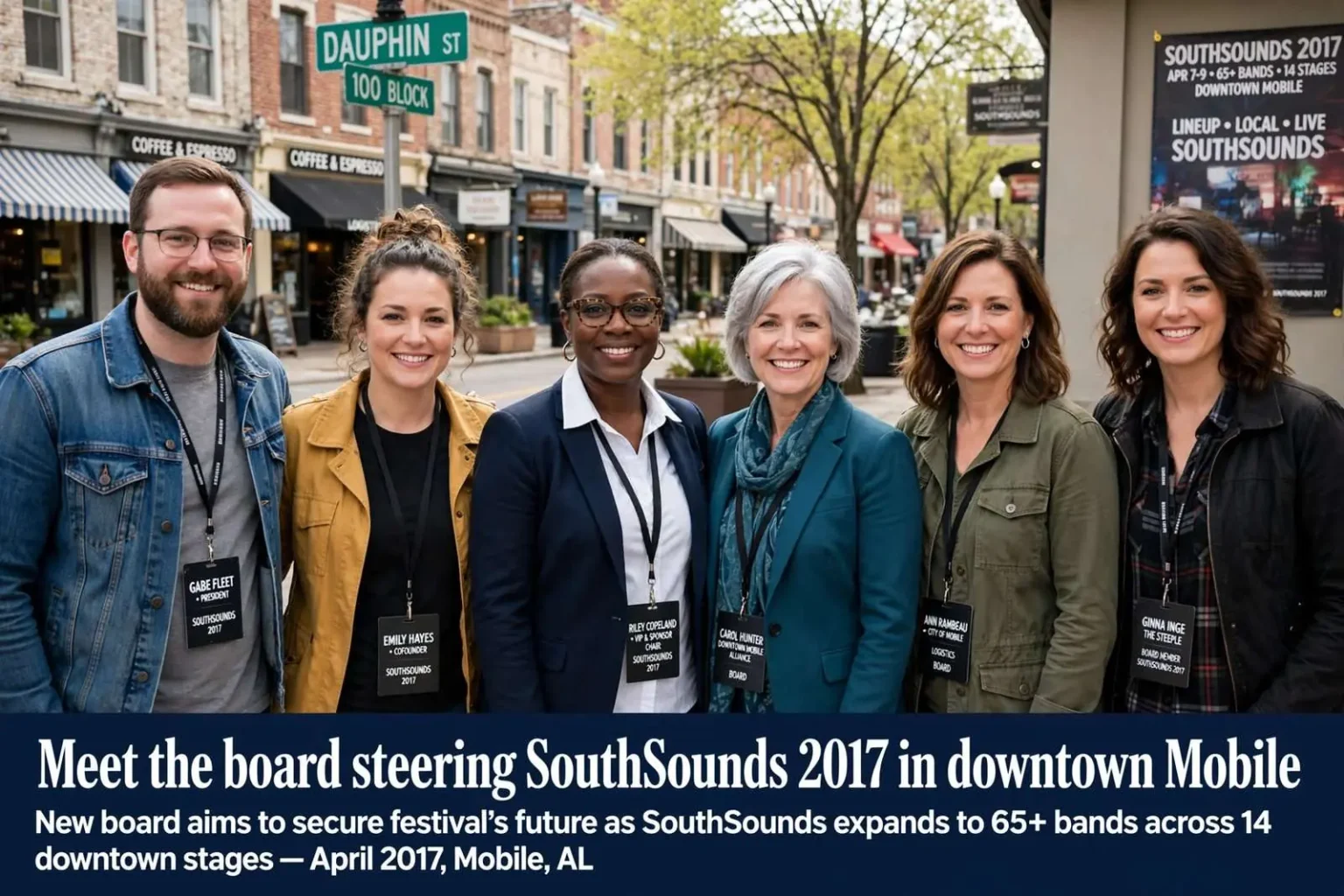
SouthSounds has changed shapes many times since its start. The festival grew out of two earlier events — Kris Skoda’s Coastline Chronicles in 2010 and the LoDa Live series helmed by Emily Hayes and Ted Flotte — before uniting as SouthSounds in 2012. What began as separate efforts to bring original music to downtown Mobile has since matured into one of the Gulf Coast’s most distinctive festivals, an event built not around headliners but around the idea that the next important acts in American music can be found first in Mobile.
Six years later, the 2017 edition spans more than 65 bands across 14 stages. The scale represents steady, deliberate growth from the early years, with venues across downtown converted for a weekend into showcase rooms hosting acts from around the region and around the country. The festival’s format — short sets, multiple stages, and an emphasis on emerging artists — follows a model popularized by national showcase festivals, adapted to the bars, theaters, and public spaces of lower Dauphin Street.
New this year is a formal Board of Directors, a group of volunteers and music advocates working to build something lasting for Mobile. The creation of the board marks an organizational milestone for a festival that has always run on passion and volunteer labor, giving SouthSounds a structure designed to carry it beyond any single group of organizers and to stabilize its relationships with sponsors, venues, and the city.
We asked several of them why SouthSounds matters and which acts they’re most excited to see.
Why it matters
“SouthSounds is important not only to downtown Mobile, but to all the citizens of our fair city,” said Riley Copeland, the board’s VIP and sponsor chairman.
Carol Hunter of the Downtown Mobile Alliance pointed to the festival’s “cool factor” as a tool for helping the city compete for 21st-century talent. Her organization has spent years working on the revitalization of downtown Mobile, and in that work the presence of a credible music festival has been a marker of the district’s progress — a signal to young professionals and creative workers that the city offers a cultural life beyond its size.
Ann Rambeau, who handles SouthSounds logistics for the City of Mobile, framed it in practical terms: the event adds to quality of life and economic growth, drawing people downtown who might not otherwise come. For city government, a festival that fills sidewalks, restaurants, and hotels for a weekend in April is an economic event as much as a cultural one.
The three perspectives — sponsor, economic development, and city operations — reflect the breadth of the new board, which pulls members from across Mobile’s civic and business community. What unites them, board members say, is a shared belief that the festival has become part of the city’s identity and deserves an institutional foundation to match.
Must-see bands
Board members named a wide range of picks, a list that doubles as a guided tour of the 2017 lineup. Ginna Inge of The Steeple on St. Francis highlighted Muddy Magnolias, The Wild Feathers, and Big Freedia — a trio of acts spanning soulful roots duets, indie rock, and New Orleans bounce, and a fair sample of the festival’s stylistic range.
President Gabe Fleet pointed to The Wild Feathers, Young Mister, and Sweet Crude. The overlap with Inge’s list around The Wild Feathers made the Nashville band one of the weekend’s consensus picks among board members, while Fleet’s other selections — a stripped-down singer-songwriter project and a Louisiana indie-pop band singing in both English and French — showed the depth of the undercard that showcase festivals like SouthSounds exist to surface.
Emily Hayes, a cofounder, leaned local with Bantam Foxes, Jeff the Brotherhood, She Returns From War, and The Hallers. Her list reflects the festival’s founding instinct: that Mobile’s own scene deserves the same stages, sound, and attention as the touring acts, and that a hometown audience will show up for bands it can follow all year long.
The volunteer media coordinator, covering the festival since 2012, urged fans not to miss local favorites like The Dirty Lungs, Glass War, Jamell Richardson, Infant Richard and the Delta Stones, and Black Titan. The picks skew heavily toward Mobile and the surrounding Gulf Coast scene, underscoring a point the festival’s organizers make every year: SouthSounds is as much a showcase for what grows here as for what passes through.
A community effort
SouthSounds began as a nonprofit special event under the Mobile Arts Council and still runs on volunteer energy. The connection to the Arts Council gave the festival its early legitimacy and administrative home, and the nonprofit structure remains central to how the event operates — earnings go back into the festival, and the labor that builds it comes largely from people who donate their time.
That volunteer core is substantial. Beyond the artists themselves, the festival depends on stage managers, door staff, merchandise volunteers, drivers, and the dozens of small jobs that turn a downtown of bars and venues into a coordinated multi-stage event for a weekend. The new board’s mandate is in part to organize and sustain that workforce, giving the festival a dependable pipeline of volunteers year over year.
The two-parent lineage of the festival still shows in its character. Coastline Chronicles, Kris Skoda’s 2010 event, and the LoDa Live series run by Emily Hayes and Ted Flotte each brought original live music to downtown venues at a time when the district’s nightlife scene was rebuilding. When the efforts merged as SouthSounds in 2012, they combined Coastline Chronicles’ festival ambitions with LoDa Live’s local venue network — a pairing that produced the multi-stage, multi-day format the festival still uses.
Downtown Mobile itself has changed alongside the festival. The lower Dauphin entertainment district, with its concentration of bars, restaurants, and restored buildings, has been the center of the city’s downtown revival, and SouthSounds has grown up as one of the district’s signature annual events. The festival’s April date lands in the heart of Mobile’s spring events season, following Mardi Gras and Azalea Trail Run season, and giving the city a music-focused anchor in the weeks after the carnival chaos subsides.
Building something lasting
As Hayes put it, the goal was always to grow at a sustainable pace so the second weekend of April in Mobile, Alabama would become synonymous with SouthSounds — and to keep bringing the best emerging music in the country to the stages of downtown Mobile. That long-view framing explains both the slow build of the festival’s first six years and the board’s creation now: the organizers want the event to outlast them.
Showcase festivals live or die on curation. With more than 65 bands on 14 stages, the 2017 lineup required months of listening, outreach, and booking — work done largely by volunteers who screen submissions, follow regional scenes, and weigh which acts fit the festival’s identity. The board’s involvement formalizes some of that process, adding accountability and continuity to decisions that were previously made by a smaller circle.
The board also gives sponsors a more stable partner. Copeland’s role as VIP and sponsor chairman exists because the festival’s growth has depended on local businesses underwriting everything from staging to hospitality, and corporate sponsors tend to commit to organizations with governance and continuity, not just enthusiasm. The structure is a signal that SouthSounds intends to be an annual fixture rather than a project that depends on whoever is willing to run it each year.
Mobile’s broader festival calendar gives the event a strong foundation to build on. The city is one of the South’s most experienced festival towns, with a Mardi Gras tradition that predates the better-known celebrations to the east and a downtown accustomed to closing streets and moving crowds. SouthSounds borrows that operational know-how while offering something the carnival season does not: a weekend built around discovery, where the bands on stage are ones most of the audience has never heard of and the point is to find out what the fuss is about.
The April timing also works in the festival’s favor for touring acts. Early spring is a heavy window for regional touring, and a Gulf Coast stop between New Orleans and the Florida Panhandle fits neatly into many bands’ routes. That geography has quietly helped SouthSounds book up-and-coming acts on their way through the region, letting a modest budget stretch further than it would in a market with pricier guarantee expectations.
For the 2017 festival, the practical effect will be visible in the weekend itself: more than 65 bands, 14 stages, a downtown filled with wristbands and guitar cases, and a slate of acts the festival’s own board is eager to see. The longer-term effect is harder to see but more significant — a festival that began as a merger of two volunteer projects now has the organizational bones to keep going, and a city that has learned to plan its second weekend of April around the music.


