University of South Alabama Mobile
University of Mobile Students Launch Local Arts Magazine ‘Ant Farm’
A pair of University of Mobile students created 'Ant Farm,' a magazine celebrating local artists and Mobile's creative community and history.
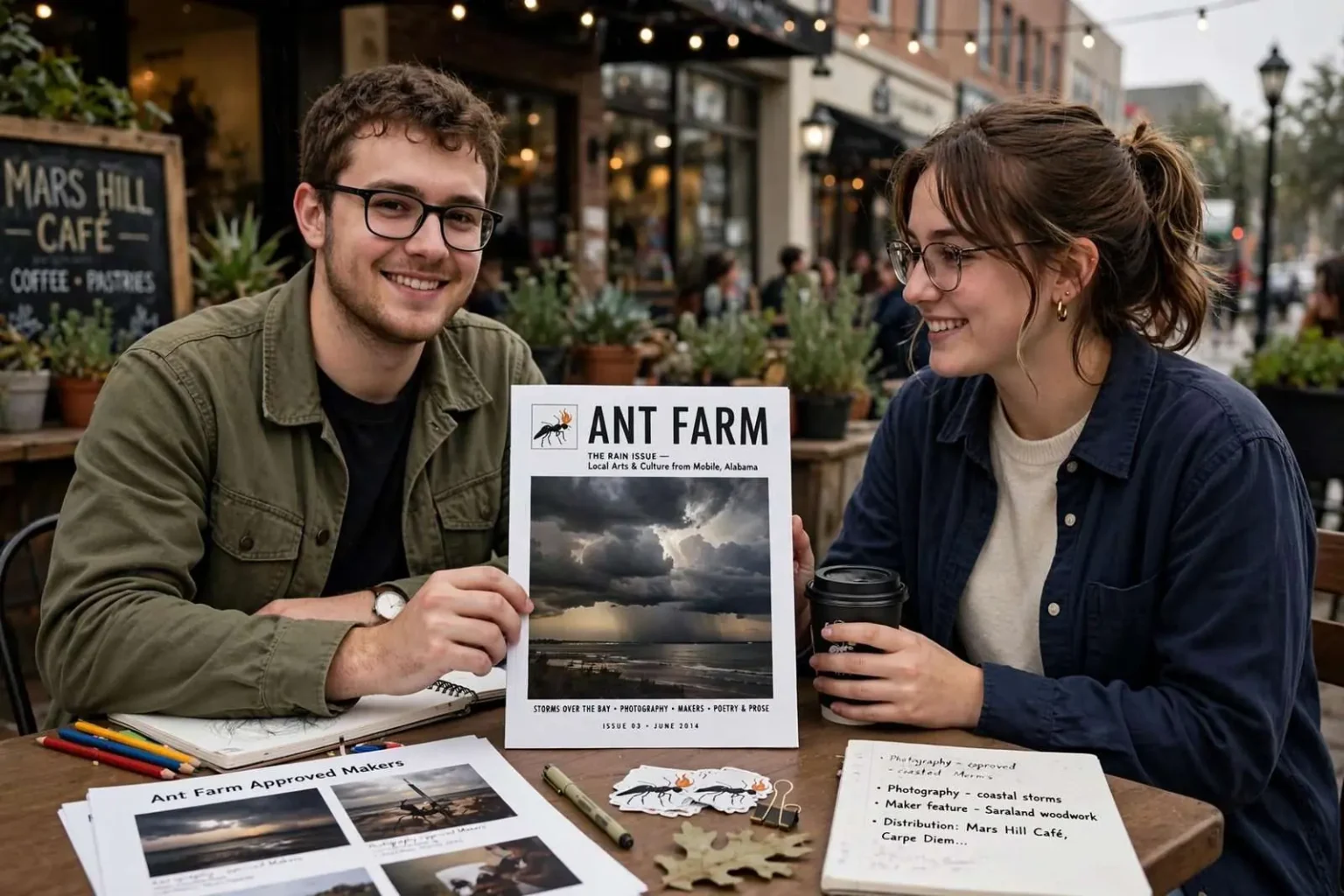
Two University of Mobile students have turned classroom skills into a homegrown publishing venture, launching a magazine called “Ant Farm” that spotlights local artists and Mobile’s creative scene.
The magazine was co-founded by Heath Vester, a junior studying fine arts with a concentration in graphic design who serves as design director, and Eleanor Mason, a senior English major who serves as editor-in-chief. The name is a nod to local history: fire ants are believed to have entered the United States through the Port of Mobile, and the founders wanted a title that paid homage to that piece of the region’s past.
Vester said the goal behind the project was to give local creatives and artists a platform to share their work while showcasing what sets Mobile apart from other Southern cities when it comes to art, culture and history.
Three issues had been published as of early June, with a fourth planned for later in the month — a pace that put the student-run publication on a roughly quarterly rhythm in its first year, moving from a digital experiment to a printed product within three issues.
A magazine with a mission
The founders’ pitch was straightforward: Mobile’s creative community deserved a publication of its own, one that treated local photographers, painters, makers and writers as subjects worth covering rather than background for someone else’s story. Cities across the South have seen independent arts magazines emerge in recent years as cheap digital publishing lowered the barrier to entry, and Ant Farm’s founders bet that Mobile’s scene — anchored by its museums, galleries, festivals and a deep tradition of Gulf Coast visual culture — could sustain one.
Although its founders and much of its staff are current or recent University of Mobile students, the magazine is not officially affiliated with the university, according to a university spokeswoman. The independence freed the publication to cover the broader creative community without campus boundaries, even as the university’s arts programs supplied much of its talent pipeline.
From pixels to print
The first two issues were released online at antfarmmobile.com, while the third marked the magazine’s first run in print. The transition from web to paper is a deliberate statement in the publishing world of the mid-2010s: digital-only publications cost nothing to distribute but are easy to ignore, while a physical magazine placed in a coffee shop invites the idle pickup that turns a browser into a reader.
Print copies have been distributed at Mars Hill Café and Carpe Diem in Mobile, Shop Around the Corner and Moka’s Coffee House in Saraland, and The Little Shop in Satsuma — a distribution map that stretched the magazine’s reach from midtown Mobile north through the county’s suburban corridor, precisely the cafes and indie shops where locally minded readers linger.
That grassroots distribution model, common among independent zines and arts quarterlies, costs the magazine nothing in rent and builds relationships with the businesses it covers — several of which would later appear in its own pages.
“The Rain Issue”
That third issue, themed “The Rain Issue,” features photography of thunderclouds and coastal storms alongside a recurring feature called “Ant Farm Approved Makers,” which highlights local businesses and photographers with a distinctive creative eye.
The theme suits the Gulf Coast. Mobile’s climate delivers some of the most dramatic weather imagery in the country — afternoon thunderheads stacking over the bay, summer storm fronts rolling in from the Gulf, the saturated light that follows a downpour — and coastal photographers have long mined it. Giving storm photography a full issue’s worth of space placed the magazine’s Gulf Coast identity at the center of its editorial voice.
The “Ant Farm Approved Makers” feature, meanwhile, gave the publication a signature franchise: a recurring section that functions simultaneously as editorial content and as a service to the local businesses that host its print copies. The format — curatorial, approving, deliberately local — mirrors the “best of” features that established city magazines use, scaled to a city the size of Mobile and produced by a staff working from classrooms and coffee shops.
A small staff with a wide reach
The magazine’s small staff includes 2014 University of Mobile graduate Christian Hilley as director of photography, Christian Mott, a University of South Alabama graduate, as co-editor, and 2015 University of Mobile graduate Stephen Tindal as an online blogger and editing assistant, rounding out a team that mixed current students with recent alumni and one recruit from across town at the University of South Alabama.
That blend mattered for the publication’s identity. By drawing from both of Mobile’s private university scene and the larger public university across the city, Ant Farm positioned itself as a Mobile publication rather than a campus one — a distinction its non-affiliation with the University of Mobile made official.
Small staffs also mean overlapping jobs. On a publication of this size, the design director who lays out the pages is also the photographer wrangling submissions, and the editor-in-chief writes, edits and answers the magazine’s email. The founders’ fine arts and English backgrounds split the labor naturally: Vester’s graphic design training shaped the magazine’s visual identity, while Mason’s literary training ran the words.
Mobile’s creative scene, covered locally
The magazine arrived amid a period of visible creative activity in Mobile. The city’s downtown revival had brought new galleries, studios and performance venues to the lower Dauphin corridor, the annual calendar of festivals draws regional artists to the area, and long-running institutions such as the Mobile Museum of Art give the scene an anchor that many cities its size lack.
What the scene historically lacked, the founders argued, was a publication dedicated to documenting it between events — a place where a Saraland woodworker, a midtown photographer and a Satsuma painter could appear in the same issue, distributed in the shops where their neighbors already gathered.
The fire-ant name that ties it together is pure Mobile: the port city has been the Gulf’s front door for more than three centuries, for better and worse, and the founders’ decision to embrace an invasive species as their mascot captured the magazine’s tone — affectionate about the region, unsentimental about its history, and determined to claim even the uncomfortable parts as local heritage.
The economics of a startup magazine
Independent arts magazines survive on the same narrow margins everywhere: modest print runs, sponsorships and advertisements from local businesses, and volunteer labor. Ant Farm’s model — free digital issues building an audience, then a print run placed in sympathetic businesses — follows the playbook that independent publications across the country have used to reach sustainability without outside investors.
The print distribution partners gained as well. Cafes and indie bookshops use local publications as ambiance, a signal to customers that the shop belongs to the community it sits in. For a young magazine, every rack space is both a distribution point and an endorsement.
What comes next
With a fourth issue planned before the summer ended, the publication’s immediate future looked steady: a themed issue cadence, a growing stable of contributing photographers and writers and a print presence that extended across Mobile County from midtown to Satsuma.
The longer test is the one every independent publication faces — whether the founders, as they graduate and move into careers, can hand the magazine to the next class of students and maintain the quality and identity that made the first three issues distinctive. For now, the founders said, the mission stands: a platform for Mobile’s creatives, made in Mobile, about Mobile — fire ants and all.
The University of Mobile connection
The University of Mobile, a private institution affiliated with the Alabama Baptist State Convention, sits on a campus in north Mobile County and enrolls a few thousand students. Its fine arts and English programs gave Ant Farm both its founders and much of its early contributor pool, and the campus’s graphic design coursework is where Vester developed the layout and typography skills the magazine’s look depends on.
Student publications have long been the proving ground for careers in media, but most are confined to campus news and official university life. Ant Farm inverted that model: rather than covering the university for students, it covered the city for everyone, using the university only as the place its founders happened to meet and learn their crafts.
The university’s spokeswoman confirmed the non-affiliation when the magazine launched, a routine clarification that nonetheless underscored the publication’s independence — its decisions, its budget and its editorial voice belonged entirely to the small staff that produced it.
Reading the local scene
The choice of themes and features reveals how the founders read Mobile’s creative identity. Storm photography first: on the Gulf Coast, weather is a shared experience that cuts across neighborhoods and income levels, and images of towering thunderheads over the bay are the region’s most recognizable visual currency. Local makers second: the makers-and-crafters movement had taken hold nationally, and Mobile’s small businesses — the coffee roasters, printers, bakers and craftspeople — were its local expression.
Putting those two strands together in a single issue gave readers a publication that felt like the city itself: coastal weather overhead, small businesses at street level, and a generation of young creatives documenting both.
Distribution in Saraland and Satsuma, cities north of Mobile along U.S. Highway 43, also made a quiet editorial statement — that the county’s creative life extends beyond the downtown corridor the city’s revival narrative usually celebrates. The shops hosting the magazine there cater to readers who might never pick up a downtown gallery guide but will leaf through a magazine left on a coffee counter.
A record of its moment
Independent magazines also serve as archives. Years from now, the issues of Ant Farm will document which photographers were emerging in Mobile in the mid-2010s, which businesses the “Approved Makers” franchise singled out and how the city’s self-image looked to the students who were then coming of age in it.
That archival value is one of the quiet arguments for print: files rot and websites lapse, but a magazine on a shelf keeps its record. For a publication founded by art and English students, preserving the moment is part of the point — the founders described the magazine as a platform, but the bound volumes of it will eventually read as a portrait of Mobile’s creative community in its most active years.