Coastal Alabama Officials Push to Restore Gulf Coast Passenger Rail
Local officials and advocates are pushing Congress to fund a study on restoring Gulf Coast passenger rail service through Mobile and other coastal cities.
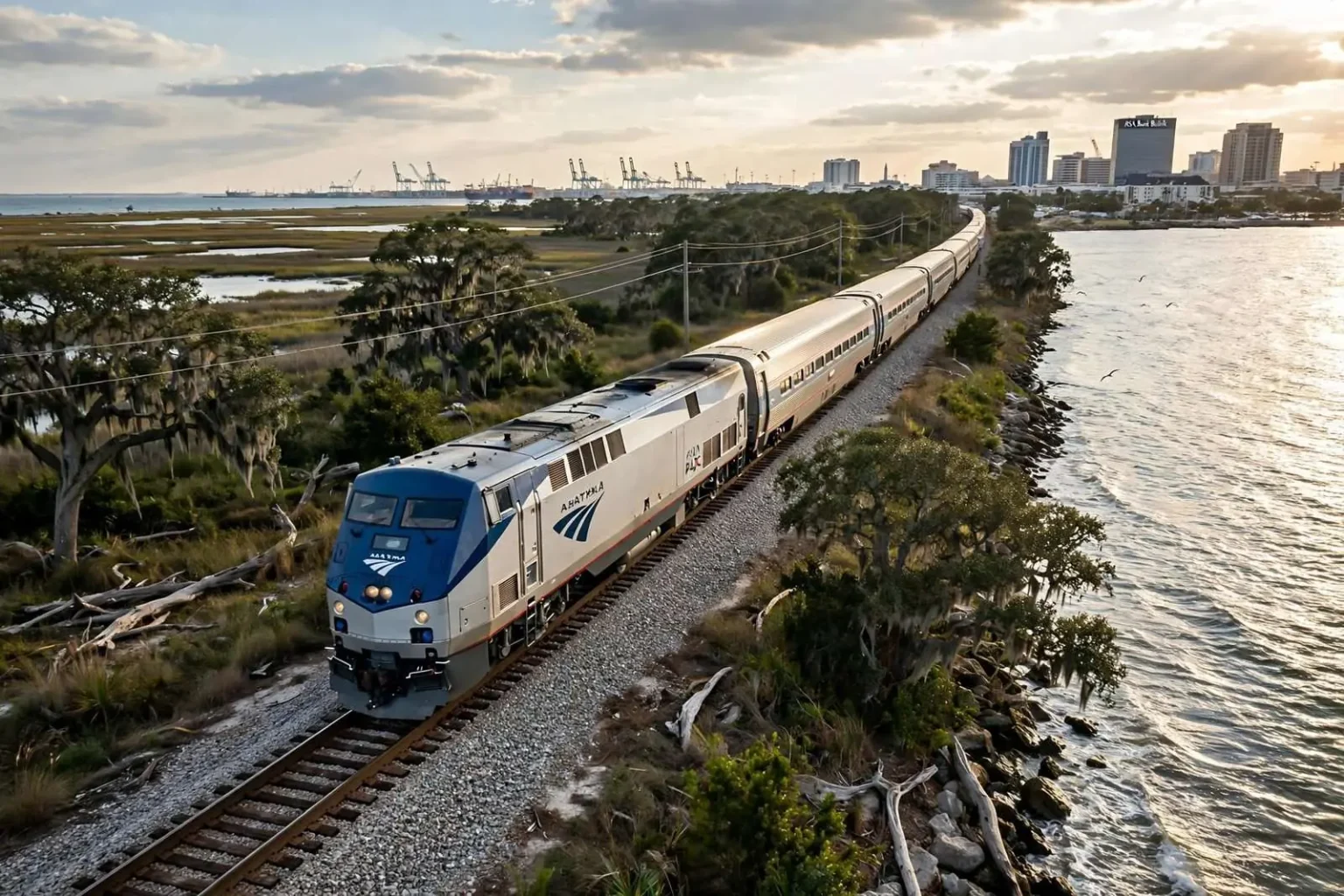
Passenger trains have not rolled along the Alabama Gulf Coast in a decade, but local officials and transportation advocates say momentum in Washington could finally put restoration back on track. Passenger rail has not operated along the coast since Hurricane Katrina forced the suspension of Amtrak’s Sunset Limited service in 2005, when the storm wrecked track and signal infrastructure east of New Orleans and left communities from Mobile to Pensacola cut off from the national passenger network.
Before the storm, the Sunset Limited, Amtrak’s long-distance train linking the West Coast with Florida, called at stations along the Mississippi and Alabama shorelines, connecting Mobile, Biloxi, Gulfport and Pensacola to New Orleans and points beyond. The storm’s damage to the route proved so extensive that passenger service east of New Orleans was never restored, even as other sections of the line resumed operations. For coastal Alabama, that has meant more than ten years without a daily rail option, a gap that stands out in a region where Interstate 10 funnels beach traffic, freight trucks and hurricane evacuees through some of the busiest and most congestion-prone corridors on the Gulf.
A Push Led by the Southern Rail Commission
Supporters, led by the Southern Rail Commission, are now pushing federal lawmakers to fund a study examining what it would take to restart daily service between New Orleans and Florida, potentially including a stop in Mobile. The commission, a federally chartered body whose membership includes representatives from Louisiana, Mississippi and Alabama, has spent years keeping the idea of Gulf Coast passenger rail alive in Washington, arguing that the corridor’s population growth, tourism economy and military installations make it a natural candidate for restored service.
The case, advocates say, is about economics as much as transportation. “This isn’t about nostalgia or rail fans, it’s about economic development and it’s about commerce,” said John Robert Smith, a former longtime mayor of Meridian, Miss., and chairman of the advocacy group Transportation for America. Smith has pointed to communities along the corridor that have used their historic train stations as anchors for downtown revitalization, and he has argued that a connected region is better positioned to compete for jobs and investment.
He said restored rail service also matters for hurricane evacuations and moving goods along the coast. That argument carries particular weight in south Alabama, where a single interstate route and a handful of bridges carry nearly all of the region’s through traffic. When storms threaten, residents of coastal Baldwin and Mobile counties routinely clog those arteries heading north, and planners have long looked for alternatives that give people more ways to move before and after landfall.
What Congress Is Considering
A passenger rail reauthorization bill moving through Congress would direct the Federal Railroad Administration to study restoring service east of New Orleans, including possible stops and financing options. Such a study would be the first formal federal examination of the corridor in years, and supporters view it as the necessary first step toward any engineering work, station construction or operating agreement.
The legislation would not itself fund a restart, but it would put the federal government officially on record evaluating the route, its ridership potential and the cost of bringing the line to the standards Amtrak would need. For the Southern Rail Commission and its allies, that kind of federal attention is exactly what the corridor has lacked since 2005, when rebuilding money flowed quickly to highways and other infrastructure but passenger rail was left out of the region’s recovery.
The study’s inclusion of financing options is significant for local officials, because it would require federal analysts to consider realistic funding models rather than simply describing a service that no one can pay for. Past proposals for the corridor have discussed combinations of federal operating support, state contributions and local station investments, and the commission has argued that a modest annual operating commitment is a fraction of what the region already spends maintaining roads that serve the same communities.
The road to a study has been long. The Southern Rail Commission had previously sought federal grant money to fund its own examination of the corridor but was passed over for competitive transportation grants, leaving the group without the resources to complete the detailed analysis that federal and state officials typically want before committing to a service plan.
The commission’s experience reflects the reality of the federal grant process, in which rail projects compete against highway, transit, port and airport proposals from every state for limited pools of money. Projects that already have completed studies, matched funding in hand and local political consensus tend to fare best, which is why advocates along the Gulf have framed the proposed congressional directive as a way to level the playing field rather than a request for operating subsidies.
Support Across the Coast
Locally, the effort has drawn support from coastal mayors, chambers of commerce and Mississippi casino operators, according to consultant Dan Dealy, who has worked for years on Gulf Coast rail restoration. The coalition spans city lines and state lines, uniting officials in Mobile and Baldwin counties with counterparts in Pascagoula, Biloxi and Gulfport, where casino resorts depend on a steady flow of visitors and have an obvious interest in making the coast easier to reach.
But Dealy said that support hasn’t always translated to Washington. At a recent town hall in Daphne, U.S. Rep. Bradley Byrne defended his vote against Amtrak funding, arguing the private sector should lead any restoration effort. The exchange underscored a long-running debate in Congress over the proper federal role in passenger rail, with some lawmakers questioning why taxpayers should subsidize intercity train service while railroads and private operators remain on the sidelines.
For advocates, the exchange in Daphne illustrated the challenge ahead: broad local enthusiasm exists, but converting it into federal funding and a service agreement requires navigating both policy disagreements in Washington and the practical question of how a Gulf Coast service would be financed day to day. Supporters have pointed out that the corridor’s freight railroads, state transportation departments and local governments would all have a role, and that a formal federal study is the mechanism for working out who pays for what.
Byrne’s district, which stretches across southwest Alabama from the Mississippi line to the Florida line, includes the communities that would benefit most directly from a Mobile or Baldwin County stop. That has made his position a focus of attention for rail supporters, who have continued to press the case at public meetings and in conversations with congressional staff about the reauthorization bill.
A Station for Mobile’s Waterfront
Mobile currently has no train station. The original depot near Cooper Riverside Park was a Katrina casualty, damaged beyond use in the 2005 storm and never replaced, leaving one of the Gulf Coast’s largest cities without any passenger rail facility at all.
Advocates say a new station along the city’s waterfront could become a tourism draw as well as a transportation asset. Downtown Mobile has invested heavily in its riverfront in recent years, and a restored rail connection would put visitors within reach of the city’s restaurants, hotels and convention facilities, while giving cruise passengers and travelers an additional way to arrive without driving.
Mobile Mayor Sandy Stimpson has expressed support for the rail effort, aligning the city with the regional coalition pushing for the federal study. City officials have watched similar projects elsewhere along the Gulf, where restored or preserved stations have become civic landmarks, and supporters in Mobile see the same potential for a facility that serves travelers while anchoring continued investment along the river.
What a Return Would Take
Restoring service would involve far more than scheduling a train. The tracks east of New Orleans are owned by freight railroads, and any passenger service would require agreements over access, capacity upgrades and signal work before a train could operate. Stations would need to be built or rebuilt in each community, and a sponsoring agency would need to be identified to manage operations and share costs.
For residents of coastal Alabama, the practical benefits would show up in everyday ways: a way to reach New Orleans without driving the interstate, an option for college students and commuters, and a fallback route when storms close highways. Business leaders have also pointed to the work force angle, noting that young workers increasingly weigh transportation options when deciding where to live, and that a connected corridor helps the coast recruit talent from larger metros.
None of those obstacles has discouraged the corridor’s advocates, who argue that the region has changed substantially since 2005. Population along the coast has grown, tourism has rebounded, and the region’s ports have continued to expand their role in international trade. A train connecting New Orleans to Mobile and on toward the Florida panhandle, they argue, would serve a corridor that is far busier today than the one Amtrak abandoned.
The proposed federal study is the next concrete step. If Congress includes the directive in the reauthorization bill and the Federal Railroad Administration completes the analysis, the corridor would for the first time in a decade have a formal blueprint showing what restoration would cost, where stations would go and how the service could be financed. Supporters say that document, more than any single vote, will determine whether passenger trains one day return to the Alabama Gulf Coast.