‘Bama Girl’ Comes to Bienville Square: A Homecoming Campaign, a Secret Society and a Free Screening
The Southern Circuit tour of independent filmmakers closes at Mobile's Ben May Main Library with a documentary about a Black student's run for homecoming queen against the University of Alabama's Machine.
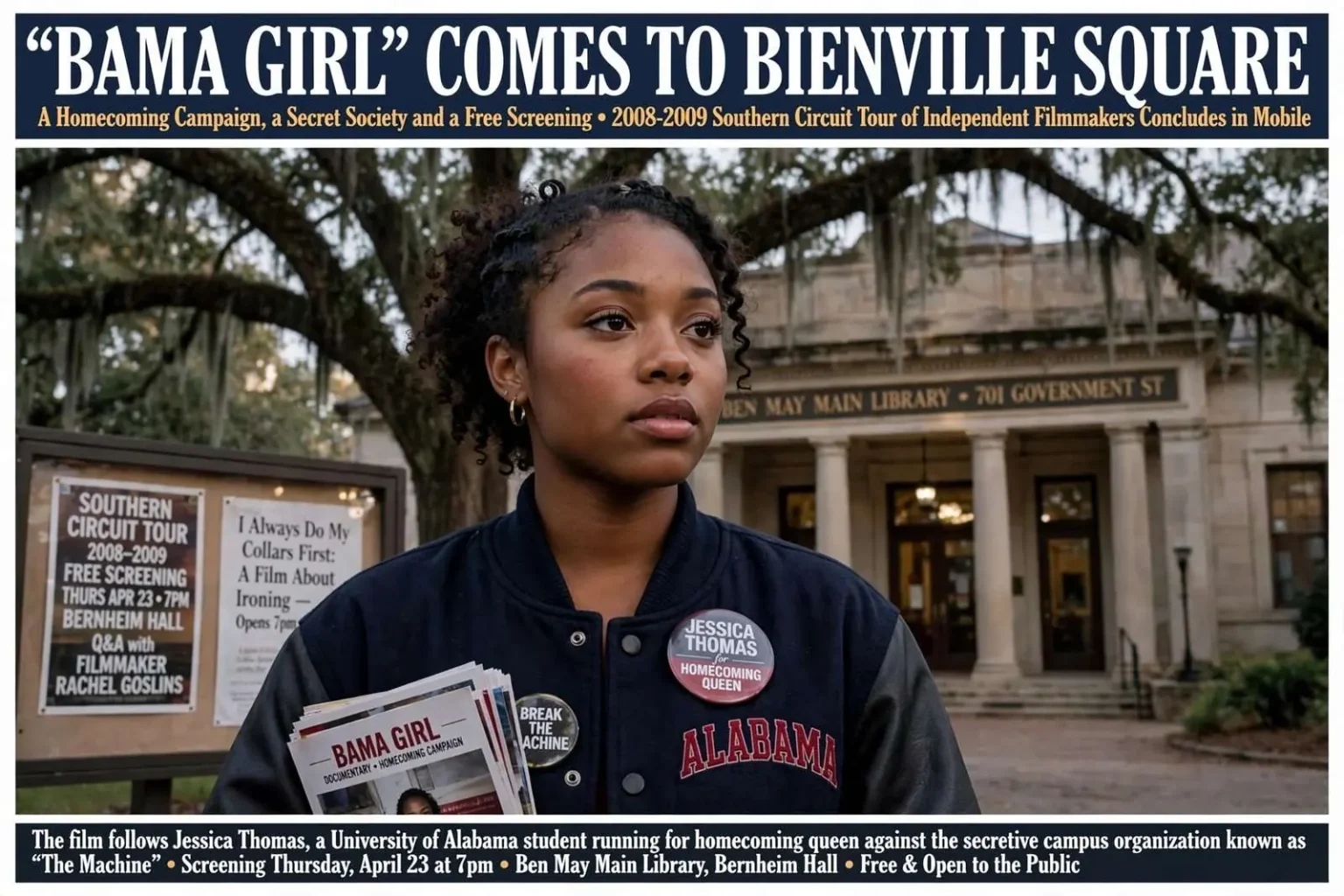
The 2008-2009 Southern Circuit Tour of Independent Filmmakers concludes in Mobile with a documentary about student politics that turns out to be about a good deal more than student politics.
“Bama Girl” follows Jessica Thomas, a young Black woman at the University of Alabama, in her campaign to become homecoming queen. On paper she is running against 15 other students. In practice she is running against a considerably larger and less visible opponent.
The Machine
The film’s central subject is an institution that most Alabamians have heard of and few have seen: a secret political organization known as “The Machine,” which for most of the past century has dominated student government and homecoming elections at the university through the campus Greek system.
Thomas’ campaign runs headlong into it — and into a segregated Greek structure, and into the internal politics of Black student organizations, which have their own calculations about how and whether to contest the Machine’s candidates. The film’s eye for those overlapping layers is what lifts it out of the campus-news genre. A homecoming election at Alabama is not one contest but several, running through sorority and fraternity chapters, through historically Black student groups, and through the informal networks that decide which candidacies get the blessing of the secret system that has crowned most winners for generations.
The history is not simple. Black students were elected homecoming queen at Alabama as long ago as 1973, and a Black student won the Student Government Association presidency in 1976. That such victories remain notable rather than routine, three decades on, is precisely the film’s point. A flagship university that desegregated its student body in the 1960s only after federal intervention was still, by the 2000s, electing its campus royalty through structures that largely reproduced the segregation of the Greek system itself — Machine-affiliated white chapters on one side, Black organizations on the other, and a small set of maverick candidates trying to run through the middle.
Thomas’ campaign becomes the film’s vehicle for all of it: the strategy sessions, the chapter meetings, the whispered questions about whether a non-Machine candidate can win, and the moments where the candidate herself has to decide what she is willing to make of the history she is running against.
The screening
The program begins at 7 p.m. Thursday, April 23, in Bernheim Hall at the Mobile Public Library’s Ben May Main Library, 701 Government St. Admission is free.
The evening opens with a short film, “I Always Do My Collars First: A Film About Ironing,” and includes a question-and-answer session with “Bama Girl” filmmaker Rachel Goslins, followed by a coffee-and-dessert reception. The pairing gives audiences a light opener before the feature, and the Q&A format has become the Southern Circuit’s signature — the director travels with the film and takes questions after the lights come up, turning a screening into something closer to a public seminar.
What the Southern Circuit is
The Southern Circuit tour brings independent filmmakers to a rotating slate of Southern venues — libraries, colleges, small museums — with the director present to discuss the work. It is a modest program with an outsized effect in cities that do not otherwise host art-house exhibition, and Mobile’s stop has become a reliable fixture of the local cultural calendar.
For audiences accustomed to multiplex fare, the Circuit offers something the market rarely delivers to mid-sized Southern cities: documentary and independent features on a big screen, followed by conversation with the person who made them. The series has historically operated on exactly that theory — that the gap between Southern audiences and independent film is a distribution problem, not a demand problem — and Mobile’s library-based screenings have drawn a mix of regulars and first-timers each season.
The 2008-2009 season’s Mobile schedule concludes with “Bama Girl,” a choice that sends the tour out of town on a subject with unusual reach for a campus documentary.
The venue and the subject
The pairing of venue and subject has a certain resonance. Bernheim Hall sits in the Ben May Main Library on Government Street, a public building in a city whose own history of race and access is neither distant nor settled. An audience there watching a film about who is permitted to win an election at the state’s flagship university is unlikely to treat the question as abstract.
Mobile’s own story runs parallel to the film’s themes in ways residents will recognize. The city’s public institutions navigated desegregation on timelines as contested as the university’s, and the questions the documentary raises — about whose candidacies get organized support, and whose communities get counted in — have local analogues in school boards, city elections and club rosters across the region.
The Machine beyond Tuscaloosa
Filmgoers who miss the screening will find the subject difficult to escape. The Machine’s influence on Alabama politics extends well beyond Tuscaloosa; a considerable number of the state’s officeholders came up through the Greek system it controls.
That reach is the documentary’s quiet undercurrent. The organization that manages homecoming elections began as a student political machine in the classic American mold, but Alabama’s scale makes the stakes different: the network of alumni it cultivates feeds directly into a state government where a handful of universities dominate the economy and the Legislature’s attention. Watching a homecoming campaign through that lens, the film suggests, is watching the first rung of a much longer ladder.
For Mobile audiences, the evening offers a rare chance to see that world up close, in a documentary that treats a student election with the seriousness usually reserved for statewide races — and in the company of a filmmaker who spent a semester inside the campaign finding out how much more the story held. Admission is free, the hall seats a substantial audience, and the season ends, fittingly, with a film about who gets to win.
A secret organization in a public university
The Machine’s secrecy is central to the film’s tension. Students acknowledge its existence, reporters write about it periodically, and alumni occasionally confirm its workings in retrospect, but the organization itself maintains no public roster, no published platform and no accountable leadership. That arrangement lets a private club function as a kingmaker in public campus elections — a structure whose critics call it anti-democratic and whose participants call it tradition.
“Bama Girl” gets inside that arrangement from the challenger’s side, which is the harder place to film from. Machine candidates can count on chapter votes and coordinated campaign mechanics; an independent candidate has to build everything from scratch, and the film documents what that looks like — the volunteer recruiting, the speaking invitations, the arithmetic of trying to out-organize a system that votes in blocs.
The segregated Greek landscape adds a second layer. Because the Machine’s base sits in historically white chapters, a Black candidate’s path runs partly through organizations the Machine does not control, and the film does not pretend those relationships are simple. Black student organizations weigh solidarity against strategy, skepticism against opportunity, and the film treats those deliberations with more nuance than campus coverage typically does.
Homecoming as a proxy fight
Homecoming queen elections look, from the outside, like popularity contests. At Alabama they have long functioned as the visible scoreboard of campus power — which is why the Machine treats them seriously, why candidates organize seriously, and why the outcomes carry symbolic weight far beyond the crown. The election’s rituals, rallies and vote counts give the film a narrative spine that abstract discussions of campus politics rarely have.
The historical markers the film cites sharpen the point. A Black homecoming queen in 1973 and a Black SGA president in 1976 proved that victories were possible generations ago; the question the film presses is why, decades later, each one still reads as an exception rather than a pattern. The answer it builds toward lies in the structures that survive between elections — the chapters, the endorsements and the quiet mechanisms that decide who runs with a real chance.
Why Mobile gets the final stop
That the tour’s 2008-2009 season ends in Mobile is a small fact with a fitting shape. The Circuit’s model depends on host venues that will pair a film with real discussion, and the library system’s Bernheim Hall has made a practice of exactly that. Mobile audiences have used the series to see documentaries about politics, race and community that commercial venues in the city do not book.
“Bama Girl” may be the season’s most local-feeling selection even though its subject sits three hours away in Tuscaloosa. The issues it raises — organized inequality, the durability of informal power, the question of who gets elected and who decides — are not confined to a campus. They are the questions a city like Mobile asks about itself, which is what has made the Circuit’s stops here more than a movie night.
Doors open for the 7 p.m. program on Thursday, April 23, at the Ben May Main Library, 701 Government St. The evening’s short film, feature, question-and-answer session with Rachel Goslins and dessert reception are all free and open to the public, the kind of evening the Southern Circuit was built to deliver — and the kind Mobile’s cultural calendar will be without until the next season’s slate arrives.