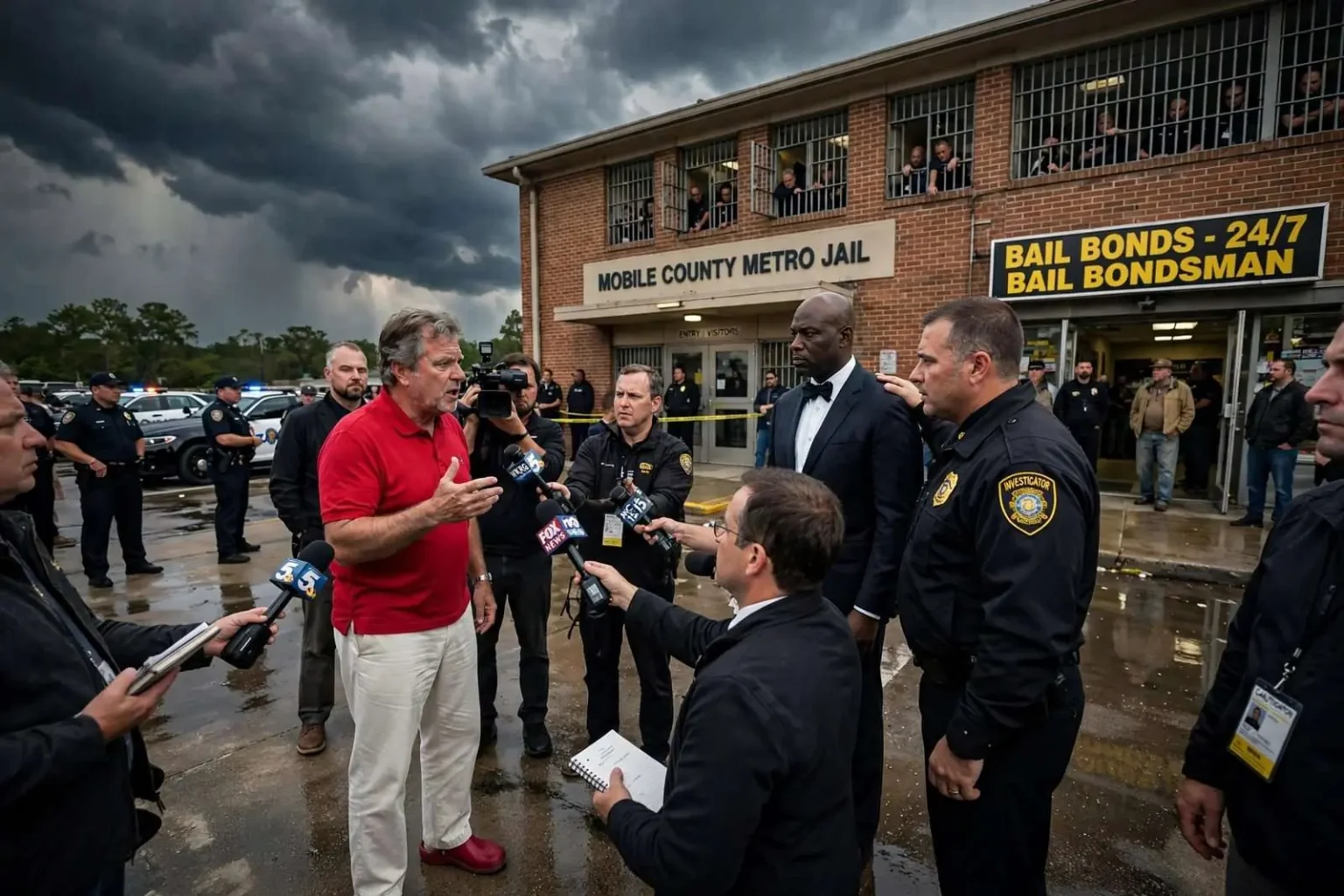
Outside the jail on Friday afternoon, the sky was dark and threatening. So was the attorney standing beneath it.
Robert “Cowboy Bob” Clark, dressed in a red polo shirt, off-white pants and crimson clogs, told reporters that his client, former Mobile County Circuit Judge Herman Thomas, was the target of a “high tech lynching” by a “racist” courthouse establishment. Thomas had been charged in a 57-count indictment with extortion, kidnapping, sexual abuse and sodomy involving young men who had appeared before his bench.
“This is racism at its very finest,” Clark said.
Police gathered on the sidewalk. Bondsmen stepped out of nearby storefronts. Clerks and guards watched from jailhouse windows. Thomas himself stood behind the media scrum — tall, bald, bow-tied, silent — until an investigator touched his shoulder and nodded toward the docket room.
He was processed and released about two hours later on bonds totaling $287,500.
How It Started
The case began, remarkably, with Thomas himself. Two and a half years ago the judge asked the state Judicial Inquiry Commission to investigate his own conduct, apparently believing he would be cleared.
The trigger was the treatment of his cousin and fraternity brother, impeached school board member David Thomas, whom Circuit Judge Rusty Johnston had sentenced to a week in the county metro jail. Herman Thomas cleared the way for him to serve the time in the more accommodating Prichard city jail instead, later denying any role in the arrangement.
The commission returned 30 counts of alleged misconduct, finding that Thomas “did willfully allow his family, social, political or other relationships to influence his judicial conduct or judgment.” He resigned rather than stand trial before the Court of the Judiciary. The Mobile County District Attorney’s office, the Alabama Attorney General’s office, the local bar and the FBI took the investigation from there.
Central to the allegations: that Thomas took inmates from the metro jail and paddled them in a converted storage room he used as a private office at the courthouse, and that he transferred cases from other judges’ dockets to his own without their knowledge.
A Career That Began With Promise
It was 1990 when Republican Gov. Guy Hunt appointed Thomas, not yet 30, to a district judgeship. The local selection committee had named him a finalist alongside former state Rep. Beth Marietta Lyons and current County Commissioner Merceria Ludgood.
He was elevated to the circuit bench in 1999 by Gov. Don Siegelman, at a moment when the local legal establishment had reason to want a Black judge who could win countywide — a counter to arguments for single-member judicial districts that would have scrambled the bench. Thomas won his elections without serious challenge.
On the bench he ran his courtroom unlike his colleagues, imposing unusually long probation terms while showing initial leniency, ordering defendants to dress neatly, get an education, find work and attend church. As the county’s only African-American circuit judge, he functioned as something between jurist, probation officer, social worker and community elder. The lines blurred.
“He changed,” said former District Attorney Chris Galanos, who hired Thomas as a young prosecutor and later served alongside him on the circuit bench.
The Indictment
The indictment names nine inmates over whom Thomas allegedly used his office improperly for personal gain, including sexual gratification. Attorney Joe Kulakowski, who spent unpaid months gathering statements and evidence, has called the matter the biggest scandal in the history of American jurisprudence.
District Attorney John Tyson Jr. dismissed the charge of racial motivation as “absolute nonsense.” Standing with Police Chief Phillip Garrett and Sheriff Sam Cochran, he said the prosecution would not rest on the word of convicted felons alone; other witnesses and physical evidence would be presented. Thomas was ordered to surrender his passport, avoid contact with witnesses and their families, and have no contact with males under 21.
The specially empaneled grand jury has not been released. “I have reason to believe we should continue this investigation,” Tyson said.
Theater at the Courthouse
The day had one more act. When Tyson’s chief investigator told Clark to leave the district attorney’s conference room, the lawyer refused unless placed under arrest.
“I’m not leaving until you arrest me,” Clark bellowed. “Say ‘you’re under arrest.’”
“You’re under arrest,” the investigator said, more in resignation than triumph. The two walked out together, peacefully. Ten minutes later everyone was back for the news conference, Clark included. Tyson took pains to clarify afterward that “Mr. Clark is not under arrest nor was he ever under arrest.”
Defense attorney Dom Soto predicted a fight. “We’re going to rally around the man,” he said, anticipating that several leading criminal defense lawyers would volunteer.
Retired Marengo County Judge Claud Nielson, tapped by Chief Justice Sue Bell Cobb after every Mobile circuit judge recused, is expected to schedule arraignment later this month.
What happened next
A second indictment returned in August 2009 added more charges, but prosecutors dropped some counts and the court dismissed others before trial, including every charge involving three of the alleged victims. Thomas went to trial in Mobile in October 2009 on 21 remaining counts. He acknowledged taking young men out of the jail to his courthouse office but said he had been counseling them, and his lawyers attacked the credibility of accusers who all had criminal records.
On Oct. 26, 2009, the jury found Thomas not guilty on seven counts and deadlocked on the other 14, which the special judge then dismissed for insufficient evidence. Tyson’s office decided not to pursue the case further. The Alabama State Bar separately moved to take Thomas’s law license, arguing that checking inmates out of jail and intervening in their cases was unprofessional conduct regardless of the verdict.