Chickasaw School Board to Vote on Reopening Vacant Hamilton Elementary
Chickasaw's school board will vote on reopening the long-vacant Hamilton Elementary as the growing district adds a second campus.
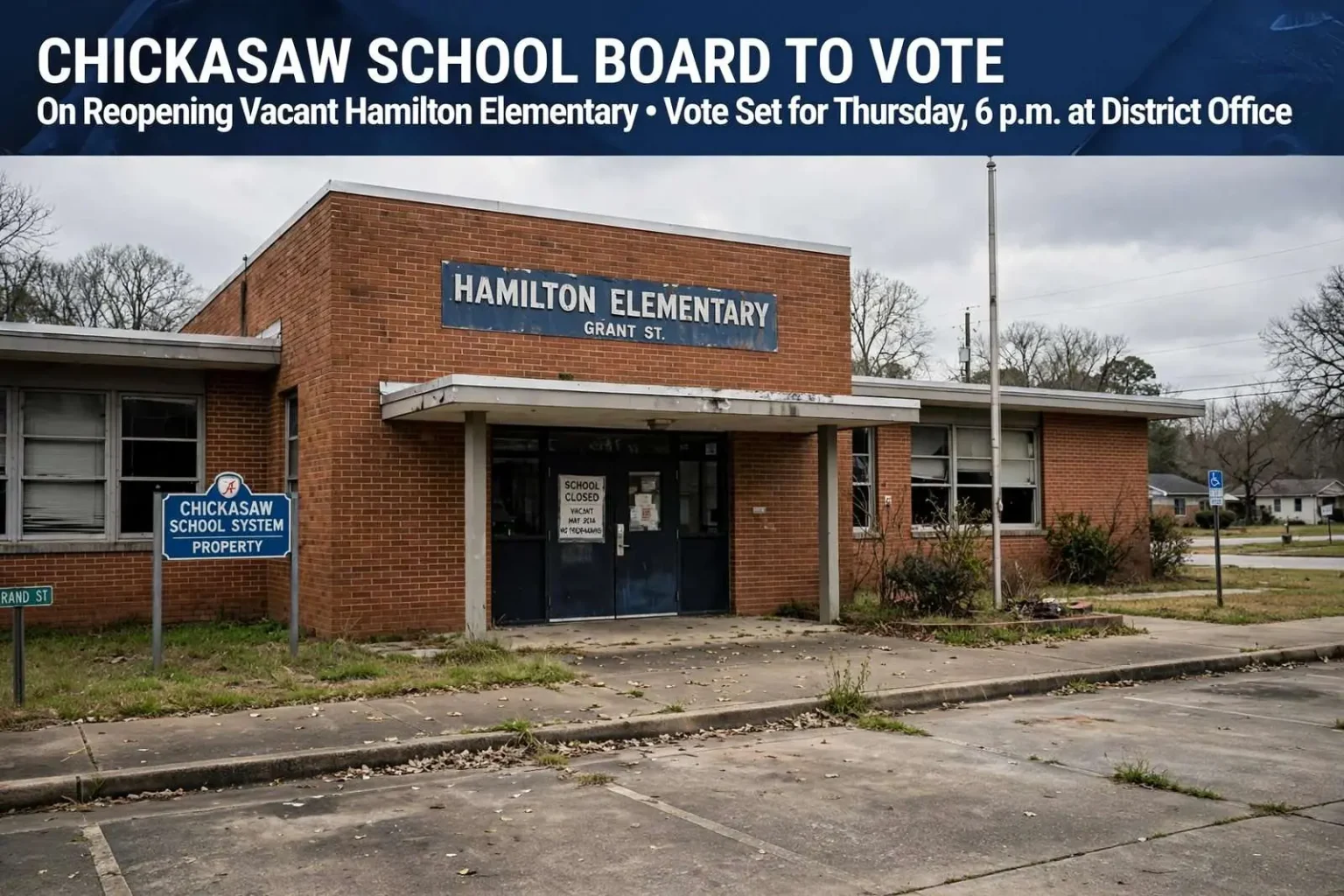
The Chickasaw school system is preparing to bring a long-vacant elementary school building back into use, with the district’s board set to vote on a plan to reopen Hamilton Elementary School on Grant Street for the coming school year. The building has sat empty since last May, after Mobile County’s magnet school program that had been housed there relocated to Eichold-Mertz Elementary in Mobile at the start of the 2014-15 school year, leaving the city’s independent district with an empty campus and a decision to make about its future.
Under the proposal going before the Chickasaw school board Thursday, Hamilton would reopen in August serving grades K-5. The move would mark the first time in years that the district operated more than one campus, and it would give the city’s elementary students a building designed for their age group rather than sharing hallways with teenagers. Board members were expected to weigh the plan at their Thursday meeting before the district commits staff and budget to the reopened school.
Currently, every grade level in the Chickasaw district attends classes in the same building, a former high school on Chieftain Way. That arrangement has defined the young district since its creation: kindergartners and high school seniors pass through the same doors, and the single campus carries the full weight of the system’s enrollment. Superintendent Kyle Kallhoff has pointed to the crowding as the clearest signal that the district needed a second home.
“Our student population continues to grow, and we’re running out of room on Chieftain Way,” Kallhoff said. The superintendent’s framing made the reopening less a question of ambition than of arithmetic — more students each year, in a building built for fewer of them, with the district’s own projections showing the trend continuing.
A District Built in 2012
Chickasaw inherited the Hamilton Elementary building as part of the 2012 separation agreement that created the city’s independent school system, splitting off from Mobile County schools. The split followed years of negotiation between the city and the county district, and it made Chickasaw one of the small number of Alabama municipalities that had chosen to run its own schools rather than remain part of a countywide system.
Under that agreement, Mobile County officials agreed to vacate the building within three years, ultimately handing over the keys in June 2014. The magnet program’s move to Eichold-Mertz Elementary in Mobile closed out the county’s use of the Grant Street campus, and the transfer gave Chickasaw possession of a school building its leaders say the city has been waiting to reclaim.
The journey to an independent district was shaped by the city’s identity. Chickasaw, a community of roughly 6,000 residents in northern Mobile County, incorporated decades ago with a strong tradition of local control, and residents had long viewed their schools as central to the city’s future. The 2012 split put that principle to the test, requiring the new district to build an administration, hire staff, and take on facilities like Hamilton while proving it could stand on its own financially.
A Financial Turnaround Made It Possible
Superintendent Kyle Kallhoff said the district is now in a strong enough financial position to reopen a second campus, pointing to progress announced in November by Chief Financial Officer Chris Arras, who reported the district had moved into the black by the end of the 2014 fiscal year. For a first-year system that had started from scratch, the shift from red to black was the milestone that made the Hamilton plan realistic rather than aspirational.
Starting a school district from nothing carries costs that established systems rarely face: an administrative payroll built from zero, transportation fleets, technology, and the maintenance of aging buildings inherited from the county. Arras’s November report signaled to the board and to city leaders that the district had absorbed those startup costs and reached stable footing, clearing the way for expansion rather than retrenchment.
The timing also lines up with practical needs. Enrollment growth in a small city district compounds quickly — each additional kindergarten class adds a cohort that moves through the system together — and the single-campus model leaves no room to maneuver when a grade level runs large. Reopening Hamilton in August, before the next school year’s enrollment arrives, gives the district space where it needs it most.
If the board approves the plan, Kallhoff said the district would likely add at least three new staff positions — a clerk, a cafeteria worker and a registered nurse — to support the reopened campus. The additions are modest by district standards, reflecting the operational skeleton a functioning elementary school requires: front-office administration, food service, and health care on site. Each position represents the difference between a building that merely exists and a campus that can safely serve children every day.
A New Name and a Bigger Mission
The school is expected to be renamed Chickasaw Elementary, and officials anticipate enrollment of roughly 480 to 500 students based on current district numbers. The new name signals the campus’s role as a city school rather than a county magnet site, and the projected enrollment suggests the reopened building would immediately relieve the pressure on Chieftain Way by absorbing a substantial share of the district’s students.
District leaders are also exploring options to expand preschool offerings using the additional space, including a possible Office of School Readiness grant. Alabama’s state-funded prekindergarten program, administered through the Office of School Readiness, has been recognized nationally for its quality standards, and districts that win grants gain access to state support for classrooms serving four-year-olds. For Chickasaw, the vacant space at Hamilton could turn an enrollment problem into an early-education opportunity.
“We’ll have more room at Hamilton, so we want to serve that preschool population,” Kallhoff said. The superintendent’s argument follows a straightforward logic: if the district must staff and maintain two campuses anyway, using the extra rooms for pre-K both serves families and builds the district’s future enrollment, since children who start in a district’s pre-K tend to continue there.
What Reopening Means for Chickasaw Families
For parents in Chickasaw, the return of a neighborhood elementary campus would change daily routines in practical ways. A K-5 school on Grant Street puts the youngest students closer to home and away from the traffic and scheduling complexities of a combined campus, while older students on Chieftain Way gain classrooms freed up by the elementary exodus. Teachers, too, stand to benefit from space that allows grade levels to organize around their own wing rather than competing for every available room.
The reopening also addresses a concern that has shadowed the district since the split: what to do with the buildings it inherited. An empty school is more than a wasted asset — it is a visible reminder of capacity going unused while students crowd another campus. Putting Hamilton back into service converts that liability into the very thing the separation agreement promised the city: schools of its own, used for its own children.
City leaders have watched the district’s progress closely, because the schools are among the most visible measures of whether incorporation-era ambitions are being met. A city that runs its own schools invites families to move in, supports property values, and anchors the sense that Chickasaw governs itself successfully. A district that cannot house its students, by contrast, hands ammunition to skeptics of the split. The Hamilton vote is, in that light, as much a civic statement as an operational one.
The Road Ahead for the Young District
The Chickasaw school board’s meeting is open to the public and begins at 6 p.m. Thursday at the district’s central office on North Craft Highway. Residents who want a voice in the decision — or simply a look at how the young district makes decisions — will get the chance to hear the proposal, the financial case behind it, and the board’s questions before the vote is taken.
Whatever the board decides, the debate itself illustrates how far the district has traveled in a short time. Two years after separating from Mobile County, Chickasaw has balanced its budget, absorbed an inherited campus, watched its enrollment climb, and now finds itself considering expansion — problems that are, in the world of school administration, the good kind to have. Districts in their first years more commonly talk about survival; Chickasaw’s leadership is talking about where to put the next five hundred students.
The plan’s details remain subject to board approval and the ordinary contingencies of a school year: hiring the clerk, the cafeteria worker and the nurse; readying classrooms that have been empty since the magnet program departed; and, if the Office of School Readiness grant comes through, standing up pre-K classrooms alongside the K-5 grades. August is the deadline that matters, and the path to it runs through Thursday’s vote on North Craft Highway.
If Hamilton reopens as planned, Chickasaw will join the small company of Alabama cities operating their own systems with multiple campuses — and will do so with a renamed Chickasaw Elementary filling rooms that sat dark for a year. For a district that began with a handshake agreement and a set of keys handed over in June 2014, the reopening would mark the moment the system stopped simply sustaining itself and started growing.