
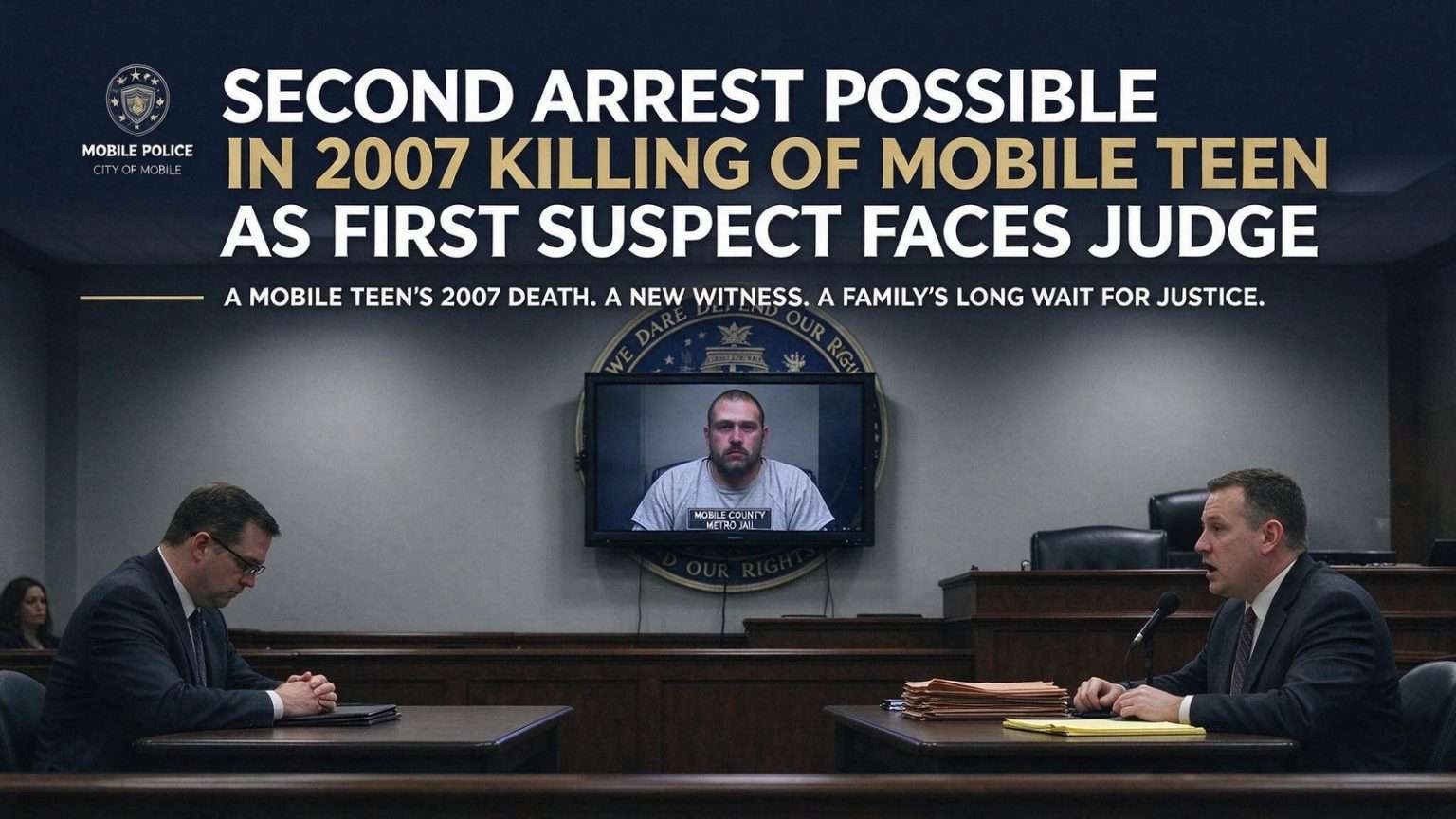
A break in one of Mobile’s oldest unsolved killings could lead to a second arrest, according to the Mobile County District Attorney’s Office. The development came as the case’s first suspect, 39-year-old Jhordis Woods, appeared before a judge this week — nearly 15 years after 16-year-old Shaywanna Robinson was shot and killed during a home invasion.
Robinson’s death in the summer of 2007 shocked a city already all too familiar with violent crime. Prosecutors say the teenager was an innocent bystander in a targeted burglary, inside a home where she was staying when two people forced their way in. She was struck by shotgun fire during the break-in and did not survive. For years afterward, the case sat unsolved, one of the long-running open files that families across Mobile County carry with them quietly, waiting for a phone call that may never come.
That phone call finally arrived this week, in the form of an arrest and a courtroom appearance that had been nearly 15 years in the making. Woods appeared before a judge by video from jail, the standard practice for initial appearances in many Alabama jurisdictions, where defendants appear remotely rather than being brought into the courtroom. The hearing was brief, but what prosecutors said in and around it signals that the investigation into Robinson’s killing is no longer dormant.
How the Case Came Back to Life
According to Assistant District Attorney Louis Walker, a new witness came forward and made this week’s arrest possible. The District Attorney’s Office declined to elaborate on the witness or on the information that person provided, an understandable posture given that prosecutors are still pursuing what they describe as a second possible arrest in the case. In cold case investigations, the arrival of a new witness is often the critical ingredient that older evidence alone cannot supply.
Cold cases like Robinson’s present investigators with a familiar set of obstacles. Memories fade, witnesses move or become difficult to locate, and physical evidence collected in 2007 was analyzed with the forensic technology of that era. Over time, however, circumstances can change. Witnesses who were reluctant or afraid to speak years ago sometimes come forward once time has passed, once relationships have changed, or once they learn that investigators are still actively seeking answers. Advances in forensic testing can also allow evidence that produced no matches years ago to be re-examined against expanded databases.
Walker praised the work of the Mobile Police Department in moving the case forward after so many years. Investigations into decade-old killings are rarely the product of a single tip or a single officer; they typically reflect years of case reviews, interviews, and coordination between detectives and prosecutors before an arrest warrant is ever presented to a judge. That a killing from 2007 has now produced a courtroom appearance is a measure of that persistence.
What Prosecutors Said in Court
“All of the evidence suggests there were two individuals that broke into the home that the victim was residing in,” Walker said following Woods’ video appearance before a judge. “It was an innocent 16-year-old girl that was inside the home and was killed with a shotgun.”
Prosecutors believe Woods was one of the two people involved in the break-in but was not the person who fired the shot. That distinction matters under Alabama law, where individuals can face murder charges for deaths that occur during the commission of certain dangerous felonies even when they did not personally pull the trigger. The state’s felony murder framework means that a participant in a burglary can bear criminal responsibility for a killing committed by a partner in that burglary, a principle prosecutors rely on in cases where the shooter remains unidentified or uncharged.
The details prosecutors outlined in court sketch the outline of the night itself: a residential break-in on Bankhead Place, two intruders, a shotgun, and a teenage girl who had no connection to whatever the intruders were after. Home invasion killings in which the victim is a bystander tend to linger longest in a community’s memory, precisely because they underscore how little separates an ordinary evening from an irreversible tragedy.
Murder Carries No Statute of Limitations in Alabama
One reason a 2007 killing can still produce an arrest in 2022 is simple: under Alabama law, murder carries no statute of limitations. While lesser offenses carry filing deadlines that can expire in a matter of years, a homicide can be charged at any point in the offender’s lifetime, no matter how much time has passed. That legal reality is a cornerstone of cold case work across the state, allowing prosecutors to act whenever sufficient evidence finally comes together rather than watching a case expire on a legal clock.
“We wish ideally we would be able to make determinations quickly,” Walker said. “Sometimes the available evidence doesn’t come out until later.”
That candor reflects the day-to-day reality of prosecuting violent crime. Cases move at the pace of evidence, not at the pace of grief, and evidence in old cases often surfaces in fragments — a recollection offered years later, a person with new information who no longer has a reason to stay silent, or forensic results that were not obtainable when the crime scene was first processed. Prosecutors in Mobile County, like their counterparts across Alabama, maintain systems for reviewing unsolved homicides precisely because they know a case that looks closed today may not stay closed.
The Mobile Police Department, the largest municipal law enforcement agency in the state, has historically handled these long-tail investigations through its investigative units, working in coordination with the District Attorney’s Office whenever a case shows renewed signs of life. The relationship matters: prosecutors can advise detectives on what evidence will be needed to sustain a charge years after the fact, when juries must weigh testimony about events that took place when many witnesses were much younger and some records may no longer exist.
The 2007 Home Invasion on Bankhead Place
Bankhead Place sits in a residential section of Mobile, the kind of street where the events of August 7, 2007, would have registered as an anomaly rather than a pattern. Prosecutors say the burglars targeted the residence itself, and that Robinson — staying inside the home that night — was simply present when the plan turned violent. She was 16 years old, the age when most of her peers across Mobile County were starting another school year, worrying about Friday night football and first-period classes rather than becoming the victim of one of the city’s most notorious unsolved killings.
Her death became one of those cases that residents of the city would remember by name long after the initial news coverage faded. Bystander victims of violent crime occupy a particular place in public consciousness because they represent the arbitrary nature of such violence — she was not the target of whatever the two intruders intended that night, and yet she bore the ultimate cost. Community members who lived through that period in Mobile’s history often cite cases like Robinson’s when discussing both the human toll of violent crime and the long shadow cast by unsolved killings on the families left behind.
In the years since 2007, Mobile has seen substantial change in how it approaches both violent crime and its unsolved legacy. The city’s police department, like departments across the country, has periodically re-examined older homicide files as technology improved and as personnel with fresh perspectives reviewed work done by predecessors. The Robinson case’s revival demonstrates the value of that continued attention — and the willingness of prosecutors to commit resources to a case that many might have assumed was permanently closed.
The Push for a Second Arrest
Authorities said they hope an arrest of a second suspect will follow. Prosecutors believe two individuals broke into the Bankhead Place residence that night, and with Woods now in custody, the identification and arrest of the second participant becomes the obvious next objective. The DA’s Office has declined to name or describe the second suspect, a deliberate approach consistent with maintaining the integrity of an active investigation.
Second arrests in old homicide cases often follow the first by a matter of weeks or months, as the initial arrest generates new attention on the case and can prompt additional witnesses to step forward. Word that prosecutors have made progress after nearly 15 years can change the calculations of people who once chose to remain silent, whether out of fear, loyalty, or the belief that the case would simply fade away. That dynamic is a recurring pattern in cold case work across Alabama and the Gulf Coast, and it is one reason prosecutors frequently emphasize that investigations remain open even after a first arrest.
For the family and friends of Shaywanna Robinson, the events of this week represent the first significant movement in a case they have lived with for nearly half a lifetime. Families of homicide victims in Alabama often describe the years-long wait for an arrest as its own form of loss, compounded by the absence of the answers that a trial might eventually provide. While no arrest can undo what happened on Bankhead Place in August 2007, the prospect of accountability — for Woods now, and potentially for a second suspect still to come — offers a measure of the resolution that families in these cases have sought for years.
What Comes Next
Because Woods is currently serving a federal sentence on an unrelated charge, he was not granted bond in the Robinson case. Defendants already in custody on other sentences routinely appear on new charges through video hearings, and any time served is coordinated between state and federal authorities. The murder charge will now move through the standard machinery of the Alabama court system: an indictment by a Mobile County grand jury, followed by arraignment and, eventually, trial proceedings that could still be years away given court backlogs.
Until then, the case that began on a summer night in 2007 remains an open investigation. Prosecutors have made clear they believe a second person took part in the break-in that killed Shaywanna Robinson, and they are pressing to find him. Nearly 15 years after the fact, the family’s long wait for answers is, at last, no longer waiting in silence.


