Chickasaw Schools Open Separate Elementary Campus for First Time
Chickasaw City Schools has opened a separate elementary campus for the first time, backed by $400,000 in renovations and a new pre-K program.
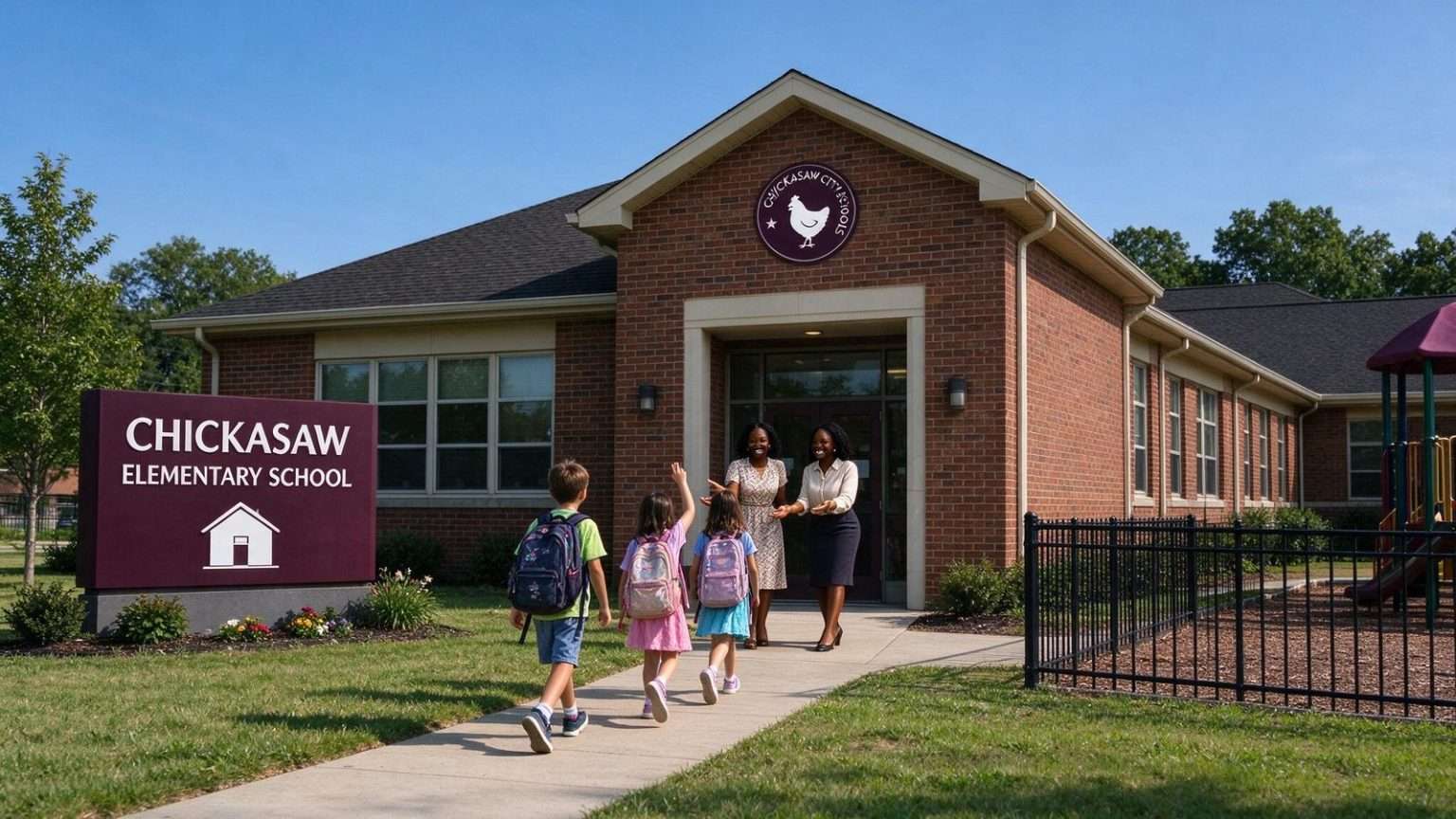
Chickasaw City Schools is entering its fourth year as an independent system with a major structural change: for the first time, the district will operate two separate campuses instead of housing all of its roughly 1,000 students under one roof.
The shift centers on the opening of a standalone elementary school, formerly known as Peter Joe Hamilton Elementary under the Mobile County school system, which sat unused for the past year. During that time, students in kindergarten through fifth grade shared library, gymnasium and cafeteria space with older students at the district’s combined school, while an interim principal worked to keep the younger children as separated as possible from the middle and high schoolers.
Sharing a building across eleven grade levels is a strain few districts ask of their schools. The youngest children walk the same corridors as teenagers headed to algebra or football practice, and every shared space — the library, the gym, the lunch line — has to be scheduled around someone else’s day. Chickasaw’s educators managed that arrangement for three years, but the district’s leaders never treated it as permanent; a dedicated elementary campus was the goal from the time the system stood up.
That interim principal, who has spent 14 years as a teacher and math coach in Mobile County elementary schools, was named permanent principal of the new elementary campus this spring. The promotion rewards the person who held the shared-building arrangement together, and it puts an elementary specialist — not a general administrator — in charge of the district’s youngest students as they finally get a campus of their own.
A community renovation project
Ahead of the opening, teachers, parents and community members pitched in to renovate the long-vacant building, painting classrooms and cleaning the property from top to bottom. Volunteer work of that kind does more than save money in a small district’s tight budget; it builds ownership. The parents who painted walls this summer are the ones who will fill the bleachers in the fall, and a campus opened by its own community starts with a constituency most new schools never have.
The district also installed a new roof and made broader technology upgrades, bringing the total investment in the campus to roughly $400,000. That includes new laptops and Chromebooks for students and smart boards in every classroom. For a district of Chickasaw’s size, a $400,000 commitment is substantial — and spending it on a roof and devices rather than ceremony reflects the practical order of priorities: keep the building dry, then put modern tools in every room.
Smart boards in every classroom, rather than in a showcase room or two, signal an all-or-nothing approach to instructional technology. Teachers in small districts often see equipment arrive unevenly, with some classrooms outfitted and others left behind; making the investment uniform means no Chickasaw elementary student’s education depends on which hallway their classroom happens to be on.
A separate grant is also funding the district’s first-ever pre-K classroom, complete with a new playground. Adding pre-K rounds out the campus’s identity as a true elementary school and gives Chickasaw families something they previously had to find outside the district: a public, on-campus starting point at age four, with a playground built for the district’s smallest students rather than borrowed from older children.
Enrollment hopes and registration realities
School board leadership said the community has wanted a dedicated elementary campus for some time, and officials expect enrollment to eventually reach around 500 students, though early registration numbers were running lower than hoped, a pattern district officials say is common at schools that rely heavily on federal Title I funding, where families often register late or not at all.
The Title I dynamic is well understood among school administrators. Federal Title I money flows to schools serving high concentrations of students from low-income families, and in such communities registration tends to happen in the final days before school — or on the doorstep — rather than in the spring, when districts prefer to plan. Families juggling work schedules, housing moves and transportation are simply less likely to register early, which leaves districts projecting enrollment from incomplete lists.
For Chickasaw, that pattern creates a planning challenge the split campus amplifies. Staffing a standalone elementary school requires estimating how many kindergarten through fifth-graders will actually show up; hire too few teachers and class sizes balloon in August, hire too many and the small district has payroll it cannot justify. Officials are betting that a dedicated campus will itself drive registration, as families who hesitated under the shared-building arrangement commit to a school designed for their children.
What the older students get
The elementary school’s separation also frees up space at the district’s original campus, which will now serve roughly 500 students in grades six through 12. Sixth- and seventh-graders will move into space previously used by younger students, while a new high school principal — a former accountant making his first stint as a principal, and previously a curriculum administrator in the Escambia County school system — works to fill several vacant faculty positions, including a special education team hired in just the past month.
The principal’s unusual résumé is worth noting. An accountant turned curriculum administrator brings budget fluency and instructional background to a first principalship — a combination that matters in a small district where a principal may effectively run his own building operations. Escambia County, on Alabama’s western edge along the Florida line, gave him experience with rural schools that face many of the same resource constraints as Chickasaw’s.
The high school is also expanding its offerings, adding career-technical programs in robotics, engineering, welding and culinary arts through a partnership with a local community college, along with a new drama class. Career-technical education has become one of the strongest recruiting tools small high schools have; welding and culinary arts lead to licenses and jobs, robotics and engineering connect to the region’s industrial employers, and a community college partnership lets a district of a few hundred students offer pathways it could never staff alone.
Every science teacher will have access to a dedicated lab for the first time, and administrators say the athletic program is on track to move up a classification in the next year, even as the school works toward building a long-term athletic facility. The classification jump is a competitive benchmark — it means Chickasaw’s teams will compete against larger schools — and it reflects a program that has outgrown its current level faster than anyone projected when the district began.
A district defining itself
The district’s outgoing superintendent, who was the system’s first employee when it broke away from the county district four years ago, is departing to lead a school system in west Alabama, with his top deputy stepping in as interim leader. The timing — a leadership transition landing in the same summer as the two-campus split — gives the interim leader a full agenda on arrival, but also a clear measure of what the district has built in four years.
Chickasaw’s separation from the Mobile County Public School System was part of a wave of municipal breakaways in southwest Alabama, in which newly incorporated or newly motivated cities chose to run their own schools rather than remain in the county system. Breaking away is the easy part politically; the harder work has been the one Chickasaw is completing now — standing up administration, hiring faculty, and eventually giving each grade band a campus built for it. The two-campus structure is the physical proof that the breakaway is maturing into a functioning district.
The outgoing superintendent’s own arc mirrors that story. As the system’s first employee, he inherited a district that existed mostly on paper: no separate campuses, no established traditions, no record of independent operation. Leaving for another superintendency — and leaving behind a district with its own elementary school, an expanding high school program and an athletic program moving up a classification — is a kind of report card on the breakaway itself.
What families in Chickasaw should watch
For parents in the city, the opening weeks of the new arrangement will answer the questions that matter most. Will registration catch up to the projected 500 elementary students as families respond to the dedicated campus? Will the renovated building’s new technology and the first pre-K classroom hold up to daily use? And will the high school’s new career-technical programs, science labs and expanded staff translate into the kind of offerings that keep Chickasaw families from looking elsewhere for grades 6 through 12?
The stakes extend beyond test scores. Small municipal districts live or die on resident confidence: families who believe in their city’s schools stay, enroll early and volunteer — as Chickasaw’s parents did this summer, painting classrooms before the doors ever opened. Families who doubt them leave quietly, taking enrollment numbers and state funding with them. The renovation volunteerism and the board’s patience with a $400,000 campus investment suggest the community intends to stay and see this through.
Four years after breaking away, Chickasaw City Schools will operate the way most districts do — an elementary school, a secondary school, a pre-K program and a superintendent’s office. Getting there required an unused building, a community work crew, a fourteenth-year math coach, an accountant turned principal and a first employee turned outgoing superintendent. The doors open this fall on the result.