Mobile Seeks $1.36 Million Federal Grant for Five Trolley-Style Buses for Second Line Transit
Mobile's City Council will consider authorizing a Federal Transit Administration grant application for five trolley-style buses for Second Line Transit: up to $1.36 million federal, with a city match of up to $320,000 and a Sept. 21 deadline.
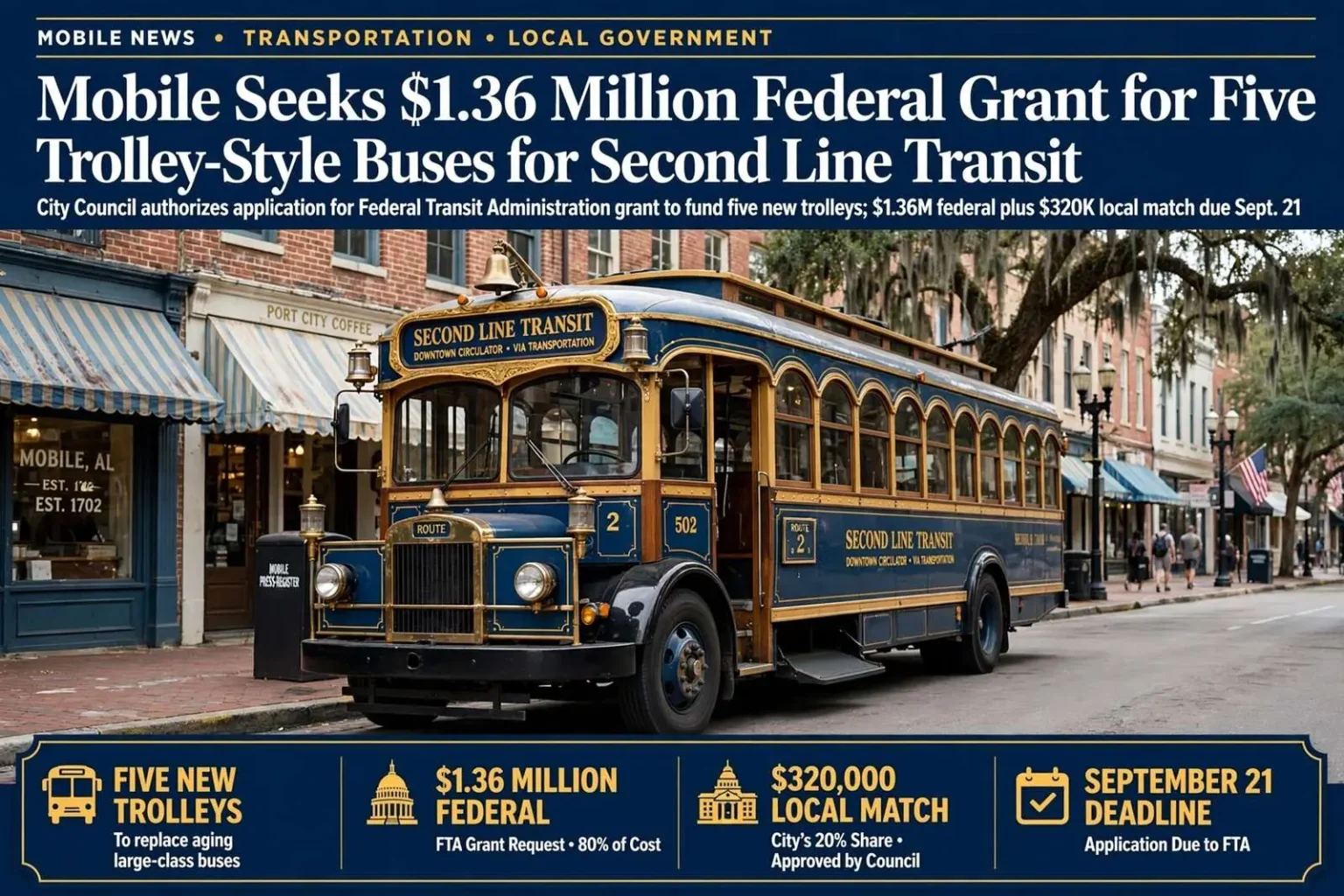
The City of Mobile wants five new trolley-style buses, and it has until Sept. 21 to ask Washington for most of the money.
A resolution set to be introduced at Tuesday’s Mobile City Council meeting would authorize the Mayor to apply for a Federal Transit Administration grant to buy the vehicles for Second Line Transit’s fixed-route network. The federal request would be for up to $1,360,000, matched by up to $320,000 from the city. The resolution says the buses would replace existing large-class vehicles as part of the route consolidation underway with the city’s transit partner, Via Transportation.
That is the entire item, and on an agenda it will take less than a minute. But the four numbers in it — five vehicles, $1.36 million federal, $320,000 local, one September deadline — describe a fairly specific set of decisions about what Mobile’s bus system is supposed to look like.
The Math in the Match
Start with the split. The federal request and the local match together come to roughly $1.68 million. The city’s share of that total is a little over 19 percent.
That is not a coincidence. Federal transit capital grants have long operated on an 80/20 formula: the federal government covers up to 80 percent of the cost of an eligible capital purchase and the local sponsor covers the rest. A request structured at roughly four federal dollars for every local dollar is a request built to the standard shape of the program.
The word “match” is doing something important there. Federal capital money is not a check that arrives to be spent freely; it is a reimbursement of a share of an approved cost. The local portion has to be real, identified and available, which is precisely why a city council has to authorize the application before it is filed. A grant application that promises a match the governing body has not agreed to is not an application anyone should file.
Divide the combined figure by five and the per-vehicle number lands at roughly $336,000. That is a useful reality check on what is actually being bought. A standard 40-foot heavy-duty transit bus — the kind built to run more than a decade in all-day service — generally costs well north of half a million dollars, and diesel-electric or battery-electric versions cost considerably more. A vehicle in the mid-$300,000 range is a smaller, lighter class of bus, which is consistent with what a trolley-style vehicle typically is: a body styled to look like a historic streetcar, mounted on a conventional bus or truck chassis, rubber-tired, running on ordinary streets with no rails and no overhead wire.
Why a Trolley Replica, and Not Just a Bus
Trolley-style buses are a familiar sight in tourist-facing downtowns, waterfronts and historic districts across the country, and there are practical reasons beyond appearance.
They are usually shorter and narrower than a full-size transit coach, which matters on the tight, older street grids and turning radii common in historic city centers. They are cheaper to buy and typically cheaper to operate and maintain than heavy-duty vehicles. And they are legible to visitors in a way an ordinary bus is not: people who would never think to look up a route map will board something that visibly announces itself as a circulator.
There are trade-offs. Lighter-duty vehicles are generally built to a shorter service life than heavy-duty transit buses. Interior capacity is smaller, and open-air or partially open designs are less useful in hard weather. The styling that makes the vehicle approachable also makes it slightly more expensive to keep looking presentable.
None of that is disqualifying. It is the reason fleets tend to be mixed: the right vehicle for a downtown circulator is not the right vehicle for a long crosstown trunk route carrying standing loads at rush hour.
Replacement, Not Expansion
The resolution is explicit that the five buses would replace existing large-class vehicles. That single word — replacing — changes what the item is.
An expansion grant adds service. A replacement grant preserves it. Transit fleets are consumable assets: buses accumulate miles and hours, maintenance costs climb, reliability falls, and at some point a vehicle spends more days in the shop than on the road. Federal transit rules recognize this by setting minimum useful-life benchmarks for vehicles bought with federal money — longer for heavy-duty large buses, shorter for medium- and light-duty vehicles — and a transit agency that does not replace vehicles on a rolling schedule eventually finds itself cancelling trips it has no working bus to run.
Nationally, deferred bus replacement is one of the most persistent problems in the industry. It is also one of the least visible, because a fleet does not fail all at once. It degrades. Riders experience that degradation as a bus that did not show up, and rarely as a capital planning decision made years earlier.
Substituting smaller vehicles for larger ones during a replacement cycle is a recognized strategy usually described as right-sizing: matching vehicle capacity to actual ridership rather than to the size of the bus that happened to be bought last time. Running a 40-foot bus on a route that carries a dozen people at a time costs more in fuel, tires, brakes and maintenance than the ridership requires, and it does so on every trip, every day, for the life of the vehicle.
What Route Consolidation Means
The resolution ties the purchase to a route consolidation underway with Via Transportation, the city’s transit partner. Consolidation is a word that makes riders nervous, and it is worth being precise about what it generally describes in transit planning.
Most small and mid-size bus networks face the same structural problem. Coverage and frequency compete for the same finite pool of vehicle hours. A network can run many routes infrequently, so that service passes near almost everyone but is useful to almost no one, or it can run fewer routes frequently, so that service is genuinely useful along the lines it serves but does not reach everywhere.
Consolidation is the move from the first model toward the second: folding low-ridership, low-frequency routes into a smaller number of stronger corridors where buses come often enough that riders stop consulting a schedule. The payoff is frequency. The cost is that some places lose their nearest stop.
Via Transportation is a company that contracts with cities and transit agencies to plan and operate service, including on-demand microtransit — app-hailed shared rides within a defined zone, using smaller vehicles and flexible routing rather than fixed stops on a timetable. That model is frequently paired with consolidation for exactly the reason above: the on-demand zone is what is supposed to cover the areas a trimmed fixed-route network no longer reaches directly, feeding riders to the corridors where the buses now run more often.
Whether that pairing works in practice depends on details the resolution does not address — zone boundaries, wait times, fares, vehicle availability and how cleanly a rider can transfer from an on-demand trip to a fixed route. Those are the questions riders will judge the change by.
How an FTA Grant Application Actually Works
The Federal Transit Administration is the agency within the U.S. Department of Transportation that funds public transportation. Its money reaches communities through two broad channels.
- Formula funds, distributed by statutory formula to urbanized areas and states based on population, service levels and other factors. These are predictable and recur annually.
- Discretionary or competitive funds, awarded through periodic notices of funding opportunity in which applicants compete against each other on the merits of a proposed project. Bus and bus facility funding, including vehicle replacement, has long been available through competitive programs of this type.
A competitive application is a document, not a request. Applicants are typically asked to describe the condition and age of the fleet being replaced, demonstrate that the project is consistent with local and regional transportation planning, show that the local match is committed, and address federal requirements attached to any purchase made with federal dollars — procurement rules, Buy America domestic content provisions, accessibility standards under the Americans with Disabilities Act, and civil rights and environmental review obligations.
That is why the authorization has to come first, and why the Sept. 21 deadline in the resolution matters. Competitive federal deadlines are firm. A city that has not authorized its mayor to sign and submit by the closing date does not get an extension; it gets the next round, whenever that is.
The Timeline After the Deadline
Residents who read about a grant application sometimes expect to see the result on the street within months. Transit capital does not move that way.
After submission comes federal review and selection, then announcement of awards, then the execution of a grant agreement. Only then does procurement begin — a formal, competitively bid process governed by federal rules, ending in a contract with a manufacturer. Bus manufacturing is build-to-order, and delivery lead times are measured in many months rather than weeks. Vehicles then have to be accepted, inspected, lettered, equipped with fareboxes and communications gear, and put through operator training before they carry a passenger.
None of those steps is unusual or avoidable. They are simply why the distance between “the council authorized an application” and “there is a new bus at the curb” is long.
It is also worth saying plainly what Tuesday’s vote would and would not do. Authorizing an application is not receiving a grant. Competitive programs are oversubscribed by design; applicants that do everything right are routinely not funded in a given round. The resolution buys the city a place in the competition and nothing more.
What to Watch
A few things will indicate how this fits into the larger picture of Mobile transit:
- Which routes the trolley-style vehicles are assigned to once the consolidated network is settled, and whether they are used on downtown and visitor-facing corridors or as general fixed-route workhorses
- What happens to the large-class vehicles being replaced — retirement, sale, or retention as spares
- Where the up-to-$320,000 local match is drawn from within the city budget
- How the consolidated fixed-route map and any on-demand zone fit together, particularly for riders whose nearest stop moves
- Whether the application is funded, and if not, whether the city reapplies in a later round
Why It Matters
Mobile is not a city where most people ride the bus, which is exactly why bus decisions here tend to pass without much notice. But a fixed-route network is infrastructure for the households that have no alternative — people getting to shift work, to dialysis, to school, to a grocery store — and the vehicles are the part of that infrastructure that wears out fastest and most visibly.
Five buses will not remake the system. What the resolution shows is a city trying to do two things at once with the same purchase: keep a fleet from aging out from under the service, and shift toward vehicles sized for the network it is actually building rather than the one it inherited. Whether the federal money arrives is out of the council’s hands. Getting the application in by Sept. 21 is not.
Update: First Branded Trolley Debuts, and the Bus-Wrap Plan Changes
The first fully branded Second Line Transit trolley made its public debut during Mobile’s Labor Day Parade on Monday, Sept. 7, and is now running the downtown loop.
“I feel like a proud father who’s holding his child for the first time,” Mayor Spiro Cheriogotis said. “I’m thrilled. I mean, I met the trolley here this morning. We took a ride in. It’s everything I dreamed of.”
Cheriogotis framed the vehicles as a recruiting tool for a transit system that has struggled to attract riders who have other options.
“I want that person, who lives in Mobile, is visiting Mobile and has never really thought about utilizing public transit, to see one of those trolleys and say, ‘Where’s that going? I might hop on that,'” he said.
A Reversal on Wrapping the Buses
City officials had originally said every city bus would be rewrapped in Second Line Transit branding. After looking more closely at the cost, they scaled that back.
“When I thought about spending hundreds of thousands of dollars to fully wrap these buses that we are actively trying to, you know, downsize the buses in exchange for trolleys, it didn’t make sense to spend those dollars to me,” Cheriogotis said.
Instead, the existing buses will get decal logos promoting the trolleys — a change that is consistent with the logic of the grant application itself. If the fleet strategy is to retire large-class vehicles in favor of trolleys, a full wrap on a bus scheduled for replacement is money spent on an asset the city intends to phase out.
The Longer Goal
Cheriogotis said his personal goal is to transition Mobile to an all-trolley transportation system by the end of his term in 2029. The five vehicles in the pending federal grant request would be a step in that direction rather than the whole of it; a full fleet conversion on that timeline would require several more rounds of capital funding.
The City Council is considering the resolution authorizing the mayor to apply for the Federal Transit Administration grant, which would provide more than $1.3 million toward the five trolley-style buses against a $320,000 local match.
Update: The Council Approves the Application, but Not Without Pushback
The Mobile City Council approved the resolution authorizing Mayor Spiro Cheriogotis to apply for the federal grant for five trolley-style buses, with a local match of about $320,000. The grant application remains pending, and the city would have to receive the federal funding before it could purchase the vehicles.
The vote came after a debate that ranged well beyond the item itself.
‘We Should Probably Put the Brakes on a Bit’
Councilman Ben Reynolds said he supports trying the five trolley-style buses but wants city leaders to determine whether they actually increase ridership before committing money to expand the fleet.
“We brought on a new operator and haven’t really seen the results of their operation yet,” Reynolds said, referring to New York-based Via Transportation, which is taking over the city’s public transportation system under a contract the council approved last year, “and then we are going head over heels in purchasing trolleys not only with the federal grant but with money set aside in the budget for additional trolleys.”
“We should probably put the brakes on a bit,” he said.
Reynolds also questioned whether roughly $2 million in the city’s upcoming fleet-maintenance budget should be directed toward additional trolleys or toward other transit needs. The discussion began during the council’s pre-conference meeting and continued into budget talks, where the administration is seeking nearly $15 million to build out the Second Line Transit System.
“If we see real results, we can come back to the table and say ‘trolleys work, let’s go get them,'” Reynolds said, urging an analysis of the transportation expenditures the city is weighing — including potential future support for Amtrak’s Mardi Gras Service between downtown Mobile and New Orleans.
During an afternoon Finance Committee meeting, Reynolds suggested the city may have more pressing priorities, such as improving the mowing of roadsides and drainage ditches. “There are areas in the budget that I think probably should get more money and we are forgoing that opportunity by doing some of this,” he said.
Councilwoman Samantha Ingram said she would like to see a comparative analysis of public transit ridership using smaller buses.
The Mayor: Six Trolleys Is Too Few to Judge
Cheriogotis argued that more trolleys are needed before officials can fairly assess whether they increase transit use.
“It would not be fair to judge the efficacy of trolleys based on six,” he said. “Six is not even replacing a fifth of our buses. We need to go further than that before we pause and take stock.”
The city already has one trolley, which arrived earlier this month at a cost of approximately $100,000, purchased with money remaining from a previous capital budget. Five more would follow if the grant is awarded.
The mayor, who has described himself as “obsessed” with trolleys and campaigned on bringing them to Mobile, has advocated replacing the city’s buses with what he describes as more nimble trolley-style vehicles. He has said he is open to accelerating that transition even if it means incurring federal penalties for retiring buses before the end of their federally recognized 12-year service life.
Cheriogotis said the trolleys would carry as many passengers as larger buses while being better suited to Mobile’s older neighborhoods and tighter street corners, and that the most significant benefit could be improved transportation access for workers without vehicles. He cited Mobile Chamber statistics indicating that roughly 30% of the city’s workforce has been unable to access employment opportunities because of transportation limitations.
“If we are adding 5,000 to 6,000 jobs, we have to have those people,” he said.
The mayor acknowledged that his confidence in trolleys is largely a “gut” reaction based on examples from other cities rather than on any formal study.
The Kansas City Comparison, and Its Limits
Cheriogotis has pointed to Kansas City’s streetcar system as evidence that trolleys can increase ridership.
The comparison has a significant qualification. The KC Streetcar is an electric rail system running on tracks embedded in city streets. It opened in 2016 as a downtown line a little more than two miles long, heavily subsidized by the federal government, and has since expanded by an additional three and a half miles. Ridership has increased steadily, and the system charges no fares.
Mobile’s proposal does not include light rail. A rail system would require substantial infrastructure and federal funding to construct new tracks. Cheriogotis has not ruled out pursuing light rail in the distant future but said there are no plans to move in that direction now because of the cost.
Reynolds rejected the comparison outright.
“KC has a billion-dollar airport and a professional football team, it’s not comparable,” he said. “We are heavily reliant on using our own vehicles. Let’s see if the changes we already agreed and have been made, let’s see if they produce results. Then let’s have a smaller trolley space in downtown to the (new) airport. But to suggest we need a trolley riding around at Government and Azalea, I don’t know if that is required.”
Beyond the Trolleys
Cheriogotis said the capital investment associated with the new transit system extends well past vehicle purchases. He acknowledged the need to launch Via’s microtransit service, install new signage and improve bus stops, though the total cost of those improvements remains unclear.
The microtransit service, operated by Via, will rely primarily on a cellphone app and provide what the mayor described as more efficient curbside transportation. He said it is critical that Second Line Transit successfully launch that service and familiarize residents with the technology.
“It primarily is improving frequency and the timing so that a citizen is not waiting for an hour or more for a bus, a trolley, or a microtransit transport to arrive,” Cheriogotis said. “So trolleys, I think, are integral to the plan.”
What Happens Next
Second Line Transit is set to launch at the end of September. The city says the new trolley will operate on the Downtown Circulator route on Saturdays and rotate through fixed routes during the week. New routes and microtransit service are also expected to begin at the end of the month.