Mobile Council Districts to Get $3 Million Each for Infrastructure Projects
Mobile City Council members unanimously approved a plan giving each district $3 million from penny sales tax revenue for local infrastructure needs.
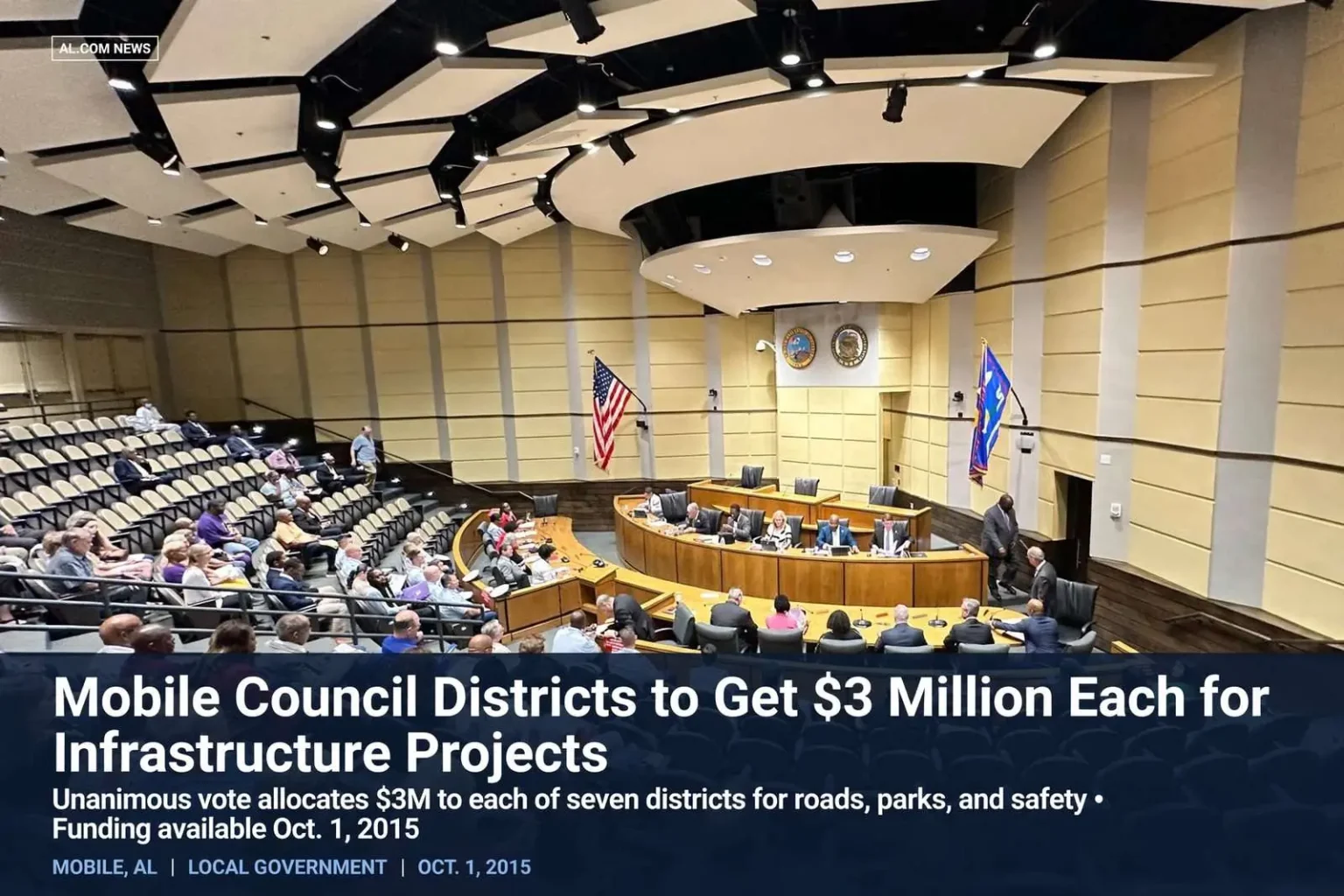
Mobile City Council members voted unanimously to give each of the city’s seven districts an additional $3 million for infrastructure needs, setting off what Council President Gina Gregory described as long-range planning that gives residents a real voice in how their neighborhoods get rebuilt.
The vote centered on an amendment to the city’s recently extended penny sales tax, spelling out how the additional revenue generated by the tax will be divided. Under the plan, each of the seven council districts receives $3 million earmarked for miscellaneous capital improvements. Beyond the district allocations, the amendment also sets aside $5 million for economic development incentives, $2.5 million for public services and safety, and another $2.5 million for the city’s General Fund to help cover costs like retiree health care.
Gregory said the amendment followed weeks of debate that at times pitted the specific needs of individual districts against citywide priorities that cross district lines, calling the eventual unanimous vote a sign the council found common ground. The money will not actually become available until Oct. 1, 2015, with the same allocation cycle expected to repeat for fiscal years 2017 and 2018, matching the length of the temporary sales tax extension.
Mobile Mayor Sandy Stimpson called the council’s action significant for city residents, noting that citywide capital improvement funding has grown sharply on his watch, from $3.5 million available in 2014 to $14.3 million allocated for 2015, with $21 million projected for 2016.
District 3 Councilman C.J. Small, who co-sponsored the amendment alongside District 1 Councilman Fred Richardson, said the new funding will help him finish revitalizing Ann Street, where the first phase of work began in September and is expected to wrap up by early summer. The remaining stretch of the project, along with park upgrades, an overhaul of Baltimore Street and repaving on streets off Dauphin Island Parkway, are among his district’s other priorities.
Not every council member was fully on board. District 5 Councilman Joel Daves, who chairs the council’s finance committee, was the lone vote against the amendment’s earlier recommendation, though he said his position softened as discussions continued. District 6 Councilwoman Bess Rich said she still hopes the council will revisit broader tax reform down the road, even as she called the new district-specific funding an attractive option in the meantime.
Each council member must still bring individual spending requests back to the full council for approval before any of the $3 million per district is actually spent, a distinction officials say separates the funds from purely discretionary spending.
How Mobile’s council districts came to be
Mobile has elected its City Council from seven single-member districts since 1985, when the city replaced its at-large commission government with a mayor-council system. The change followed years of voting-rights litigation, including the U.S. Supreme Court case City of Mobile v. Bolden, over the at-large system’s effect on Black voters.