Mobile Fire-Rescue Pulls a Burning Freezer Motor From the I-65 Service Road Walmart
Mobile Fire-Rescue was called to the Walmart Supercenter on the I-65 service road Sunday afternoon, entering a smoke-filled grocery section to find a burning freezer motor. The cause was ruled accidental and no one was hurt.
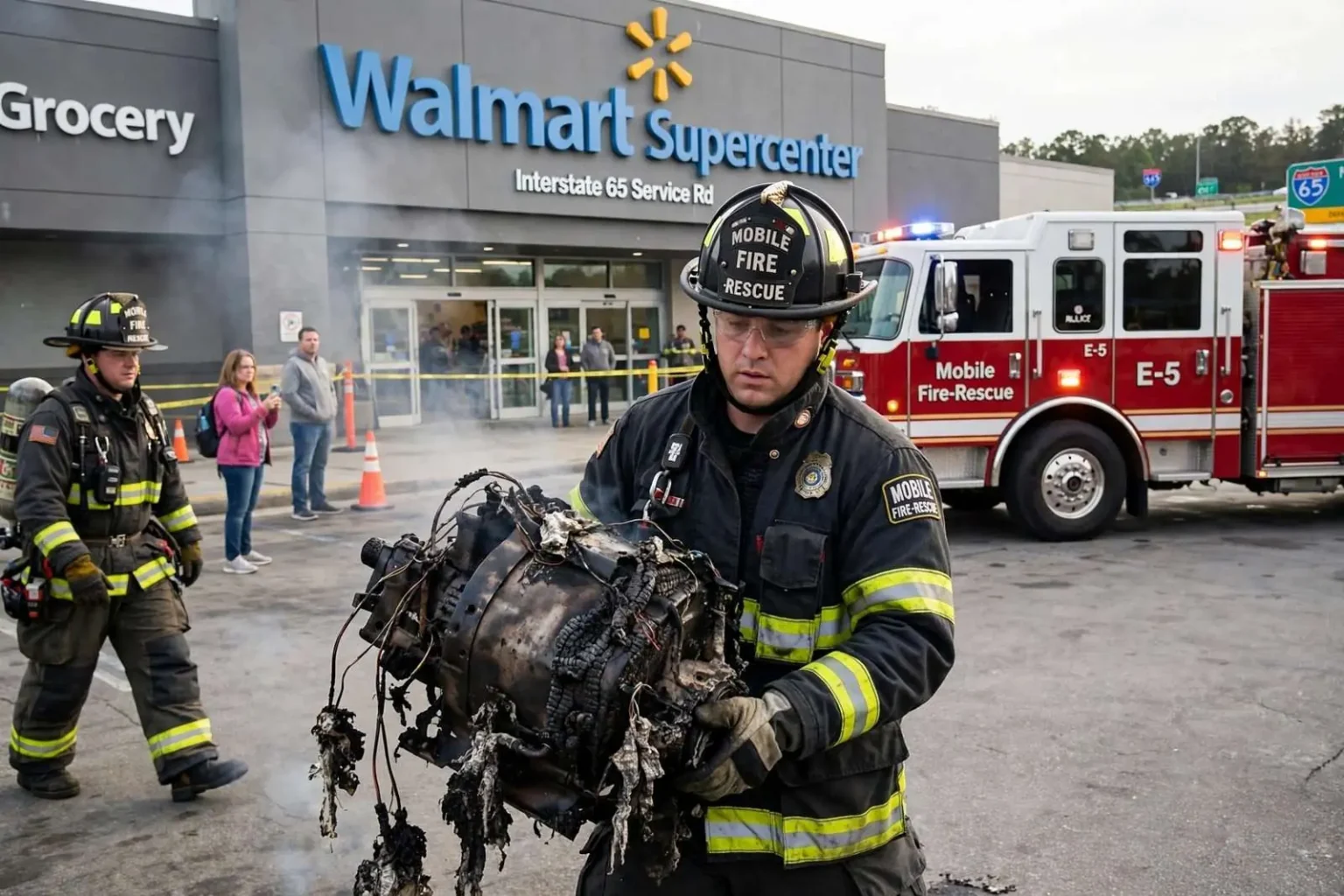
The call came in on a Sunday afternoon, and by the time crews from Mobile Fire-Rescue reached the Walmart Supercenter on the Interstate 65 service road, shoppers were already coming out.
Officials said the department was dispatched to the store at about 3:19 p.m. Firefighters arrived to find the grocery section filled with smoke and people evacuating. Inside, they located a motor burning in a freezer, put the fire out and carried the motor out of the building.
Investigators determined the cause to be accidental. No one was hurt.
That is the whole of it, and the brevity is the point: this is what a successful commercial fire response looks like. A piece of equipment failed, the failure was contained to the equipment, everyone got out, and the object that caused the problem left the building in a firefighter’s hands. What follows is not more detail about this particular incident — there is none to report — but context on why a fire like this happens, why it produces so much smoke, and how the people who respond to one work the problem.
Why Refrigeration Motors Catch Fire
A supermarket freezer aisle is one of the most mechanically dense environments in an ordinary retail building. Every case is a working refrigeration system, and each one depends on electric motors: compressors that circulate refrigerant, condenser fans that dump heat, evaporator fans that push cold air across the coils and through the case. In a large store, that adds up to a great many motors, many of them running nearly continuously, in a room that is warm on one side and freezing on the other.
Electric motors are generally reliable, and the failure modes that lead to fire are well understood in the trade. Among the common ones:
- Bearing wear. As bearings degrade, friction and heat rise and the motor draws more current than it was designed to draw.
- A locked or stalled rotor. If a fan blade jams or a shaft seizes, current spikes and windings can overheat quickly.
- Insulation breakdown. The varnish and film insulating the copper windings degrades with heat and age; once it fails, a short inside the motor can arc.
- Restricted airflow. Dust, packaging debris and grease accumulating on coils and around motor housings trap heat that the design assumed would be carried away.
- Aging capacitors and controls. Start and run capacitors and their wiring are frequently implicated in motor failures in refrigeration and HVAC equipment.
What most of these have in common is that they are gradual. A motor rarely goes from healthy to burning in a moment. It usually runs hot for a while first, which is why preventive maintenance in commercial refrigeration leans heavily on the unglamorous work of cleaning coils, checking amperage draw and listening for bearings on their way out.
It is also why the phrase “a motor on fire in a freezer” is less paradoxical than it sounds to anyone who has not worked on the equipment. The cold air is inside the case. The machinery keeping it cold is doing thermal work, and it is the machinery that burns.
A Little Fire, a Lot of Smoke
A burning motor is physically small. The smoke it makes is not.
What burns in a motor failure is mostly plastics and polymers: winding insulation, wire coatings, fan blades, plastic housings, sometimes lubricants and nearby packaging. Those materials produce dense, dark, acrid smoke out of proportion to the size of the flame, and they produce it quickly.
Inside a big-box store, that smoke has an enormous open volume to fill and very few walls to stop it. Modern retail buildings are essentially one very large room under a high ceiling. There are no interior compartments to hold a smoke layer in place, and the same ventilation systems that keep a store comfortable can distribute smoke well beyond the aisle where it originated. The result is a building where the visible problem — smoke across a whole department — is far larger than the actual fire.
That gap matters for occupant safety, because smoke, not flame, is the primary hazard in the overwhelming majority of structure fires. The combustion products from burning plastics are irritating and toxic, and they degrade visibility long before they threaten anyone with heat. Someone in the middle of a large store may be unable to see an exit sign well before they feel any warmth at all.
Getting People Out of a Building That Size
Evacuating a supercenter is a different problem from evacuating an office. The occupant load is high, most of the people in the building have never been in it before under any kind of stress, and nearly all of them entered through the same one or two doors they instinctively want to leave through.
That is why building and fire codes treat large retail occupancies the way they do. Exits are required at multiple points around the perimeter, including through back-of-house areas that customers never see. Aisle widths and travel distances to an exit are regulated. Exit signage has to be visible and independently powered. Emergency lighting has to work when the normal power does not.
Retail chains generally train staff on emergency procedures that follow the same broad logic across the industry: recognize the problem, notify, get customers moving toward the nearest exit rather than the familiar one, sweep assigned zones including fitting rooms and restrooms, and account for employees at a designated gathering point outside. Large stores are also typically protected by automatic sprinkler systems and monitored fire alarms, which are designed both to control a fire and to summon a response without anyone having to place a call.
The detail from this incident that most reflects that framework is the sequence: firefighters arrived to a smoke-filled grocery section as people were already evacuating. Getting out ahead of the fire department is what is supposed to happen.
Working a Fire Inside a Supercenter
For arriving crews, the hard part of a call like this is usually not extinguishment. It is location.
A department responding to smoke in a store of that size faces a search problem: tens of thousands of square feet under one roof, dense racking and display fixtures that block sightlines, reduced visibility from the smoke itself, and no way to tell from the parking lot which department the problem is in. Firefighters entering that environment work in teams, on air, following hose lines or walls, often using thermal imaging cameras that read heat through smoke to find the hot spot in a room where nothing can be seen.
Meanwhile the incident is being managed on several fronts at once. Someone is accounting for occupants and confirming the building is clear. Someone is working with store staff to shut down power to the affected equipment, because an energized electrical fire is a hazard to the crews as well as the building. Someone is planning ventilation to clear the smoke and improve conditions inside.
Physically removing the burning component from the building, as crews did here, is a standard and practical move once a fire is knocked down. It ends any chance of rekindle inside an occupied structure, gets the smoke source out of the space, and leaves investigators with an intact piece of evidence to examine outside.
After the Smoke Clears
The response ends when the fire is out. The recovery does not.
Smoke in a food retail environment creates a set of problems that have nothing to do with structural damage. Combustion residue settles on surfaces and on packaging, and the odor penetrates porous materials. Grocers operate under food safety rules that govern when product exposed to smoke, heat or a loss of temperature control can be sold and when it has to be discarded, and the standard practice in the industry is to err heavily toward disposal. A refrigerated or frozen case that has been out of service also has to be brought back down to temperature and verified before anything goes back into it.
Cleanup after even a small commercial fire therefore tends to involve more people than the fire did: restoration crews, refrigeration technicians, corporate loss-prevention staff and, in a grocery setting, health inspection requirements. It is the reason a store can be affected for far longer than the length of the incident that caused it, and the reason the size of a fire is a poor predictor of how much work it leaves behind.
Update: Store Closed Monday, Expected to Reopen Tuesday
The Walmart remained closed on Monday, according to a store employee, sending customers to other locations for the day. The store was expected to reopen Tuesday.
Store officials said customers who needed prescription refills during the closure could still use the store’s curbside pickup service — a detail that matters more than it may appear. A supermarket closing for a day is an inconvenience; a pharmacy closing for a day is a medication gap for anyone due for a refill, and maintaining curbside dispensing while the sales floor was shut kept that from becoming a problem.
A roughly one-day closure is consistent with what a contained equipment fire in a grocery section typically requires: smoke remediation, an assessment of any refrigerated and frozen product exposed to smoke or a temperature excursion, replacement or repair of the failed unit, and a health inspection sign-off before food sales resume.
What “Accidental” Means in a Fire Report
The word carries a specific meaning in fire investigation, and it is more precise than the everyday sense of “an accident.”
Fire investigators in the United States generally work from a common methodology, most widely codified in NFPA 921, the Guide for Fire and Explosion Investigations. Under that framework, a fire’s cause is classified into one of four categories: accidental, natural, incendiary or undetermined. Accidental means the fire resulted from something other than a deliberate human act to ignite something that should not have been ignited — an equipment failure, an electrical fault, an unintended ignition. Undetermined is the honest classification when the evidence does not support a conclusion, and it is used more often than people expect.
Reaching a classification involves identifying the area of origin, the first material ignited, the ignition source and the circumstances that brought them together. Ruling a cause accidental is therefore also ruling out the alternatives — which is why an accidental determination is a finding, not a shrug.
For a commercial building, that finding has consequences beyond the fire report. It shapes the insurance claim, informs any maintenance or equipment questions the operator needs to answer, and closes the question of whether anyone set the fire.
Why It Matters
Nobody was injured, the fire was confined to a single piece of equipment, and the store is one of thousands like it. On its face this is a small story.
But it is a fair illustration of the ordinary work that keeps small stories small. Equipment fails in commercial buildings constantly, and the difference between a failure that ends with a motor in a parking lot and one that ends with a building loss is a chain of unremarkable things holding: detection and alarm systems that work, a staff that moves customers toward exits, exits that are unlocked and unobstructed, a fire department that arrives quickly, and crews trained to find a small fire in a very large dark room.
On a Sunday afternoon in Mobile, that chain held.