Mobile to Spend $231K Wrapping 62 Vehicles as Second Line Transit Replaces WAVE
The Mobile City Council will consider a $230,950 contract with Star Graphics to rebrand 62 vehicles for Second Line Transit, the system replacing WAVE Transit after Labor Day.
MOBILE, Ala. — Mobile is preparing to put the Second Line Transit name on 62 vehicles as the city moves closer to replacing WAVE Transit, a rebrand that signals one of the most consequential changes to public transportation the city has undertaken in decades.
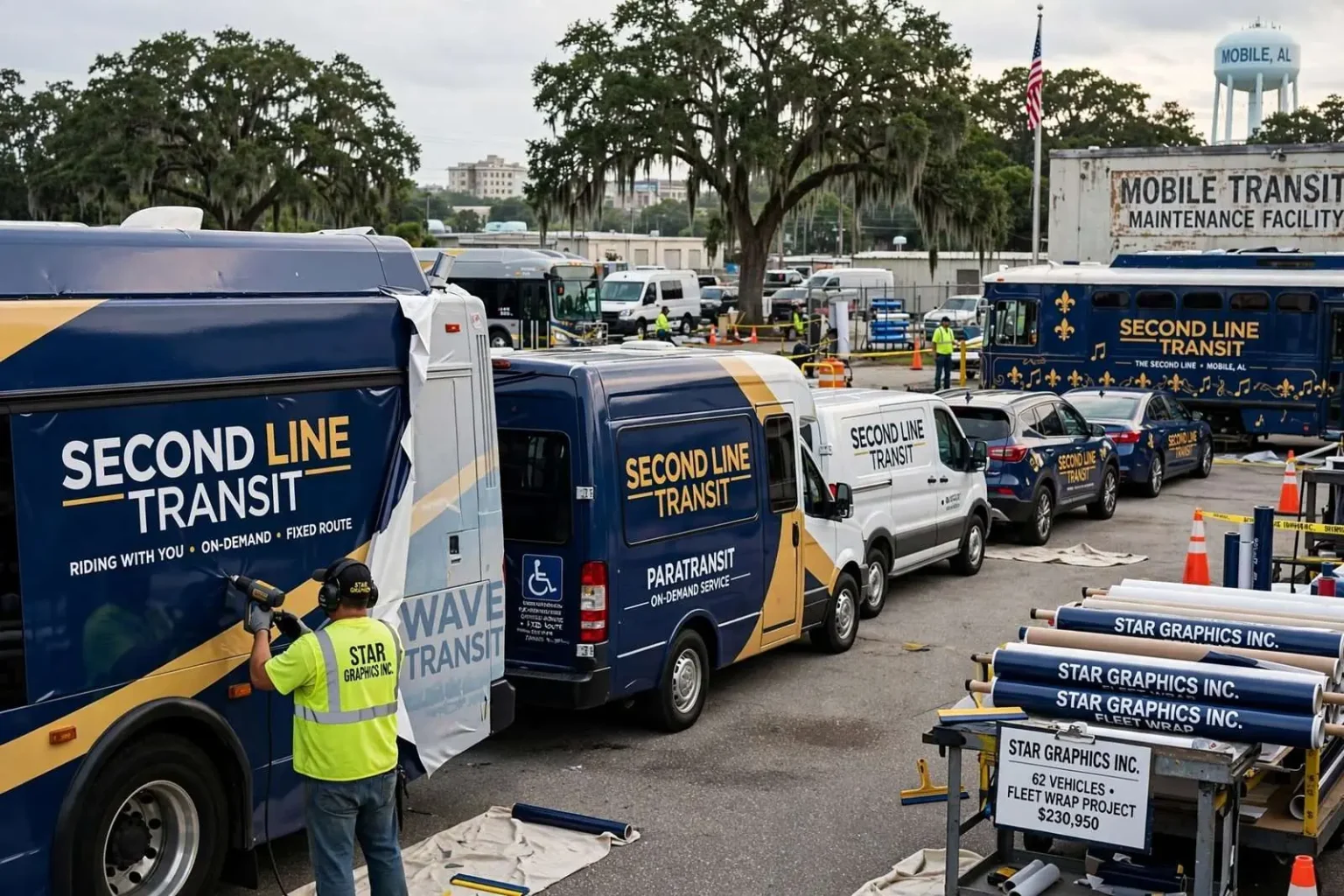
The Mobile City Council will consider a $230,950 purchase order to Star Graphics Inc. on Tuesday to rebrand the fleet: 16 buses, 11 vans, four SUVs, 12 sedans, 18 paratransit shuttles and one trolley. Wrapping that many vehicles in a new identity is no small undertaking, and the purchase order represents the moment when the transition from the old system to the new becomes visible on every street the fleet travels.
More Than a Name Change
The rebrand is one visible piece of a much larger overhaul of Mobile’s transit system. Second Line is designed to combine traditional fixed-route buses with expanded on-demand service, an approach intended to reach residents whose trips do not align neatly with existing routes. That hybrid model has gained traction in mid-sized cities where fixed routes alone leave substantial coverage gaps.
On-demand service — sometimes called microtransit — allows riders to request a pickup within a defined zone, with software routing the vehicle. It works best as a complement to fixed routes rather than a replacement, filling first-mile and last-mile gaps and serving lower-density areas where a full-size bus on a schedule cannot be justified. For riders, the practical difference is significant: instead of planning a day around a route map, they can summon a van much as they would a ride-share.
The model reflects a hard truth about transit in Gulf Coast cities like Mobile. Development patterns here spread homes, jobs, schools and medical care across a wide footprint, and the density that makes fixed-route buses efficient simply does not exist along many corridors. Riders in West Mobile stand to gain the most from a system that can flex to meet them where they live.
How the Contract Came About
The city previously sought bids for the vehicle graphics but received no responsive bids. It then used a competitive price quote process to select Star Graphics. That sequence is worth noting for what it says about the local market: fleet graphics work at this scale requires specialized capacity — vinyl wrapping 62 vehicles of six different types is not a job most sign shops can absorb — and a no-bid outcome usually reflects a thin regional market rather than a procedural problem.
A Delayed Launch
Second Line was originally expected to launch July 27. The city delayed the change in part because rebranding the fleet was taking longer than anticipated. Officials have since said the new system is expected to launch sometime after Labor Day, though an exact date has not been announced.
The delay illustrates the interlocking complexity of a transit overhaul. Buses, vans and shuttles cannot carry the new name until the wraps are installed; route maps, signage, bus stop placards, websites and phone systems all have to change in the same window; and operators and dispatchers need training on the new on-demand software before the first ride request arrives. A slip in any one of those streams pushes the whole launch, and vehicle graphics — the most physically labor-intensive piece — proved to be the constraint.
For current WAVE riders, the practical guidance remains to watch for city announcements on route changes, keep riding as usual in the meantime, and expect a transition window during which both systems’ identities appear around town. Fixed routes continue to run on their existing schedules until the city announces the new service plan, and paratransit riders will receive direct communication about how the changeover affects their scheduled trips.
The fleet inventory itself tells the story of the hybrid design. Sixteen full-size buses continue the traditional fixed-route mission along the busiest corridors, where passenger volumes justify them. The vans, SUVs and sedans form the flexible backbone for on-demand zones, while the 18 paratransit shuttles carry forward the system’s obligations to riders with disabilities who qualify for door-to-door service under federal law.
The End of the WAVE Era
WAVE Transit has operated as Mobile’s public transit system for years, running fixed routes from downtown out to the neighborhoods and commercial corridors that generate the city’s heaviest ridership. Like transit systems across the South, it has contended with the arithmetic of a dispersed, car-oriented region: rising operating costs, buses that often run with empty seats, and coverage that ends precisely where many riders begin and end their trips. The city’s decision to replace WAVE with Second Line reflects a judgment that incremental fixes would not close those gaps, and that a redesigned system with a new operational model offered a better path.
The name itself carries local resonance. A “second line” is the rolling parade that follows the main procession in the brass band tradition of the Gulf Coast, a celebration that takes over the street as it moves. Borrowing the name for a transit system ties the new service to the region’s cultural identity — and signals that the system is meant to move, to reach people where they are, rather than to serve only the fixed procession of traditional routes.
Why the Overhaul Matters for Mobile
The stakes of the transition reach far beyond branding. Thousands of Mobile residents depend on transit to reach work, school, medical appointments and groceries, and the reliability of that service shapes their access to the entire economy. Employers along the city’s major job corridors have long cited transportation as a barrier to filling entry-level positions, and hospitals and clinics see the consequences when patients cannot reliably reach appointments. A system that extends meaningful service beyond the traditional route map has the potential to change those outcomes.
The paratransit piece deserves particular attention. Federal law requires public transit systems to provide comparable door-to-door service for riders whose disabilities prevent them from using fixed-route buses, and those services are expensive to run and heavily used by riders who have no alternative. Carrying the 18 paratransit shuttles into the new system preserves that obligation and, if the on-demand technology is applied to the paratransit fleet, could improve scheduling and reduce the long booking lead times riders often experience.
There is a fiscal dimension as well. Rebranding 62 vehicles at $230,950 is a modest line item compared with the cost of the service redesign it accompanies, but transit budgets are assembled from modest line items, and every dollar spent on graphics is a dollar not spent on service hours. City officials making that tradeoff are betting that a clear, fresh identity will build ridership quickly enough to justify the investment — a bet that mid-sized cities with similar transitions have generally found worthwhile, since a system that looks new is easier to market than one that looks like a patchwork.
Looking Past Labor Day
The weeks between now and the post-Labor Day launch will determine how smooth the transition proves. Wrapping 62 vehicles takes time even for a well-equipped shop, and the city must sequence the work so that service never stops: vehicles are pulled from rotation in groups, wrapped, and returned while spares cover their routes. Meanwhile, the on-demand zones, booking technology and fare structures that define the new system await their public unveiling.
When the wraps are done and the launch date arrives, Mobile will have something it has not had before: a transit system designed around the way people actually move through a Gulf Coast city, with the name to match. Riders will judge it by the things that matter — whether the bus comes, whether the van arrives when the app promises, whether they can get to work on time. The 62 vehicles wearing the new name will be the most visible promise that this time is different.
The price quote process the city used instead is a standard procurement tool for exactly this situation: when formal competitive bidding fails, the purchasing code allows direct quotes from qualified vendors to keep the project moving. The $230,950 figure covers the wrap design, production and installation across the 62 vehicles.
Vehicle wraps are a demanding product. Each bus, van and shuttle has different body geometry, windows, door configurations and surface materials, and a wrap must survive years of Gulf Coast sun, rain and road wear without peeling or fading. Shops with the space, staff and installation equipment to handle a fleet of this size are scarce, which is why cities in similar positions often find themselves negotiating with a single qualified vendor rather than choosing among many.
Sequencing the work around daily service adds another layer of difficulty. Vehicles are pulled from rotation in groups, wrapped, and returned while spare buses cover their routes, so passengers never notice the gap. A fleet of 62 vehicles moving through a single installation shop takes weeks of disciplined scheduling, and that timeline was one of the reasons the city’s original July 27 launch date slipped past Labor Day.
What Riders Should Expect
When the new system debuts, riders will encounter changes beyond the paint. Fixed-route riders will want to review the updated route and schedule information the city publishes before the launch, since the redesign may adjust some routes to pair with the new on-demand zones. On-demand riders will book trips through the system’s app or phone line, with vehicles arriving within a scheduled window rather than at a fixed stop time.
Fares, transfers and passes are expected to be explained in the city’s launch announcements, and paratransit riders should watch for instructions on how certification carries over from the old system to the new one. City officials have emphasized that no service interruption is planned during the changeover, with the existing schedule remaining in effect until the new plan takes over.
The transition from WAVE to Second Line is a bet that Mobile can run transit differently than it has before. The wrapped fleet — buses, vans, SUVs, sedans, shuttles and a trolley bearing one name — will be the most visible sign of that bet as the vehicles roll out after Labor Day, and the riders they carry will be the ones who decide whether it paid off.
Inside the Delay: Outreach, Aging Buses and a Mayor Who Wanted Trolleys
The delay was more than a scheduling slip, city officials told council members when the slip became public. Deputy Director of Administrative Services Jacob Laurence said multiple community meetings had been held in recent weeks to explain the new routes, but organizers concluded more dialogue was still needed. “Over the course of the previous public engagement there were some concerns the public continued to maybe not quite get, and we want to ensure the success of the system translated into public confidence in that system,” he said.
The rebrand itself also proved slower than promised. Rebranding the existing fleet of buses and MoGo Rideshare vehicles to carry the Second Line Transit name would take longer than anticipated, Laurence said, and the city planned to sell some buses nearing the end of their useful life rather than pay to rebrand vehicles it was about to sell off.
The cost of the wraps themselves drew the mayor’s scrutiny. Mayor Spiro Cheriogotis said he sent the wrap proposal back to the drawing board after seeing the price tag. “I want trolleys,” he said. “When I saw hundreds of thousands of dollars going to bus wraps, that didn’t feel to me to be a good and just usage of the taxpayers’ dollars.”
Cheriogotis also argued that additional education and outreach would help current riders navigate the switch. “We just want to make sure we love all the people we’re serving right now with our transit system,” he said. “We don’t want to lose them. We don’t want them to feel left out.”