University of South Alabama Fairhope
Nine Guardians of Mobile Bay: Meet the 2026 Watershed Award Winners
The 2026 Watershed Award winners include a stranding network scientist, a Fairhope park ranger, a freelance journalist, marine researchers and a longtime river monitor, all honored for protecting Mobile Bay.
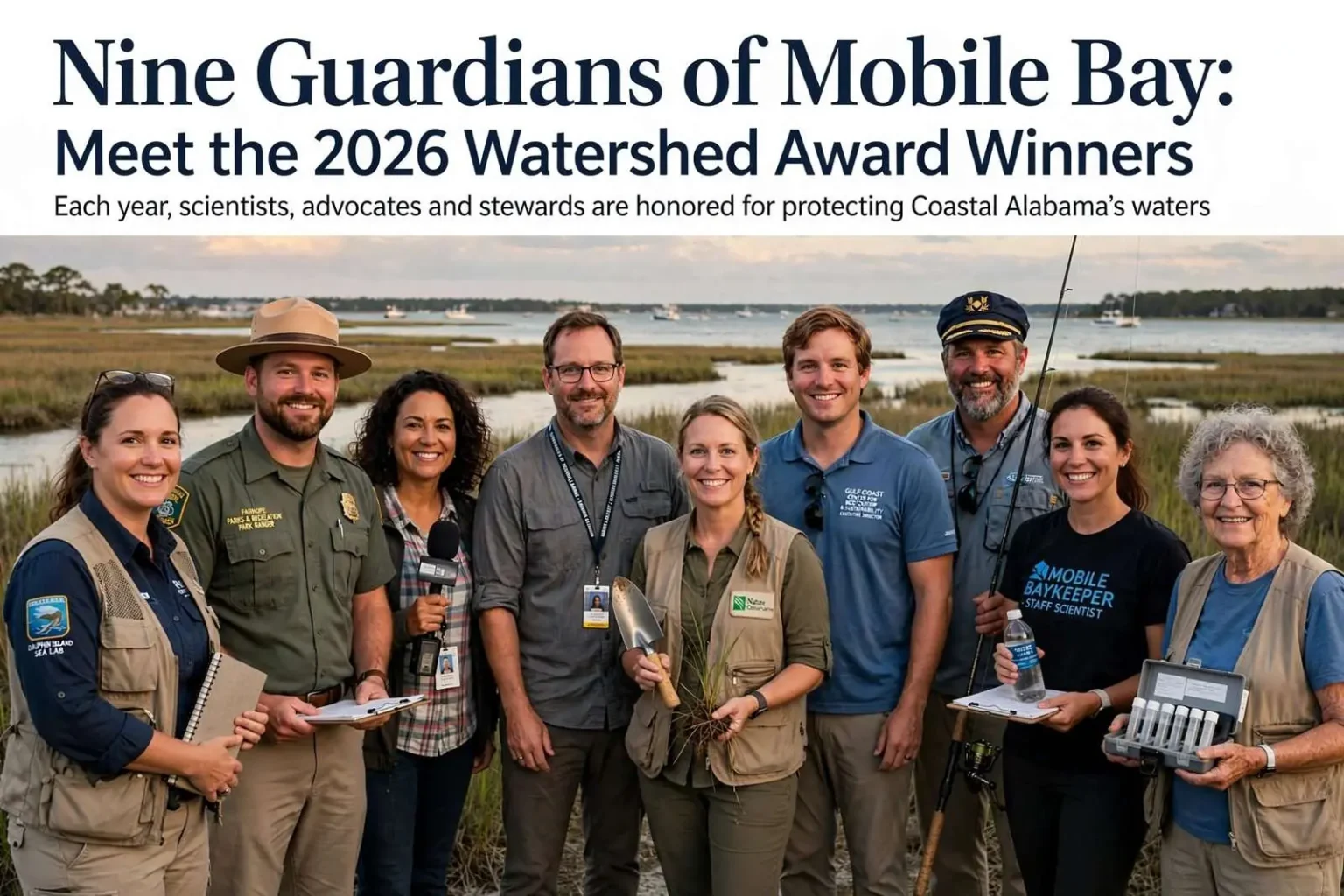
Each year, a small group of scientists, advocates and stewards are recognized for their work protecting Mobile Bay and the waterways that feed it. The 2026 class of Watershed Award winners spans careers as varied as park ranger, broadcast journalist, marine biologist and fishing guide, but all nine share a common thread: a deep commitment to the health of Coastal Alabama’s waters.
Mackenzie Russell
When Mackenzie Russell walked across the stage to receive her high school diploma, her family shouted, “Save the whales!” She has spent the years since doing exactly that. For about eight years, Russell has worked with the Dauphin Island Sea Lab’s Alabama Marine Mammal Stranding Network, where she now serves as stranding programs manager, performing necropsies on dolphins and whales to determine cause of death.
“It’s kind of like CSI,” Russell said of the internal examinations she performs on animals that can weigh 600 pounds or more. “Upon arrival on scene, I examine the location to get an idea of any signs that can help point to what happened to that animal. Why is it sick or dead? What caused it?” She notes the work carries stakes beyond animal welfare, since dolphins share much of their environment and diet with humans. “Dolphins are humans’ closest analogs,” she said. “They eat the same fish we eat. They swim in the same places we swim. We share the same environment. So if dolphins are getting sick, there is a good chance that people will, too.” Russell, a Minnesota native, holds bachelor’s and master’s degrees in marine biology from the University of North Carolina Wilmington and first learned of the Dauphin Island Sea Lab through colleagues at a prior job in Florida.
Justin Hammers
Justin Hammers oversees 108 acres, with more on the way, as Fairhope’s first park ranger and urban forester. His post is the Flying Creek Nature Preserve, where his duties range from land and facilities management to coordinating volunteer groups and leading outdoor education programs for local schools.
Much of Hammers’ work centers on combating invasive species, including kudzu, cogon grass, camphor trees, coral ardisia and Japanese climbing ferns. “One of the biggest challenges is managing invasive species,” Hammers said. “It is something people need to know about. We need to be pulling these type of plants out. I want to spread the word about what is invasive and not good for our environment.” He has also partnered with a local science education program to bring students to the preserve to learn about the watershed’s connection to Mobile Bay. A Tennessee native who grew up near a creek-side park outside Nashville, Hammers now finds himself tending a similar landscape in Fairhope.
Cori Yonge
Cori Yonge built a second career as an independent broadcast journalist after a corporate layoff eliminated her entire division in January 2022. Rather than see it as a setback, the Fairhope resident returned to the University of Alabama to pursue the master’s degree in journalism she had long wanted, encouraged by her husband, Lynn.
One of Yonge’s most notable stories focused on an unlined coal ash pond on the Mobile River at a local power plant, and the grassroots effort to force its cleanup. Her reporting centered on three founders of the Coal Ash Action Group — Sally Smith, Diane Thomas and Savannah Wilson — who pushed the utility to remove the ash rather than simply cap it in place. “Sally had been diagnosed with stage four metastatic cancer,” Yonge recalled, “but she was not going to sit around and let it consume her. She was going to do something.” The story later drew the attention of a California film producer and became the basis for a documentary, “Sally’s Ashes.” Yonge said freelance journalism is not a path to financial security so much as a calling. “There’s a place in the world for freelance writers, but it definitely is a labor of love,” she said. “I never intended to make a living as a freelance writer. I intended just to hopefully create change.”
Dr. Steven Scyphers
Dr. Steven Scyphers, a Dale County native, took a winding academic path to coastal Alabama, earning degrees at Enterprise State College and Auburn University before completing a doctorate in marine science at the University of South Alabama. After a stint as a tenured associate professor at Northeastern University in Boston, Scyphers returned to USA in 2022, where he now serves as both a faculty member in the Marine and Environmental Sciences department and the university’s first chief sustainability officer.
Scyphers’ work follows two tracks: educating the public on better coastal development practices, and studying the human dimensions of local fisheries. “By this we mean living shoreline projects to restore grasses and protect the native vegetation, as opposed to putting bulkheads or hardening structures in place,” he said. “That is probably one of the best things we can do for our shorelines.” His team is currently conducting a two-year survey of roughly 174 sites around Mobile Bay to better understand fishing opportunities and sustainability, while also partnering on nature-based stormwater management strategies across USA’s campus and the wider Mobile Bay watershed.
Katherine Baltzer
Katherine Baltzer grew up on a Kansas farm that, despite being “in the middle of nowhere,” taught her an enduring lesson: “I learned the importance of working with nature rather than against it.” A childhood trip to Florida introduced her to the ocean and set her on a path toward marine science. She moved to Alabama in 2014 and today works as a coastal conservation specialist with the Nature Conservancy in Mobile.
One of Baltzer’s signature projects has been the restoration of the lower Perdido Islands and Robinson Island near Orange Beach. “It has been loved to death,” she said of the popular area. “People love it, but so do birds, crabs and other species.” Using funding tied to the Deepwater Horizon oil spill settlement, her team planted approximately 200,000 plants across the islands, restoring acres of beach, marsh habitat and seagrass beds. Baltzer said continued growth along the coast makes sustainable development practices essential. “I know the economic drivers are important to this region, but there are ways we can go about development that minimize our impact,” she said. “Our way of life depends on our natural resources and the different services that we can get from them. If that goes away, we’re in trouble.”
Travis Langen
Travis Langen, a Southern California native who grew up in North San Diego County, recalls being immediately won over by his first visit to Alabama’s Gulf Coast. “I was blown away,” he said. “I had not realized the Gulf Coast had such an amazing coastline.” By his third visit, he knew he wanted to be part of it permanently.
Langen now serves as executive director of the Gulf Coast Center for Ecotourism and Sustainability, a nonprofit that opened in spring 2025 offering camps, programs and coastal adventures aimed at promoting sustainable tourism and environmental stewardship. “We’ve had a great year and a lot of positive feedback about this new campus,” Langen said. “It has been embraced by organizations throughout the community. We’ve hosted a ton of different events.” He said the center has partnered with organizations from across Mobile and beyond, and hopes visitors leave with a stronger appreciation for Alabama’s natural environments.
Patric Garmeson
As owner and captain of a Gulf Coast fishing charter business, Patric Garmeson spends his workdays introducing people to Coastal Alabama’s saltwater world. “I am fortunate to be outdoors and not in an office, breathing recirculated air,” said Garmeson, who was fishing offshore Fort Morgan at the time of his interview.
Garmeson said the experience of taking children fishing for the first time is part of what makes the work meaningful. “I have parents booking trips, telling me how much their children love watching fishing videos,” he said. “That is all good, but wait until that child sees the great outdoors firsthand. Seeing a different world of water and shore is pretty special.” He also raised concerns about industrial runoff and unregulated pollutants entering local waterways, noting that increased turbidity can harm both water quality and fish populations. A Pennsylvania native who moved to South Alabama at age 5, Garmeson said he has been fishing for as long as he can remember. “My parents put a fishing pole in my hands about as soon as I could walk,” he said.
Cassie Bates
Cassie Bates learned to scuba dive around age 12 and has been captivated by aquatic life ever since. Originally from the Phenix City and Columbus, Georgia area, Bates said her search for water-adjacent work eventually led her to Mobile, “where I fell in love with the area.”
The daughter of a U.S. Fish and Wildlife Service biologist, Bates holds a bachelor’s degree in biology from LaGrange College and a master’s in marine conservation and resource management from the University of South Alabama. After working as a lab manager and technician at the Dauphin Island Sea Lab, she became staff scientist for Mobile Baykeeper, a nonprofit focused on defending and reviving the health of Coastal Alabama’s waters. Among her most significant projects is a 40-page white paper examining the environmental harms of mud dumping in Mobile Bay by the U.S. Army Corps of Engineers, which she shared directly with the Corps along with community feedback. “One of the most rewarding parts of my job is attending community meetings and hearing how they value our waters,” Bates said. “The community members are from different backgrounds, so they may view issues differently, but they all see the value of protecting our area and our resources.”
Dr. Mimi Fearn
Dr. Mimi Fearn has spent decades answering a question that once stumped many locals: “Watershed? What’s that?” Her answer has become second nature. “A watershed is the land area that drains into a body of water, such as a stream, river or bay,” she said. “It is all the land where precipitation flows toward the same outlet.”
For Fearn, that outlet has long been the Dog River Clearwater Revival, a grassroots group she joined in the early 1990s to monitor the water quality of Dog River. As former chair of the University of South Alabama’s Earth Sciences department and the group’s head monitor, she has trained generations of volunteers in bacterial monitoring and water chemistry testing. “I have taught many over the years on how to do this,” she said. “I have met some wonderful people, ‘citizen angels’ who give their time and work.” A Mobile native whose family kept a boat on the river, Fearn built a 20-year university field research course around the Dog River watershed. “I know more about Dog River than most people want to know,” she said with a laugh. Though she plans to step back from her role eventually, she said her hope is to recruit more monitors, particularly among newly retired residents looking for a meaningful way to give back to the region’s waterways.