Coastal Insurance Costs Take Center Stage at Spanish Fort Governor’s Forum
The Christian Coalition of Alabama and the Homeowners Hurricane Insurance Initiative invited every candidate for governor to Spanish Fort to answer for the cost of coverage on the coast.
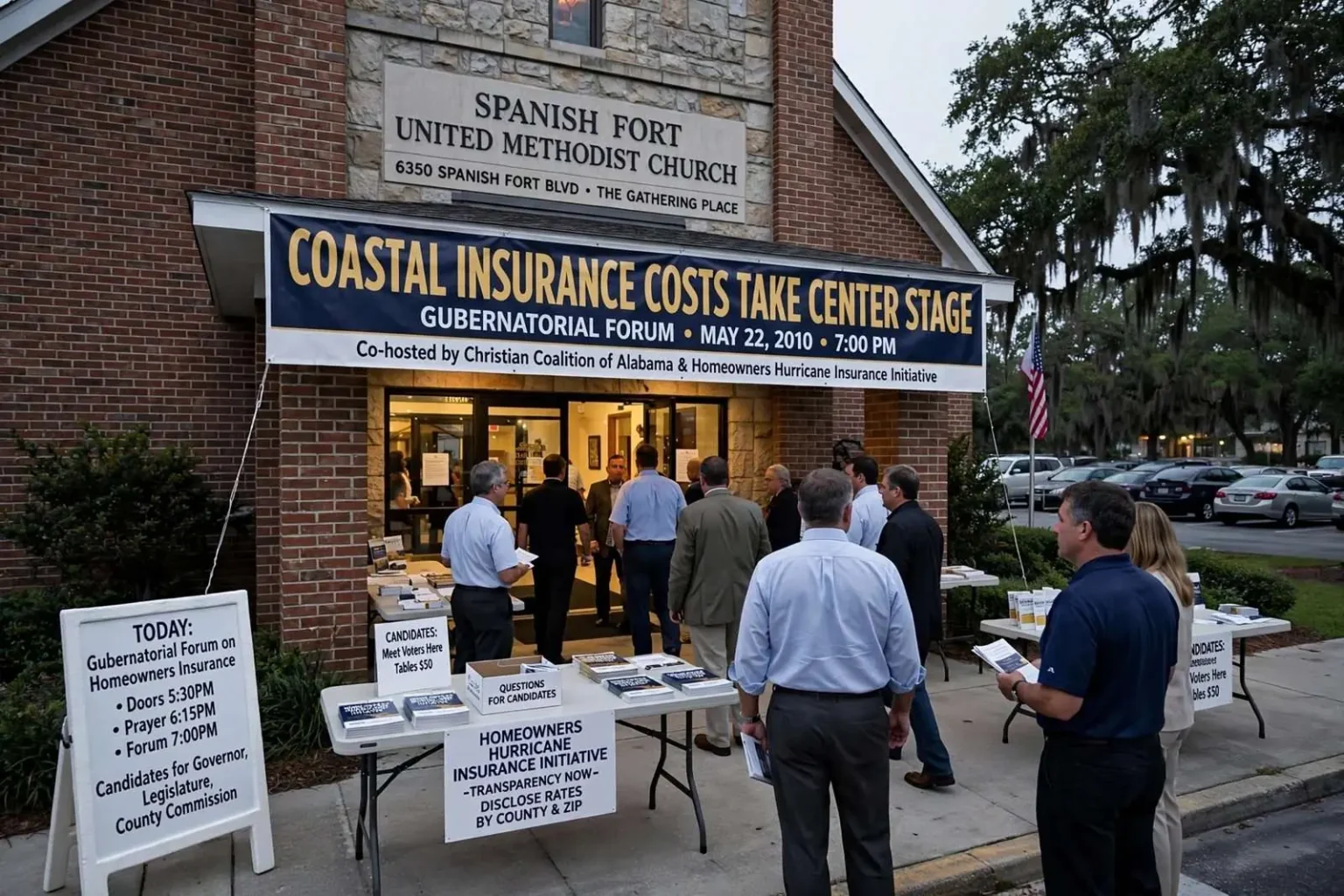
The cost of insuring a house within reach of a hurricane, long the most persistent economic grievance in Mobile and Baldwin counties, was set to get its own forum in the closing days of the 2010 primary campaign. The Christian Coalition of Alabama and the Homeowners Hurricane Insurance Initiative co-hosted a gubernatorial forum at 7 p.m. Saturday, May 22, at The Gathering Place at Spanish Fort United Methodist Church, 6350 Spanish Fort Blvd.
Every candidate for governor was invited to speak to voters about the high cost of homeowners insurance in coastal counties, according to the coalition. Also participating were Dr. Randy Brinson, chairman of the Christian Coalition of Alabama, and Dan Hanson, director of the insurance initiative.
Candidates for county commission, the Alabama Legislature and Congress were invited to set up tables and meet voters with last-minute questions before the June 1 primary. Tables were offered at $50. Doors opened at 5:30 p.m., a prayer meeting began at 6:15 p.m., and the program followed at 7 p.m.
The setting itself signaled the seriousness with which coastal Alabama regarded the issue. Spanish Fort, one of the fast-growing cities of the Eastern Shore, sits squarely in the geography of the insurance crisis — a community of new subdivisions whose homeowners in many cases paid more to insure their houses each year than neighbors a few miles inland paid, purely because of distance from Mobile Bay and the Gulf. For candidates courting votes in Baldwin and Mobile counties, no question of the 2010 cycle recurred more reliably than why wind coverage cost what it cost.
The Transparency Fight
The Homeowners Hurricane Insurance Initiative had been pressing for greater transparency at the Alabama Department of Insurance, arguing that the public should be able to see how many policies were sold in each area, how much was collected in premiums and how much was paid out in claims. Without those figures, the group argued, homeowners had no way to judge whether the rates being charged on the coast bore any relationship to the risk actually being borne by insurers.
The argument had special force in Alabama, where insurance filings had historically been treated as confidential trade information. Homeowners groups across the Gulf Coast pointed out that states such as Florida and Mississippi published far more detailed market data, allowing policyholders and legislators to see which companies were writing coverage in high-risk zones, which were pulling back, and whether reported catastrophe losses justified successive rounds of rate increases.
Insurance initiative organizers contended that the numbers, if disclosed by county and zip code, would show whether coastal ratepayers were being asked to shoulder losses that belonged to the industry statewide, or whether genuine hurricane risk explained the premiums. Either answer, they argued, would give lawmakers the grounding they needed to act — whether through market reforms, mitigation incentives or public backstops of the kind other coastal states had adopted.
The Christian Coalition of Alabama had recently adopted the issue as well, an unusual alignment that gave the campaign a reach into churches across south Alabama. The coalition, best known for social-conservative advocacy in Montgomery, framed coastal insurance costs as a family economic issue — a matter of whether working households could afford to protect the largest investment they would ever make.
“The cost for homeowners insurance has risen to the point that it’s hard for families living in Alabama’s coastal counties to protect their property and investments because of current rates,” Brinson said. “These folks need to know that there are people in Montgomery who care about them.”
The pairing of a church-based moral advocacy organization with a homeowners’ insurance pressure group reflected how the issue had spread beyond the coast itself. Rising premiums and shrinking coverage options in Mobile and Baldwin counties pushed costs into escrow accounts and housing markets across the region, and the cancellation or non-renewal notices that arrived in coastal mailboxes after each hurricane season became a shared political grievance that crossed party lines, denominations and county borders.
Why It Mattered on the Coast
The insurance crisis in coastal Alabama was not an abstraction by 2010. The region had absorbed Hurricane Frederic in 1979, Hurricane Ivan in 2004 and Hurricane Katrina in 2005, and each major storm had been followed by a round of rate increases, deductible changes and coverage withdrawals. Some national carriers had limited new wind policies in Baldwin and Mobile counties or required homeowners to accept separate, expensive wind policies on top of their standard coverage, leaving families to assemble protection from multiple policies at multiple prices.
For local real estate markets, insurance premiums functioned as a hidden tax on every transaction. Lenders required coverage, so buyers could not opt out; sellers found that escalating insurance quotes could stall sales or shrink what buyers could afford to borrow. Local officials in both counties repeatedly warned that insurance costs threatened the region’s growth machine — the migration of new residents to the Eastern Shore and to Mobile’s western suburbs that had driven decades of expansion.
Business leaders added a third layer of concern. Recruiting employers to the Gulf Coast meant recruiting their workforces, and companies weighing a Mobile or Baldwin County relocation compared total living costs against competing sites. Premium disparities that put coastal Alabama homeowners at a disadvantage against rivals in other Southeastern states were, in that framing, an economic development problem as much as a consumer protection problem.
The 2010 Political Landscape
The forum arrived at a moment of unusual openness on the issue. The June 1, 2010 primary featured a crowded Republican field for governor and a competitive Democratic contest, and every candidate had been pressed on coastal insurance during appearances across south Alabama. Voters in Mobile and Baldwin counties had watched gubernatorial hopefuls promise everything from regulatory transparency to catastrophe funds modeled on other states, and the Spanish Fort forum gave them a final chance to compare those commitments side by side, in their own backyard, days before voting began.
Down-ballot candidates were drawn in as well. County commission and legislative candidates set up tables at the church, since the issue did not stop at the governor’s office. Insurance regulation ran through the Alabama Department of Insurance and the Legislature, and local legislators had spent years fielding constituent complaints about non-renewal notices and wind policy premiums that could rival mortgage payments. A legislator’s answer to an insurance question at a church fellowship hall could matter as much to a coastal voter as anything said by the candidates for governor.
Churches themselves had become regular venues for south Alabama political forums, offering neutral ground, ample parking and seating for crowds that commercial venues could not always absorb. The Gathering Place at Spanish Fort United Methodist Church filled that role for the Eastern Shore, hosting civic gatherings in a city that had grown rapidly in the decade since Interstate 10 improvements made the bluff-side community a commuter hub for Mobile.
What Advocates Wanted From Montgomery
Beyond disclosure, the Homeowners Hurricane Insurance Initiative and allied groups had long pressed for a package of reforms discussed across the Gulf Coast: tax credits and grant programs for homeowners who hardened their roofs and openings against wind, mandatory notice and cooling-off provisions before non-renewals took effect, and a state-backed mechanism to keep coverage available in high-risk areas when private carriers retreated.
Advocates argued that mitigation incentives paid for themselves. Homes built or retrofitted to modern wind standards suffered dramatically less damage in hurricanes, which reduced claims, which in theory restrained the rate pressure that followed every storm. Publicizing loss data by area, they maintained, would demonstrate exactly that relationship and give insurers a reason to reward storm-resistant construction instead of simply raising rates across the board.
None of the groups expected a single evening forum to settle an issue that had resisted resolution for years. The goal, organizers said, was to force the topic into the open in front of the candidates most likely to control Montgomery’s response for the next four years, and to leave coastal voters with a record of who engaged the question and who deflected it.
For the homeowners who filled church meeting rooms across Mobile and Baldwin counties during those years, the forum represented something simpler: an acknowledgment that the premium notices arriving in their mail deserved a public answer rather than a shrug. The cost of insuring a house within reach of a hurricane had become, by the spring of 2010, a defining question of coastal life in Alabama — and the candidates for governor were being asked, in a church on the Eastern Shore, what they intended to do about it.
Whatever the forum’s immediate outcome, the coalition and the initiative had succeeded in aligning an unusual coalition of interests behind one demand — that the state open its insurance books to public view — and in placing that demand on the doorstep of the June 1 primary, where every vote in Mobile and Baldwin counties counted double in a close statewide race.