Mobile Children’s Hospital Seeks More Volunteer Pet Therapy Teams
USA Children's & Women's Hospital in Mobile is recruiting more pet therapy teams to comfort young patients during hospital stays.
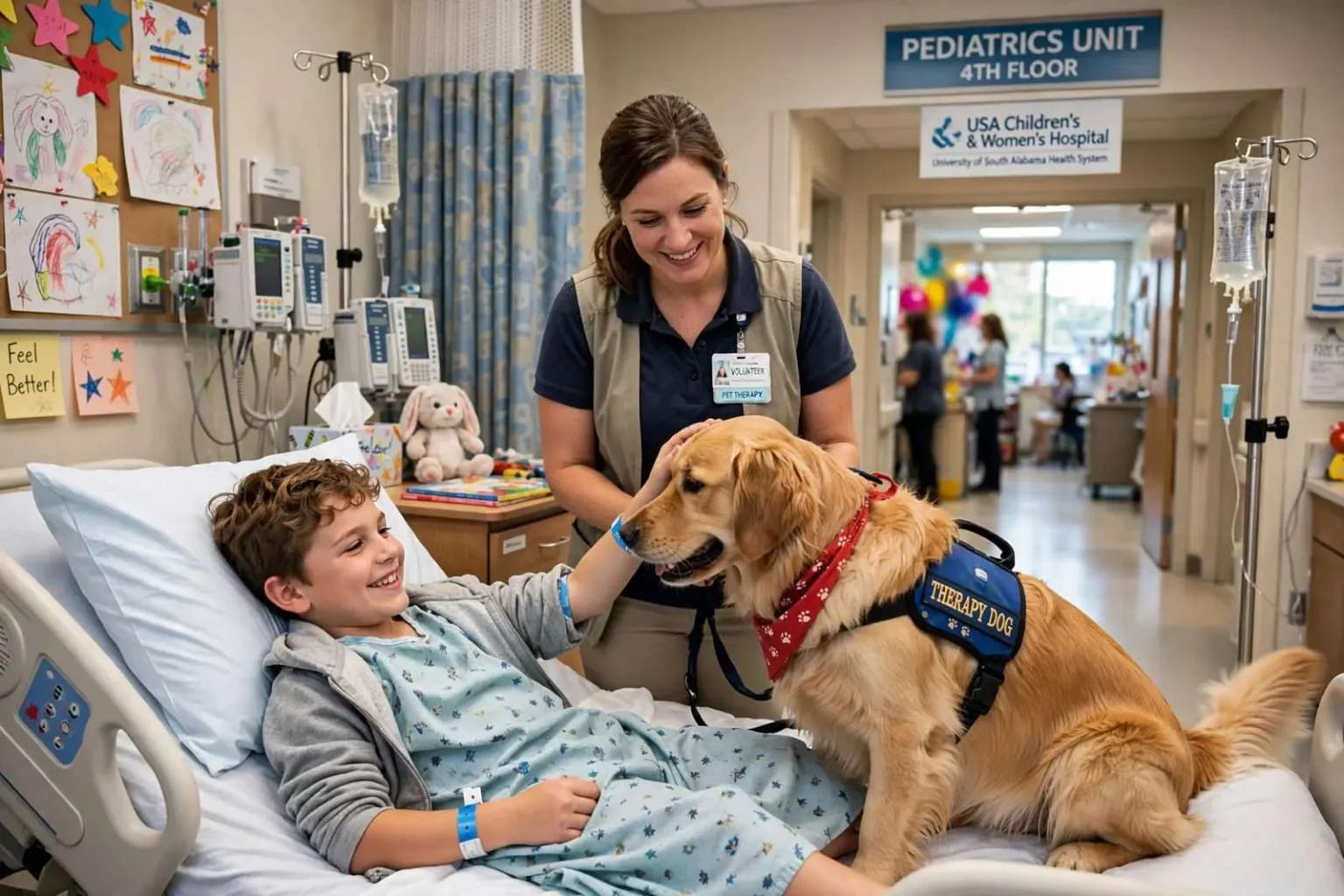
At USA Children’s & Women’s Hospital in Mobile, some of the most effective comfort for young patients doesn’t come from medicine at all — it comes on four legs, with a wagging tail. The hospital runs a pet therapy program that brings specially trained dogs and their handlers onto the pediatric floors, giving children a familiar, calming presence during what can be a frightening and disorienting stay away from home. Staff say the visits help ease anxiety in ways that traditional care simply cannot replicate.
“We want to normalize the hospital environment as much as possible,” said Brenda Maddox, a certified child life specialist at the hospital. Children who are used to playing with pets at home lose that outlet the moment they’re admitted, she said, and reintroducing it — even briefly — can make a real difference in a child’s mood and stress level.
Right now, the hospital has eight certified pet therapy teams that rotate through visits twice a week, on Tuesdays and Thursdays. But hospital leaders say that’s not enough to meet demand, and they’re actively recruiting more volunteer teams to expand the schedule. Each team consists of a handler and a dog that have been evaluated and certified together, and the visits are scheduled so that the program reaches as many units as possible on the days the dogs are in the building.
What it takes to become a team
Belinda Baggett, director of volunteer services at the hospital, said becoming a certified pet therapy team is a serious commitment that typically takes several months of preparation. Dog-and-owner pairs must complete training and certification through a recognized program before they can begin hospital visits, and not every dog is suited for the work — therapy animals need calm temperaments and the ability to handle the sights, sounds and unpredictability of a busy hospital floor.
That last point is the one experienced handlers emphasize. A hospital is a demanding environment for a dog: wheelchairs and IV poles moving through hallways, alarms, unfamiliar smells, elevator rides, and children who may grab, squeal or move suddenly. Therapy organizations evaluate dogs on exactly those skills, testing whether an animal can stay calm amid noise, accept handling from strangers, and remain steady around medical equipment. A dog that passes has demonstrated a temperament that goes well beyond basic obedience.
Handlers are evaluated too. Certification programs expect the human half of the team to understand infection control practices, hospital etiquette and the limits of what a therapy visit should involve. At a children’s hospital, that includes working around immunocompromised patients and following staff direction about which rooms and units are appropriate for visits on a given day.
Anyone interested in pursuing certification is encouraged to start by researching the requirements through a national pet therapy organization before reaching out to the hospital’s volunteer office for more information. National organizations maintain their own testing standards, insurance and training materials, and completing their process is the prerequisite step that hospital volunteer programs build on.
Why the visits matter
The theory behind pet therapy in hospitals rests on well-documented ground: interaction with animals can lower stress, provide comfort during procedures and recovery, and offer children a nonverbal source of reassurance in an environment dominated by adults asking them to hold still. Child life specialists like Maddox work precisely at that intersection, using play, preparation and comfort measures to reduce the fear that hospitalization produces in children.
A therapy dog visit interrupts the rhythm of a hospital stay. For a child who has spent days attached to monitors, ten minutes with a calm dog can be the first experience on the unit that asks nothing of them — no procedure, no test, no medicine. Staff at hospitals with established pet therapy programs consistently describe the visits as among the most anticipated events on the pediatric floors, for patients and, often, for the nurses and physicians who stop to greet the dogs as well.
More volunteers needed beyond the dogs
Pet therapy teams aren’t the only volunteers the hospital is looking for. Baggett said there’s ongoing need for people willing to help in the hospital’s volunteer program in a range of other roles, from supporting families at information points to assisting staff with the many small tasks that keep a large medical facility running smoothly.
Hospital volunteer programs of this kind typically place volunteers throughout the facility: greeting and wayfinding at entrances, supporting the family waiting areas, helping with clerical work, staffing gift shop and special events, and providing an extra set of hands in units where a non-medical helper can free clinical staff for patient care. For a hospital that serves children and mothers, volunteers also play a comfort role — holding a hand, entertaining a sibling, or simply being another friendly adult in an unfamiliar place.
The process for non-pet volunteers is more straightforward than therapy certification, though it still involves an application, background screening, health clearances and an orientation before volunteers begin their assignments. Commitments can often be tailored to a volunteer’s schedule, and students exploring healthcare careers are among the most common applicants, along with retirees and community members with flexible daytime hours.
The hospital and its community
USA Children’s & Women’s Hospital, part of the University of South Alabama’s health system, serves as the region’s dedicated children’s and women’s hospital, drawing patients from Mobile, Baldwin County, the Florida Panhandle and south Mississippi. A hospital with that catchment area treats children staying far from home — sometimes hours from their own bedrooms and pets — which is exactly the population that a pet therapy program is designed to reach.
Volunteer support plays a proportionally large role in hospitals of this kind. Auxiliary groups and individual volunteers supplement staff services in ways that budgets cannot, and programs like pet therapy exist at all because volunteers give their time and, in this case, their dogs. The eight teams currently serving the hospital represent months of training and a standing commitment of their Tuesdays or Thursdays; doubling or tripling that number would let the program reach more units and more children each week.
For dog owners considering the work, the reward is concrete. Handlers describe the visible change in a child during a visit — from withdrawn to engaged, from tearful to smiling — as unlike anything a donation of money produces. The commitment is real: certification takes months, visits require reliability, and every trip into the hospital means following infection control rules without exception. But the hospital’s message to the community is clear that demand currently outruns supply, and that more certified teams would mean more children reached.
How to get started
The path the hospital recommends is straightforward. First, research national pet therapy organizations and their certification requirements — training, temperament testing and health documentation for the dog are standard elements. Second, complete the certification process with your dog. Third, contact the hospital’s volunteer services office, where director Belinda Baggett’s team coordinates scheduling and onboarding for new teams.
Prospective volunteers without dogs can contact the same office about the hospital’s other volunteer needs. Either way, the entry point is the same: the volunteer office of USA Children’s & Women’s Hospital in Mobile, which matches willing helpers — with or without four legs — to the roles where the need is greatest.
A day in the life of a therapy team
The routine for a certified team on a Tuesday visit gives a sense of what the commitment looks like. Handlers check in through the volunteer office, confirm the units they will cover that day, and follow the hospital’s infection control protocols — which can include washing the dog’s paws, keeping the animal away from certain rooms and respecting any isolation precautions in effect. From there, the team moves room to room with staff guidance, stopping wherever a child wants a visit and skipping wherever one doesn’t.
The visits themselves are short and flexible. Some children want the dog up on the bed; some prefer to watch from a parent’s lap. Some want to give commands, offer treats or show off drawings, and some simply want to touch the fur and sit quietly. Experienced handlers read each situation and let the child set the pace, which is part of what certification evaluates and part of why the hospital values teams whose dogs can handle unpredictability without stress.
Families often report that the dog visit becomes one of the memories children carry from a hospital stay — a bright spot in the middle of treatment. That is the outcome the program aims for, and it is why Maddox frames the work as normalization: for a few minutes, the hospital floor feels a little like home.
The breeding ground for future volunteers
Hospital volunteer programs tend to draw from a reliable set of pools, and Mobile has all of them: university students from the nearby campus building healthcare résumés, retirees with weekday availability, and dog owners whose animals have the right temperament and idle capacity for the work. Local kennel clubs and training groups also feed therapy programs, since handlers whose dogs already compete in obedience or agility often look for community outlets for the animals’ skills.
The hospital’s recruiting message reaches those audiences through its volunteer office, and the office coordinates both the pet therapy track and the general volunteer track. What both tracks share is screening and reliability — a hospital cannot function with volunteers who appear unpredictably — so applicants should expect a formal process rather than a casual sign-up.
The need, hospital leaders say, is ongoing rather than seasonal. Children are admitted year-round, and the pediatric floors’ demand for visits does not pause when school is in session or when holidays thin the volunteer ranks. Eight teams covering two days a week is the current baseline; every additional certified team extends the program’s reach, whether by adding a third visit day or by deepening coverage on the existing Tuesdays and Thursdays.
For anyone who has watched a child light up at the sight of a friendly dog, the proposition is simple: the hospital has the patients, the training programs have the certification path, and the volunteer office has the door. What the program needs most is more pairs walking through it.