Mobile Council Approves $85,000 Deal to Guide Outreach for Three Mile Greenway Trail
The Mobile City Council authorized an $85,000 community engagement contract with Planning Next for the 13-mile Three Mile Greenway Trail, along with several other city contracts covering recycling, mowing and HVAC maintenance.
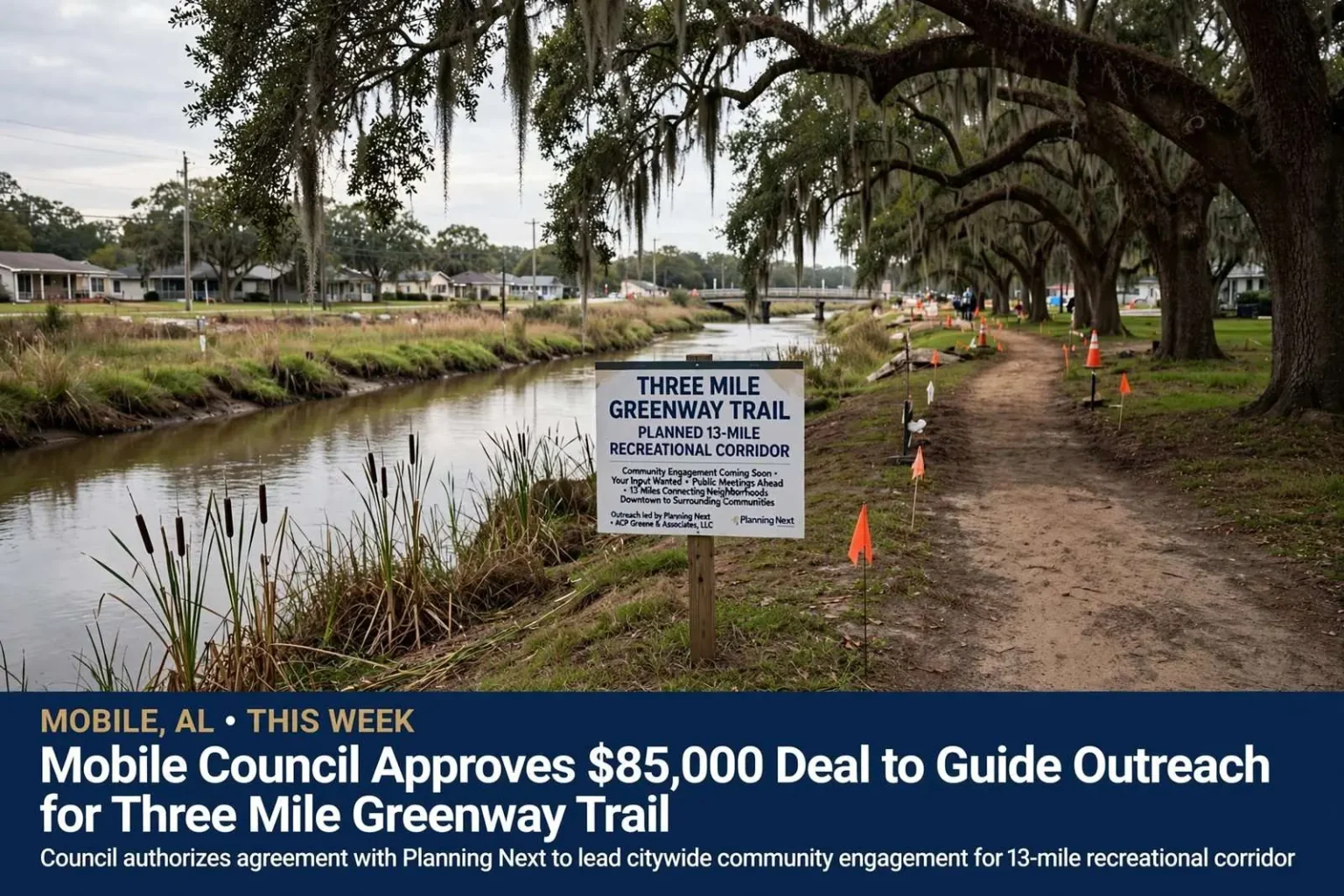
The Mobile City Council voted this week to authorize an $85,000 agreement with ACP Greene & Associates, LLC — operating as Planning Next — to lead community engagement for the Three Mile Greenway Trail, a planned 13-mile recreational corridor through the city. The vote put public money behind the public part of a project that has been on the city’s drawing board for years, and it committed the administration to a structured process of getting residents’ input before the trail’s route and amenities are locked in.
The measure was sponsored by Mayor Sandy Stimpson and Vince Calmetti, who oversees the city’s major projects. Under the contract, Calmetti’s office will take the lead on publicizing the project, with the $85,000 covering outreach for the entire 13-mile route rather than a single segment. That whole-route framing matters: cities that build long trails segment by segment often end up with neighbors who are surprised by each phase, and the Stimpson administration’s approach here is designed to treat the greenway as one connected project from the start.
“I or my staff will be doing all of the outreach for assistance on brochures, planning meetings and the public meetings,” Calmetti said. Brochures, planning sessions and open public meetings are the standard toolkit for major infrastructure outreach, and the contract effectively outsources the organization of that process to a firm whose business is helping municipalities communicate with the residents a project will touch.
Council Vice President Levon Manzie said he backed the agreement because of the benefit he expects the trail to bring to residents across Mobile. “I think this Three Mile Greenway is going to be a great recreational amenity for thousands upon thousands of our citizens,” Manzie said. “This contract will (have us) work with them on the outreach, making sure citizens understand about what’s going on throughout the process of building the entire 13-mile route; so I supported the contract because it’s paramount that citizens are engaged, informed and are able to offer their commentary and opinions so there’s not a vision of seven of us (on the council) and the mayor, but something that all citizens can buy into.”
What a greenway buys a city
Trail projects carry price tags that can surprise residents who picture a paved path, because a 13-mile corridor means acquiring or agreeing on rights-of-way, building safe road crossings, handling drainage and lighting, and then maintaining the whole length indefinitely. Spending $85,000 on engagement before committing to construction is the cheap part — and, in the eyes of planners, the part most likely to save money later by surfacing objections while route changes are still lines on a map rather than poured asphalt.
Outreach also does the political work a long project requires. A greenway takes years from first meeting to final segment, spanning multiple councils and administrations, and the projects that survive are the ones where residents feel they helped shape the plan rather than being handed a finished decision. That was precisely the distinction Manzie drew between “a vision of seven of us and the mayor” and something the whole city can buy into.
The case for engagement early
Manzie added that he hopes to see the pace of engagement pick up once the contract is finalized. “I’m hopeful that we can get this done as quickly as possible,” he said. “As soon as we get the contract done and consummated by both parties, I’m hopeful that the engagement process will be strengthened and there’ll be stronger and regular engagement of the whole trail so that citizens throughout the city feel ownership of what will be the Three Mile Greenway Initiative.”
That ownership question is the reason cities spend real money on outreach before pouring concrete. A 13-mile trail crosses dozens of neighborhoods, multiple council districts and hundreds of private properties along its edges, and the residents nearest the route — whether they welcome it for their children or worry about it at their fence line — are the people whose buy-in determines whether a greenway arrives as a celebrated amenity or a string of disputes.
Greenway and trail projects like this one are often pitched by cities as a way to expand recreational access, encourage walking and biking, and connect neighborhoods that might otherwise be separated by roads or waterways, while also raising property values and drawing visitors to nearby businesses. National experience with urban trails bears out the pitch: corridors built on old rail lines and creek beds have repeatedly become the most heavily used recreation infrastructure in their cities, serving commuters on bikes and families on evening walks at the same time.
The Three Mile Greenway has been discussed in Mobile for years as part of a broader vision for connected trails linking downtown and surrounding neighborhoods, and the community engagement contract is intended to make sure residents have a voice in how the final 13-mile route and its amenities take shape. Amenities along a corridor of that scale typically include trailheads, benches, signage, water fountains and safe street crossings, and each of those details is a decision residents can weigh in on during the engagement process the new contract funds.
For the neighborhoods the route passes through, the process will decide questions that matter daily: where entrances land, which streets the trail meets, how crossings are engineered and what buffers separate the path from homes and backyards. That is why the contract specifies meetings across the entire route rather than a single citywide session, and why council members from different districts watched the vote with their own constituents in mind.
The route’s namesake, Three Mile Creek, winds through a swath of the city where flooding, drainage and open space have long been intertwined issues, and a greenway along its corridor carries the potential to combine recreation with the stormwater and environmental benefits that come from restoring space along an urban waterway.
Other business before the council
Council members also acted Tuesday on five resolutions held over from the previous week’s meeting. The carry-over docket covered agreements and payments that touched everything from recycling to mowing to museum maintenance, a reminder that the greenway vote shared the agenda with the ordinary contracting work that keeps a city of Mobile’s size running.
They authorized an agreement with Emerald Coast Utilities Authority for the acceptance and processing of source-separated recyclables, at an estimated cost of $45,000 a year. The contract pays a Pensacola-based utility to process the material Mobile residents separate into their recycling bins, an arrangement that keeps the city’s curbside program functioning without Mobile operating its own processing facility.
Two additional resolutions approved contracts with Best Price Services, LLC, for right-of-way mowing services — $37,800 for Springhill Avenue and $40,500 for Dauphin Island Parkway. Right-of-way mowing is one of those services residents judge a city by directly: overgrown medians and ditches along major corridors read as neglect, and the two contracts cover some of the busiest gateways in the city, from the Springhill Avenue corridor in the northwestern part of Mobile to Dauphin Island Parkway running south toward the bay. Corridors like those set the tone for visitors and residents alike, which is why mowing contracts routinely draw more public comment than their dollar amounts would suggest.
The council also authorized a three-year, $35,502 contract with Johnson Controls, Inc., for preventative maintenance and service of the HVAC Direct Digital Controls system at the History Museum of Mobile. For a museum housed in the city’s historic Old City Hall, climate control is not just about comfort — it is preservation. Documents, textiles and artifacts deteriorate quickly when temperature and humidity drift, and the digital controls contract pays to keep the building’s environmental systems calibrated and running over three years.
In a final action, members approved a $20,000 invoice payment to the Southern Tennis Association, Inc. Invoice payments of that kind are how the city settles obligations for tournaments, facility use and youth programming partnerships, and they typically trace back to events already hosted or services already rendered under prior agreements.
The payment closed out the council’s Tuesday agenda, which stretched from a 13-mile trail vision to a mowing contract to museum machinery — the full range of what a city council’s consent agenda actually governs.
For the greenway itself, the outreach contract marks the point where a long-discussed vision starts behaving like a project: money committed, a firm hired, meetings scheduled and a route to be refined with the public looking on. Residents can expect brochures, planning sessions and public meetings to follow as the 13-mile corridor’s path and amenities take their final shape — the step Manzie and the administration both described as essential to building a trail the whole city can claim.