New Hilton Garden Inn Breaks Ground on Former BayFest Stage Site in Downtown Mobile
A new 93-room Hilton Garden Inn broke ground in downtown Mobile at the site of a former BayFest stage, part of developer Mike Cowart's growing downtown hotel portfolio.
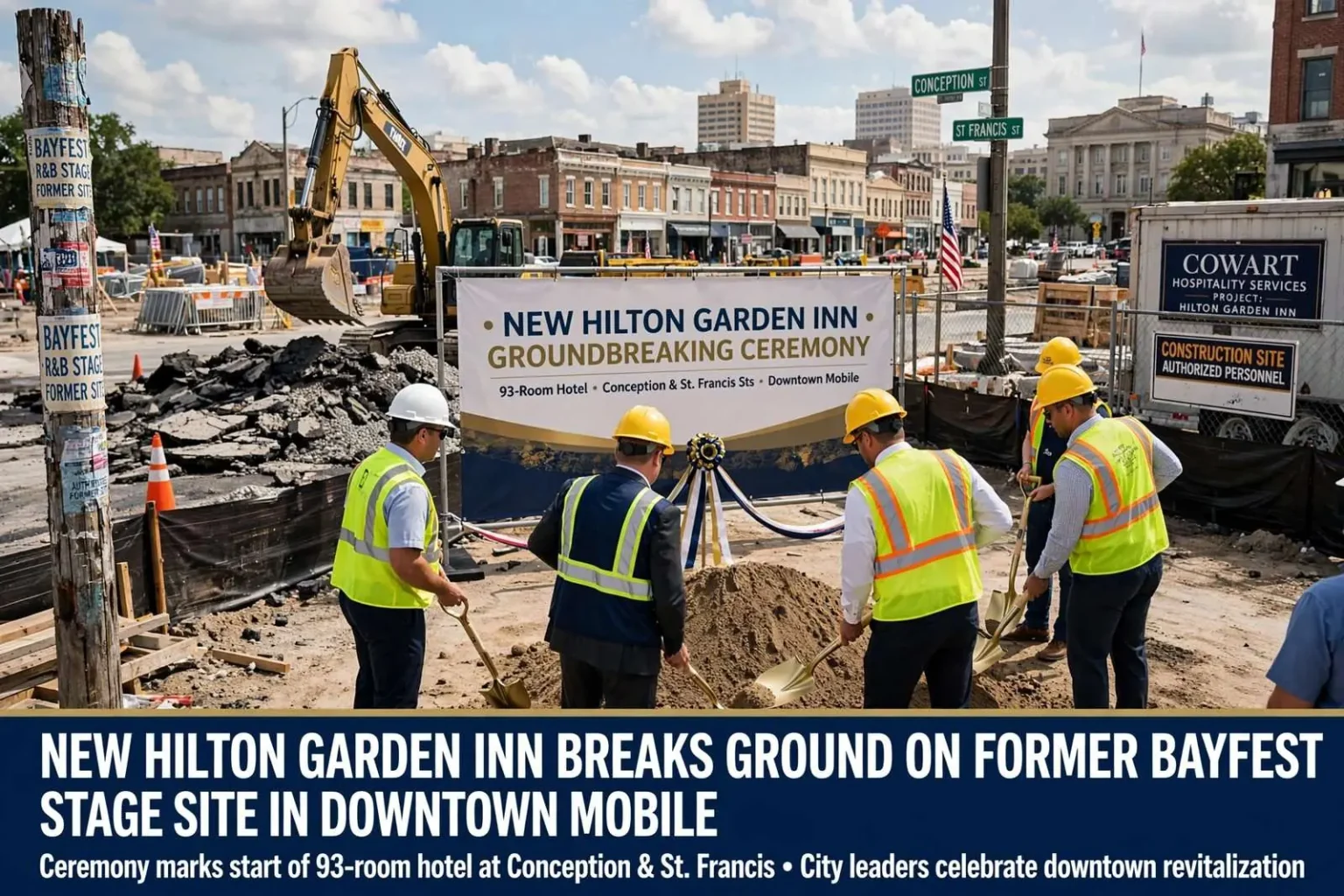
Mobile Mayor Sandy Stimpson joined developer Mike Cowart and Mobile City Councilman Levon Manzie Wednesday morning for a groundbreaking ceremony marking the start of construction on a new 93-room Hilton Garden Inn at the corner of Conception and St. Francis streets in downtown Mobile. Crews were already tearing up asphalt on the former parking lot at the site as officials gathered to celebrate the project’s launch, turning what has been a slab of parking spaces into the city’s newest piece of hospitality development.
“This corner is a premier site in the city,” Stimpson said during the event. The mayor’s assessment of the location reflects the way downtown Mobile’s map has shifted in recent years, with blocks near the city’s central squares and business corridors becoming some of the most sought-after ground for new investment. Manzie described the hotel as part of a continuing wave of investment reshaping downtown Mobile. “The vibrancy and revitalization is not stopping,” he said. “It’s ever-increasing.”
The hotel is being developed by Cowart Hospitality Services, led by Mike Cowart, who has also built two other downtown hotel properties, the Hampton Inn and the Candlewood Suites. The new Hilton Garden Inn gives the company a third downtown property and extends a run of investment that has made Cowart one of the most active private developers in the city’s urban core, with a portfolio that now spans three hotels within blocks of one another.
Cowart said the new Hilton Garden Inn will be custom designed with a contemporary interior and will include an upscale cocktail lounge intended to give downtown visitors and residents another option for evening entertainment. The lounge adds to the property’s role beyond simply providing rooms, positioning the hotel as a gathering spot in its own right and contributing to the after-hours activity that city leaders have worked to build along the downtown streets near the site.
A Site With a Festival Past
The site carries some history for Mobile’s music and festival scene. The parking lot had previously hosted one of the main stages for BayFest, the city’s long-running music festival, and the start of hotel construction forced organizers to rework the festival’s footprint for that year’s event. For festivalgoers, the lot at Conception and St. Francis had been a familiar landmark of BayFest weekends, one of the gathering points in the grid of downtown stages that fills the streets each October.
BayFest founder Bobby Bostwick stopped short of calling the change a downsizing, but said the festival board would need to make adjustments to accommodate construction on the site of the event’s R&B stage, potentially replacing the smaller gospel stage with R&B programming and spreading gospel music across other stages instead. The reshuffling illustrates the balancing act a downtown festival performs as the blocks it uses fill in with permanent development, and Bostwick’s framing made clear the board’s goal was to preserve the festival’s programming even as its footprint shifted.
BayFest organizers had also been scheduled to give a presentation to the Mobile City Council the day before the groundbreaking, but a lengthy council meeting pushed that presentation back. Bostwick said additional presentations were planned before both the City Council and the Mobile County Commission in the weeks that followed, along with other festival announcements, including what he described as “something we’ve never done in 21 years.” The tease suggested a significant reveal on the way for an event that has been a fixture of the city’s calendar since its founding.
A ribbon-cutting for the new hotel was slated for August of the following year, setting a construction timeline of roughly a year and a half from the first day of asphalt removal to the opening of the 93-room property. For a mid-sized downtown hotel, that pace is typical, and it means the corner at Conception and St. Francis will spend the better part of two years as an active construction site before returning to service as a lodging and entertainment address.
Part of a Downtown Building Boom
The project reflects a broader trend of hospitality investment in downtown Mobile, where a string of new hotels has opened over the past decade as the city has worked to draw more visitors, conventions and residents back into its historic core. Hotels anchor that strategy: they fill rooms during festivals and conventions, put people on the sidewalks on weeknights as well as weekends, and give the restaurants, bars and shops along the nearby corridors a steadier flow of customers.
The location at Conception and St. Francis places the new hotel within walking distance of Bienville Square, the main post office, the government plaza and the entertainment blocks that run along Dauphin Street, making it convenient for both business travelers and festival crowds. Proximity to those destinations has been a selling point for downtown properties generally, and Cowart’s earlier hotels demonstrated the demand for rooms in that part of the city.
City officials have framed the hotel boom as evidence that the public investments made downtown over the past two decades — street improvements, park renovations and the convention business that feeds the local economy — are paying off in private construction. Each new property, leaders argue, makes the next one easier to justify, and the Hilton Garden Inn announcement was presented in exactly those terms, as one more link in a chain of projects rather than an isolated bet.
What the Hotel Means for the Neighborhood
For the blocks surrounding Conception and St. Francis, the transition from parking lot to hotel changes the character of the corner in ways that extend past the construction period. A 93-room property brings daily traffic of guests, staff and visitors, along with the evening activity generated by the planned cocktail lounge. Developments of this scale also carry jobs — front desk, housekeeping, food service and management positions that stay in place long after the ribbon-cutting — and they add to the property tax and sales tax base that supports city services.
The loss of a parking lot, meanwhile, is part of the same calculation. Downtown parking has been a recurring topic as surface lots give way to buildings, and festival organizers like BayFest feel the change acutely, since open lots serve double duty as staging areas and venue space during major events. City planners have generally accepted the trade-off — fewer surface lots in exchange for a more active streetscape — but the transition requires adjustments from the events and businesses that relied on the lots.
Cowart’s decision to build a third downtown property signals confidence in the trajectory Manzie described at the groundbreaking. Developers commit to hotel projects on long timelines, and the assurance that downtown Mobile can fill additional rooms years from now rests on the continued growth of the convention calendar, the festival economy and the residential population moving into the urban core.
A Festival Adapting as the City Grows
For BayFest, the year ahead involves both disruption and reinvention. The loss of a main stage site for construction is the kind of challenge the festival has navigated before, and Bostwick’s public stance — that the changes amount to adjustments rather than a downsizing — was aimed at reassuring attendees and sponsors that the event’s programming would survive the reshuffling intact. Moving R&B to the gospel stage’s footprint and spreading gospel acts across the remaining stages keeps every genre represented even as the map changes.
The pending presentations before the City Council and the Mobile County Commission will shape the festival’s relationship with the governments that support it, and Bostwick’s promise of a never-before-done announcement gave those appearances added weight. Twenty-one years into the event’s run, organizers are clearly positioning it as an institution that continues to evolve rather than simply repeat itself.
The groundbreaking itself was a brief affair on an active construction site, with asphalt already coming up behind the speakers as they talked. Ceremonies of this kind have become familiar markers along downtown’s skyline over the past decade, but each one represents a set of private decisions — financing, design, site acquisition and hiring — that came together long before the shovels appeared. In this case, the decisions produced a 93-room hotel from a developer who already knew the downtown market well, on a corner the mayor called the city’s premier site, in front of a councilman whose district includes the blocks where the investment will land.
By the time the Hilton Garden Inn opens the following August, the corner that once hosted festival stages will have a permanent role in downtown life, and BayFest will have remade its footprint around the new building. Both outcomes — a finished hotel and a reworked festival map — are snapshots of the same phenomenon Manzie described at the groundbreaking: a downtown where construction cranes and street festivals share the same few blocks, each reshaping the other as the city’s revitalization continues.