Alabama Coastal Cleanup marks 30 years with new recycling push
The 30th annual Alabama Coastal Cleanup returns Sept. 16 with a new recycling partnership, drawing volunteers to shorelines across Mobile and Baldwin.
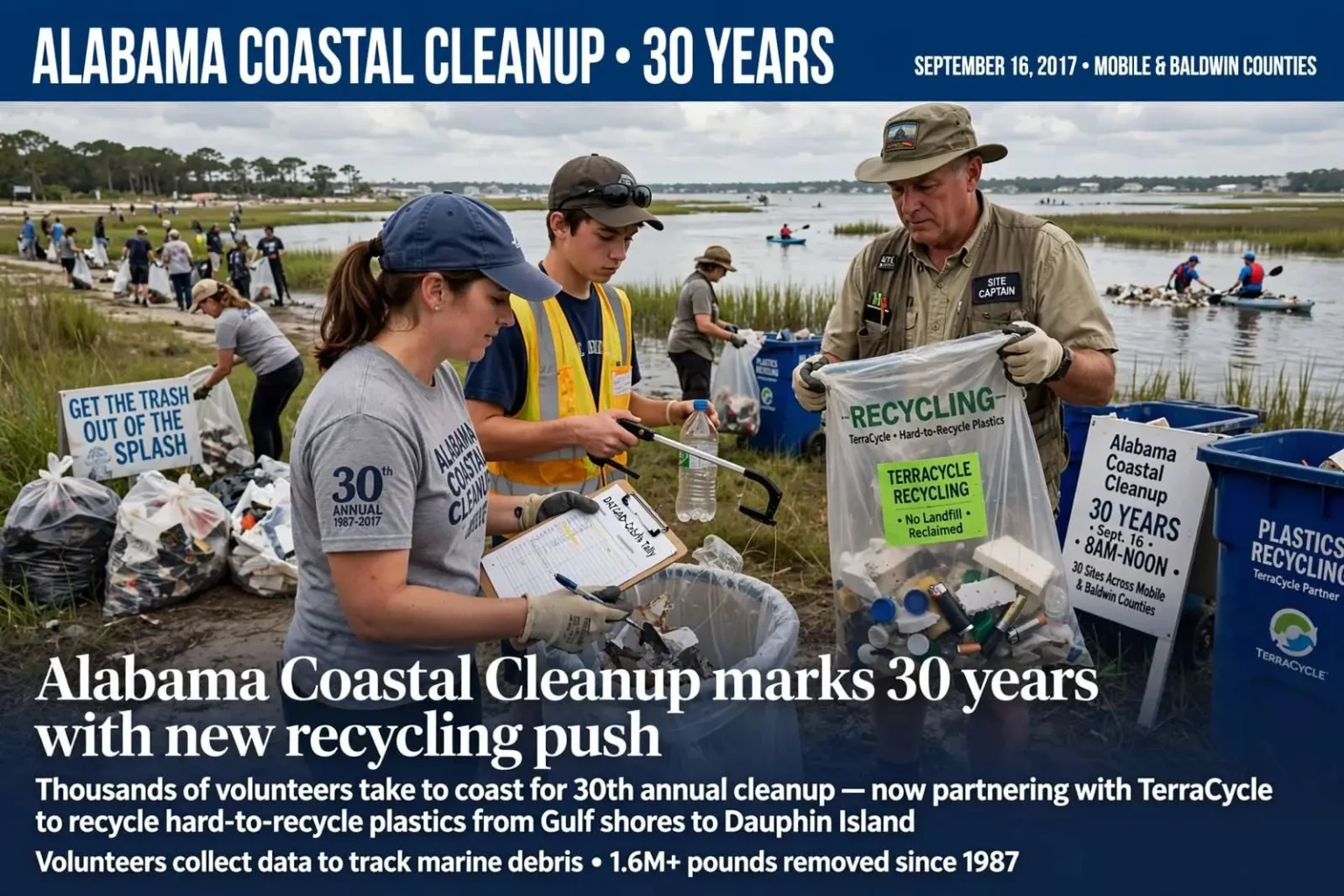
The Alabama Coastal Cleanup, the state’s largest single-day volunteer event, returns for its 30th year on Saturday, Sept. 16, inviting residents and visitors to “get the trash out of the splash.” From 8 a.m. to noon, volunteers on foot and on the water will fan out across Alabama’s coastline and waterways, from Gulf Shores to Dauphin Island, collecting litter that has washed up or been left behind.
Three decades on, the cleanup has become a late-summer tradition as fixed on the Alabama coast as anything on the calendar. Thousands of participants — families, students, church groups, businesses and civic clubs — will spend a Saturday morning picking up cigarette butts on the beach sand, hauling tires from bayou banks and pulling debris from the water itself, all logged by hand on data cards that feed one of the world’s largest records of marine litter.
The event is part of the International Coastal Cleanup, the global effort coordinated through The Ocean Conservancy, which has made Alabama’s contribution a part of an international database of debris. Every bag of trash collected here is counted by type and location, turning a morning of hard work into data that scientists and policymakers use to track what is polluting the world’s waters and where it comes from.
A new focus on recycling
This year’s cleanup adds an enhanced recycling effort. Working with the Weeks Bay Foundation, Thompson Engineering and the Alabama Coastal Foundation, organizers are partnering with TerraCycle to capture hard-to-recycle plastics — the kind of washed-up debris that ordinary bins cannot handle.
TerraCycle specializes in reclaiming materials that conventional recycling programs reject: bottle caps, cigarette lighters, foam pieces, fishing line and the odd plastic fragments that wash ashore in volume on Gulf beaches. In past years, much of that material went to the landfill even after volunteers collected it; the new partnership gives it a second life instead.
“Given the recent recognition of the harmful effects of marine debris in the environment, we are excited to be a part of this effort to remove and recycle plastics from our area waterways,” organizers said.
The emphasis on plastics reflects a shift in how the world understands marine debris. Research over the past decade has documented plastic fragments entering the food chain, sea turtles and shorebirds swallowing bags and balloons, and microplastics accumulating in the waters of Mobile Bay and beyond. Removing plastics from the shoreline before they break apart into fragments is one of the few interventions that demonstrably works.
Three decades of cleanup
In 2016, more than 4,200 volunteers hauled in close to 36,700 pounds of trash. Since the first Alabama Coastal Cleanup in 1987, volunteers have collected and properly disposed of more than 1.6 million pounds of debris.
Those numbers tell a story of persistence. What began in 1987 as a modest shoreline effort has grown into an operation spanning two counties, requiring months of planning, hundreds of site captains and a roster of sponsors that has grown with the event. The 1.6 million pounds collected over 30 years represents countless man-hours of bending, bagging and hauling — and an equally long commitment from the organizers who return every September.
This year, 30 cleanup sites are spread across Mobile and Baldwin counties. The sites cover the full range of Alabama’s coastal habitats: the sugar-sand beaches of the Gulf, the public access points along Mobile Bay, the bayous and creeks of the Mobile-Tensaw Delta’s southern reaches, and the waterfronts of Dauphin Island, Fairhope, Daphne and the Eastern Shore.
Participants who collect trash receive a T-shirt and cleanup supplies. The shirts — collector’s items for longtime volunteers, who can date a shirt by its annual design — are part of the event’s identity, and the supplies, from gloves to bags to data cards, are staged at each site by the local captains.
How to take part
Information and site captain contacts are available at AlabamaCoastalCleanup.com or by calling 251-928-9792. Volunteers do not need to register weeks in advance; showing up at any of the 30 sites at 8 a.m. on Sept. 16 is enough, though groups planning to bring large parties are encouraged to contact their site captain so supplies are on hand.
Each site operates on the same model: volunteers check in, receive bags, gloves and a data card, and are assigned a zone to comb. Site captains — local residents who have taken responsibility for their stretch of coast, some for many years running — organize the check-in, collect the filled bags and tally the data cards at noon. On the water, boaters and kayakers reach debris that shore-based crews cannot, covering the marsh edges and shallow flats where litter collects.
Dress is practical: closed shoes, sun protection and water to drink. Volunteers of all ages take part, and children are welcome with a parent or guardian, making the cleanup one of the coast’s most family-friendly volunteer events.
The partners behind the effort
The event is made possible by the Poarch Band of Creek Indians as presenting sponsor, along with dozens of local and corporate supporters. The Poarch Band’s presenting role ties Alabama’s only federally recognized tribe to the stewardship of the state’s coastal waters, and the roster of supporting sponsors — businesses, agencies and nonprofits — reflects how broadly the cleanup draws support.
The partner organizations behind the recycling initiative each bring a specialty. The Weeks Bay Foundation, the land trust and conservation organization supporting the Weeks Bay National Estuarine Research Reserve, contributes decades of watershed expertise on the eastern side of Mobile Bay. Thompson Engineering, the Mobile-based engineering firm, lends technical capacity and volunteer manpower. The Alabama Coastal Foundation, which works year-round on coastal stewardship and education, anchors the organizing effort alongside the event’s long-running institutional partners.
Government partners play their part as well. The Alabama Department of Conservation and Natural Resources and local municipalities support the event with sites, disposal and logistics, and the data the cleanup generates helps inform the state’s coastal management programs.
Why the cleanup matters
The case for spending a Saturday morning picking up litter goes beyond aesthetics. Debris on Alabama’s beaches and waterways threatens wildlife that ingests or becomes entangled in it, degrades the experience of the millions of visitors who drive the state’s tourism economy, and eventually breaks down into microplastics that enter the food web.
Mobile Bay and its surrounding waters drain one of the largest watersheds in the country, gathering runoff from across Alabama and portions of the Southeast before it passes through the bay to the Gulf. Litter dropped in Montgomery, Tuscaloosa or Birmingham can travel down rivers to the coast, which is why cleanup organizers stress that the event’s value extends far inland — the coast is where the state’s waters finally deliver whatever has been carried along.
The data cards filled out by volunteers feed that understanding. Year after year, Alabama’s results show the same leading items — cigarette butts, food wrappers, beverage containers, plastic pieces — giving educators and advocates concrete evidence for the policies and habits that could reduce the debris at its source.
Thirty years of volunteers
The people who show up each September are the event’s real story. Some have volunteered every year since 1987, watching the event grow from a handful of sites to the statewide operation it is now. Students from South Alabama and coastal high schools earn service hours. Businesses send employees as team-building service days. Fishing clubs, kayak groups and dive shops take on the water sites, combining their sport with stewardship.
The event has survived on that volunteer energy plus a coordinating structure that has refined itself over three decades. Site captains receive their supplies in advance, safety protocols are standardized, and the lunch-and-tally gatherings that follow the morning’s work have become reunions of their own. The event’s persistence through hurricanes, oil spills and economic downturns says something about the coast’s attachment to its waters.
The 2017 cleanup comes, like every edition, after a year of ordinary wear on the coastline — beach season traffic, storm debris and the slow accumulation of litter in the marshes and bayous that the event’s shore crews rarely reach. The volunteers who return each September know they are re-clearing ground that will need clearing again; the point is the net effect, pound by pound, over decades.
From cleanup to culture change
Organizers have long described the cleanup as both an event and an education. Every volunteer who spends four hours pulling plastic from a marsh edge comes away with a visceral sense of where trash goes, and the data cards — on which volunteers record each item — turn that experience into documentation. Children who pick up cigarette butts on the beach at eight often become the adults who never toss one at twenty.
That educational current runs through the event’s partners. The Alabama Coastal Foundation’s year-round programs, the Weeks Bay Foundation’s estuary education work and school-based cleanup clubs all extend the single September morning into a longer conversation about consumption, waste and the coast.
The new recycling partnership adds a chapter to that story. Volunteers at the 30th annual cleanup will not just remove plastics from the shoreline — they will see those materials diverted from the landfill and reclaimed, closing a loop that previous cleanups could only leave open. For an event built on volunteers’ hands, the addition is a reminder that the tools of stewardship keep improving even as the task continues.
A September tradition continues
The 30th annual Alabama Coastal Cleanup runs from 8 a.m. to noon on Saturday, Sept. 16, at 30 sites from Gulf Shores to Dauphin Island and across Mobile and Baldwin counties. Volunteers receive supplies, T-shirts and the gratitude of a coast that has been cleaned by their predecessors 29 times before.
Site locations, captain contacts and details are available at AlabamaCoastalCleanup.com or by calling 251-928-9792. Whether a first-timer with an hour to spare or a veteran captain with three decades of Septembers behind them, every pair of hands adds to a record that now stands at more than 1.6 million pounds of debris removed from Alabama’s waters — and counting.
As the organizers put it: get the trash out of the splash.