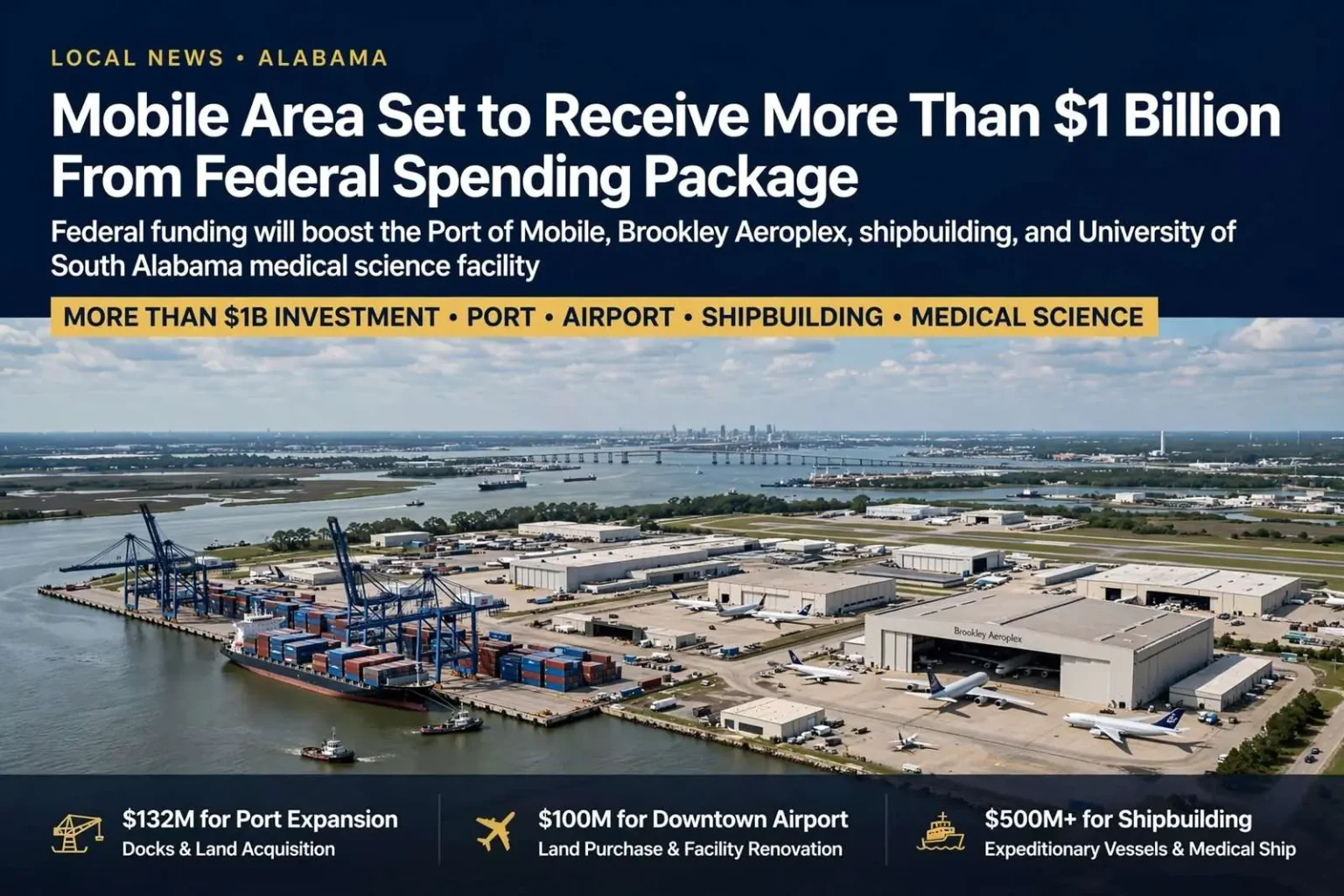
The Mobile area is positioned to receive more than $1 billion in federal funding after Congress passed a package of spending bills this week, according to Sen. Richard Shelby, R-Tuscaloosa. The legislation cleared the U.S. House on Wednesday and the Senate on Thursday by a vote of 68-31, sending it to President Joe Biden’s desk.
The package represented the product of the annual appropriations process, in which Congress funds the federal government agency by agency and, along the way, directs specific sums to projects in members’ home states. As the top Republican on the Senate Appropriations Committee, Shelby has used his seniority over the years to steer an extraordinary share of federal investment toward Alabama, and the Mobile area — home to the state’s port, its largest shipbuilder and a growing aerospace sector — has been among the chief beneficiaries. The vote of 68-31 reflected the bipartisan support that appropriations bills typically command once final, with 31 senators opposing the measure’s overall spending level.
“Throughout every appropriations process, I have worked diligently to create the conditions for growth and success throughout the state of Alabama, and that certainly includes Mobile,” Shelby said in a statement. “I am very proud to announce that this package includes more than $1 billion in funding for the Mobile area, with $300 million for improvements to the Port and the airport. South Alabama stands to benefit immensely from these investments. Mobile has a lot of potential, and this funding will improve upon its existing infrastructure to transform our coast and the entire state.”
The declaration capped months of negotiation over the fine print of the spending bills, in which individual line items for Mobile-area projects were embedded within larger agency budgets. For local officials, the announcement is the moment the abstract appropriations process becomes concrete: land purchases, dredging contracts, building construction and shipbuilding work that will be let over the coming years, each with contracts, payrolls and suppliers attached to the Mobile economy.
Among the largest allocations, the Mobile Downtown Airport will receive $100 million to purchase land, conduct surveys and renovate and relocate on-site facilities.
The Downtown Airport sits on the site of the former Brookley Air Force Base, the sprawling military installation that closed in the 1960s and has since been redeveloped into the Brookley Aeroplex, one of the largest urban airport-industrial sites in the country. The field has become a cornerstone of Mobile’s aerospace economy, hosting major aircraft assembly and maintenance operations along with aviation suppliers. An investment of $100 million in land acquisition, surveys and facility renovation signals an expansion phase for the airport — more acreage, more modern facilities and more capacity for the aviation companies that have made southwest Mobile County a national center of aerospace manufacturing employment.
The Port of Mobile is set to receive $132 million for land acquisition, dock construction and site development, funding that officials say will help the port keep pace with growing shipping demand along the Gulf Coast.
The port is one of the busiest deepwater ports on the Gulf of Mexico, handling containers, coal, timber, chemicals and steel through terminals along the Mobile River and the city’s harbor. Container traffic has grown steadily as global shipping patterns have shifted and as the port’s modern container terminal has attracted larger vessels and new services. Expanding docks and developing land around the terminals is how a port converts that demand into capacity — and every acre of new terminal space means more cargo moving through Mobile, more longshore hours, more trucking and rail connections, and more warehouse construction across the region.
The U.S. Army Corps of Engineers will receive $65 million for dredging activities in the region, along with $50 million earmarked for maintaining donor and energy transfer ports, work tied to keeping shipping channels navigable for the vessels that move cargo through Mobile Bay.
Dredging is the unglamorous work that keeps a port alive. Mobile Bay’s shipping channels accumulate silt continuously, and the giant vessels calling at the port require guaranteed depths at every tide; without constant maintenance dredging, ships must lighten their loads, which raises the cost of every ton of cargo. The Corps’ dredging budget for the region covers the ship channel through the bay and its approaches, and the funding for donor and energy transfer ports maintains the specialized terminals where bulk commodities — petroleum products, chemicals and other energy cargo — move between ships, pipelines and storage. For the port’s customers, that money is the difference between Mobile as a reliable deepwater gateway and Mobile as a port with depth restrictions.
More than $500 million of the package is directed toward the construction of one additional Expeditionary Fast Transport vessel and an Expeditionary Medical Ship, continuing a long relationship between Mobile’s shipbuilding industry and federal defense contracts.
The shipbuilding allocation anchors Mobile’s position in the nation’s naval-industrial base. Expeditionary Fast Transport vessels — high-speed catamarans that move troops, equipment and supplies at transit speeds other transports cannot match — have been a Mobile-built program for years, with successive hulls constructed at the city’s riverfront yards. The Expeditionary Medical Ship, a newer class, extends that work into a floating hospital capability designed to support Marine Corps operations in the Pacific. Each vessel represents years of work: hundreds of welders, pipefitters, electricians and engineers on steady payrolls, plus orders flowing to suppliers across the Gulf Coast.
The University of South Alabama will receive $60 million to construct a new medical science building, along with an additional $81 million in federal funding directed to other area projects in the package.
For the university, a $60 million medical science building is among the largest single facility investments in its history. USA’s medical school trains physicians for the entire central Gulf Coast region, and its teaching hospital complex is one of Mobile’s largest employers and its primary provider of specialized care. A new medical science building expands classroom, laboratory and research space at a time when medical education has grown more technology-dependent and when the region’s physician shortages make expansion of the medical pipeline a pressing public need. The building will anchor the university’s academic medical corridor and support the biomedical research enterprise that draws faculty and grants to Mobile.
What the Money Means for Mobile
Taken together, the allocations trace a deliberate map of Mobile’s economic future. The port and the Corps funding deepen the harbor economy that has defined the city since its founding. The airport money builds on the aerospace cluster that has replaced the old Brookley base with private industry. The shipbuilding funds sustain the yards that carry Mobile’s name onto the Navy’s muster lists. And the university’s medical building invests in the institutions that train the region’s doctors and anchor its health economy.
The economic ripple effects extend well past the job sites. Construction spending at that scale flows through local contractors, equipment suppliers and service businesses, and the permanent capacity the projects create — deeper channels, bigger terminals, more hangar space, new labs — raises the ceiling on what Mobile companies can compete for in the years ahead. Port growth supports trucking and rail employment across south Alabama; aerospace expansion attracts suppliers who site their own facilities nearby; shipbuilding sustains apprenticeship pipelines that feed the region’s skilled-trades workforce.
For Shelby, whose appropriations career has been defined by steering federal investment toward Alabama, the package is the latest and among the largest entries in a ledger that includes harbor deepening, federal buildings, research funding and military construction across the state. For Mobile’s officials, the work now shifts from Washington to the home front: acquiring land, obligating the funds on schedule, meeting the environmental and contracting requirements that attach to federal money, and delivering projects that justify the investment. The billion-dollar figure will be repeated in speeches; the measure of success will be the cranes on the skyline and the ships on the ways over the coming years.
The appropriations process that produced the package is worth understanding, because it explains how a city ends up with a billion dollars. Each year, Congress must pass a series of spending bills covering the federal government’s discretionary programs, and members of the Appropriations Committees — where Shelby has long been Alabama’s advocate — submit requests for specific projects in their states. The committee staffs negotiate which requests survive, agency officials testify about their priorities, and the final bills that reach the floor carry line items that rarely make headlines until the vote is done. Once enacted, the money flows through the agencies — the Corps of Engineers, the Navy, the Transportation Department — which obligate it through contracts over the following fiscal years.
The Senate’s 68-31 vote reflected the broad support such packages typically receive, along with the perennial argument over their size. Supporters pointed to the infrastructure needs the bill addresses; opponents criticized the overall spending level. For Mobile, the distinction is academic: once the president signs, the local line items become obligations the agencies are required to work toward, and the city’s task is to be ready to receive them.
Local readiness has been building for years. The port authority has planned terminal expansions in step with container growth; the airport authority has marketed Brookley’s expansion land to aerospace prospects; the university has been planning its medical sciences needs as enrollment and research activity have grown. Federal money of this magnitude rewards sponsors who have designs, permits and land options in hand, because agencies can obligate funds only as quickly as projects can absorb them. The $300 million set aside for port and airport improvements alone will generate years of construction activity across the harbor district and the Brookley Aeroplex.
The long arc of federal investment in Mobile runs from the city’s origins as a colonial port through the Navy yards of the Second World War to today’s mix of maritime commerce, aerospace manufacturing and military shipbuilding. Each generation of federal spending has left permanent infrastructure behind, and each has built the case for the next. This week’s package — with its billion-dollar total, its ship hulls, its dredging funds and its medical sciences building — writes the newest chapter in that history, and Mobile’s economy will be reading it for years to come.