Fallen Bienville Square Oaks Live On as Art in Downtown Mobile
Oak trees felled by Hurricane Sally in Bienville Square became art by regional artists, debuting at downtown Mobile's March 11 Art Walk.
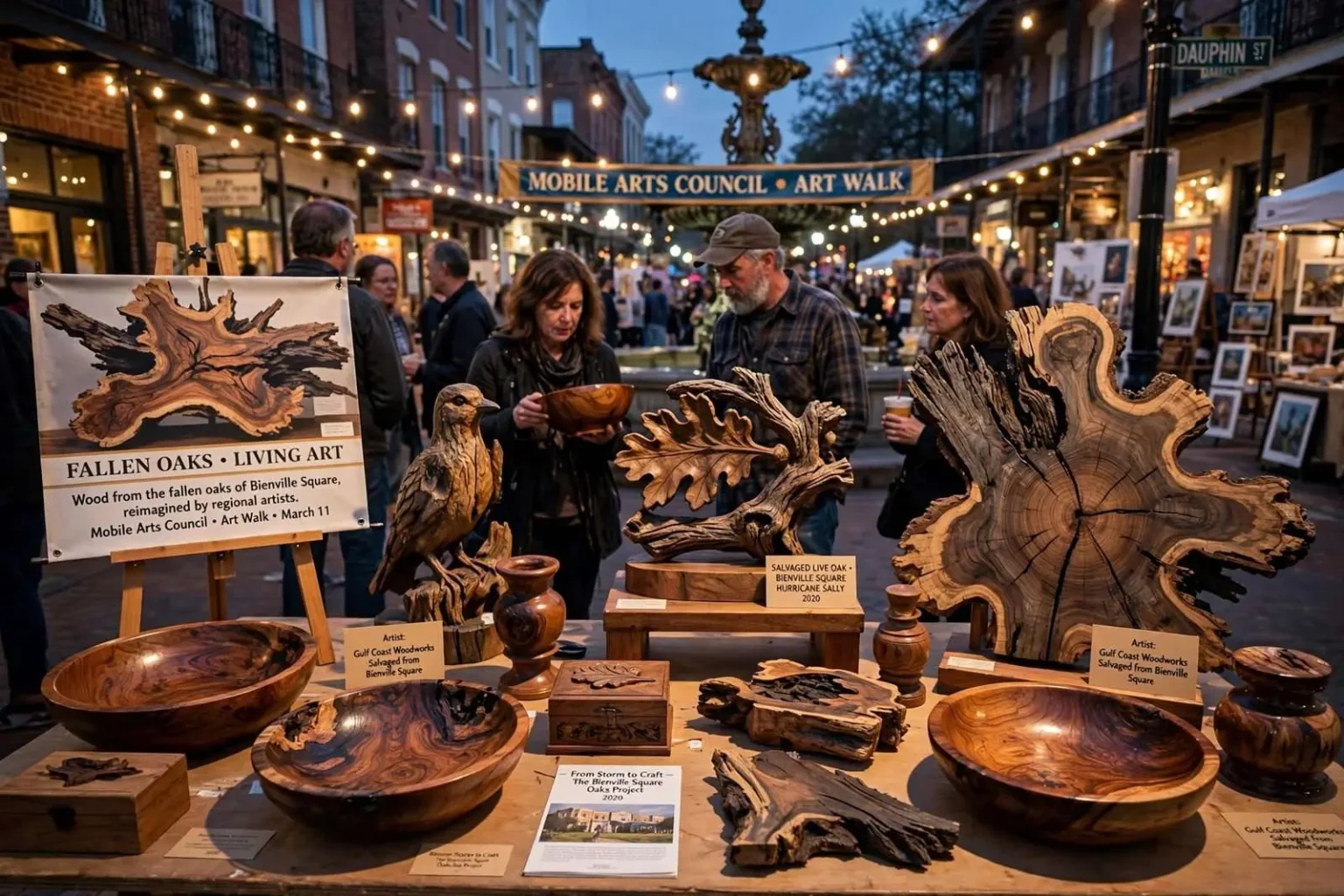
The iconic oak trees lost from Bienville Square after Hurricane Sally have found a second life. Wood salvaged from the storm-damaged trees was transformed into a collection of art pieces by artists from across the region, and the works were put on public display for the first time at downtown Mobile’s Art Walk on Friday, March 11.
Mayor Sandy Stimpson highlighted the project in his nightly message on Wednesday, March 9, noting that he had seen the finished pieces that morning. According to the mayor, craftsmen and artists from around the region used the downed oaks to create woodwork and art that now carries the story of the storm and the square’s beloved canopy.
For a city that watches its oak canopies the way other cities watch their skylines, the project turned grief into craft. The trees that shaded generations of Mobilians — lunch breaks on the benches, Mardi Gras gatherings, kids climbing the low branches — will now live on in forms that can sit in homes, offices and public spaces, each piece carrying grain and history from the square itself.
A Community Effort
The Mobile Arts Council helped bring the project to life, recruiting artists who produced an impressive set of pieces from the salvaged wood. City officials shared photos of some of the works, though they noted those images represented only part of what was created for display — a collection that grew as word of the project spread through the region’s arts community.
Artists who work in salvaged wood describe the material as unlike anything purchased new. Storm-felled live oak carries decades of growth rings, weathered edges and character that only time can produce, and working with wood from a known place — a beloved downtown square — changes the act of making into something closer to commemoration.
The Arts Council’s role connected the city’s storm response to its cultural infrastructure. Rather than hauling every downed trunk to the mulch pile, officials saw an opportunity, and the Council’s artist network had the skills to take it. The result is a model other storm-hit communities have studied: salvage, commission, display.
Hurricane Sally, which came ashore in September 2020, stripped Mobile of many of its mature live oaks, including treasured trees in historic Bienville Square in the heart of downtown. The loss was felt deeply in a city where the squares and their centuries-old oaks are central to local identity.
From Storm Debris to Showcase
Rather than letting the fallen timber go to waste, the city and its arts partners turned it into lasting works that commemorate both the storm and the resilience of the community. The pieces debuted during the March 11 Art Walk, one of downtown Mobile’s regular celebrations of local art and culture — a fitting stage, since the walk already draws the crowds most likely to appreciate the story in the wood.
Art Walk nights transform lower Dauphin and the surrounding streets into an open gallery, with studios, shops and pop-up displays welcoming thousands of visitors. Giving the oak works their debut there guaranteed they would be seen not as storm cleanup but as civic art — a debut consistent with their meaning.
For longtime Mobilians, seeing the oaks reappear as sculpture and woodworking offered a tangible way to keep a piece of the square’s history alive. Residents who remember the canopy’s shade will find, in the grain of a bowl or the curve of a carving, a physical link to the trees they lost.
The Square and Its Trees
Bienville Square has been downtown Mobile’s gathering green since the 19th century, named for the city’s French colonial founder. Its live oaks were more than landscaping: they anchored the square’s identity, shaded its fountain and bandstand events, and appears in generations of photographs, postcards and family albums. Losing them in a single September night registered across the city as a personal loss.
Hurricane Sally’s damage to the urban forest extended well beyond the square. The storm’s slow track and sustained winds toppled trees across Mobile and Baldwin counties, damaging homes, power lines and streetscapes. Municipal crews spent months clearing debris, and the fate of the salvageable timber became part of the recovery conversation.
Live oaks, famously, are resilient — their twisted, wind-trained forms are why they have anchored Gulf Coast streetscapes for centuries. But even they have limits, and Sally’s winds crossed them for trees that had stood through many prior storms. Replanting followed, with the city and neighborhood groups committed to restoring the canopy even though its replacement timeline is measured in generations.
That is what makes the art project resonate. A sapling planted in 2021 will need decades to offer the shade its predecessors did; a piece made from the old wood needs no time at all. Together they bracket the recovery — one growing toward the future, the other preserving what the storm took.
Salvage projects of this kind follow a practical pipeline that Gulf Coast communities refined after years of storms. Once the safety hazards are cleared and insurance documentation is complete, usable hardwood is set aside rather than chipped. Mills or woodworkers then slab the trunks, and the drying process — which can take months for thick oak — determines when the material is ready for artisans to shape.
Live oak is notoriously difficult to work. Its dense, often twisted grain resists straight milling and dulls tools, but that same character produces the dramatic figuring that makes salvaged oak pieces unmistakable. Artisans who accepted the Bienville Square wood took on that challenge knowingly, and the resulting works show both the difficulty and the reward.
The city’s decision to route the timber toward artists rather than disposal was also a budget-conscious one. Downed trees are, in the normal course, an expense: cutting, hauling and grinding all cost money. Redirecting salvageable wood into a commissioned art program converts a liability into cultural capital — and, in a city that markets itself on charm and history, into a story worth telling.
The Arts Community Steps Up
The Mobile Arts Council’s recruitment effort drew woodworkers, carvers, turners and mixed-media artists from around the region. Participants ranged from established names in the Gulf Coast arts scene to emerging makers for whom working with the square’s wood was an honor as much as a commission.
Each artist approached the material differently. Some turned bowls and vessels that showcase the grain in its purest form. Others carved figures, built furniture, or incorporated the oak into pieces that mix wood with other media. The unifying thread is provenance — every work in the collection can trace its origin to a specific square in downtown Mobile and the storm that reshaped it.
Officials said the photos released by the city captured only part of what was created, suggesting the full collection spans a range of sizes, prices and styles. That breadth widens who can own a piece — from collectors seeking a major work to residents who want a small carving that belonged, in a sense, to the square they love.
The display at Art Walk doubled as an introduction for the works before they move on to whatever comes next — purchase, placement or further exhibition. Cities that have run similar programs have seen pieces placed in libraries, council chambers, museums and private collections, each placement spreading the original tree’s story a little further.
Replanting and the Long Recovery
The art project runs alongside the slower work of restoring the canopy itself. Live oaks planted after Sally will take decades to match the spread of the trees they replace, and arborists emphasize that the urban forest lost in a single night represents more than a century of growth. That arithmetic is why preservation efforts — and commemorative projects like this one — matter so much to residents.
Bienville Square’s recovery has been part of the city’s broader downtown revitalization, with the square continuing to host the gatherings that define it — from lunchtime crowds to the city’s celebrated Mardi Gras season, when downtown’s squares and streets fill with revelers. New trees, once established, will grow back into that life; the art pieces ensure the old trees remain part of it regardless.
The mayor’s decision to spotlight the project in his nightly message reflected its civic weight. Cities recovering from hurricanes track progress in debris tonnage and insurance claims, but residents experience recovery in images: a square with trees again, a downtown that looks like itself. A project that turns lost oaks into lasting works speaks to that experience directly.
For the artists, the March 11 debut was the culmination of months of work with a material that arrived with a story attached. For the city, it was proof that a community can respond to loss in more than one register — clearing, rebuilding and, when the material allows, creating. The oaks of Bienville Square shaded the city for generations; through the hands of the region’s artists, they will continue to shape it in a different form.
Residents who missed the Art Walk debut can expect the works to appear in additional settings as the collection moves through its display schedule, with the city and the Arts Council sharing details as pieces find their permanent places. Each one, whatever its form, carries the same origin: a beloved square, a September storm, and a city that chose not to let its oaks disappear without a trace.