Construction Set to Begin on Foley’s $16 Million Sports Complex Fields
Heavy equipment is set to break ground on 15 athletic fields at Foley's planned sports tourism complex after the city approved a construction contract.
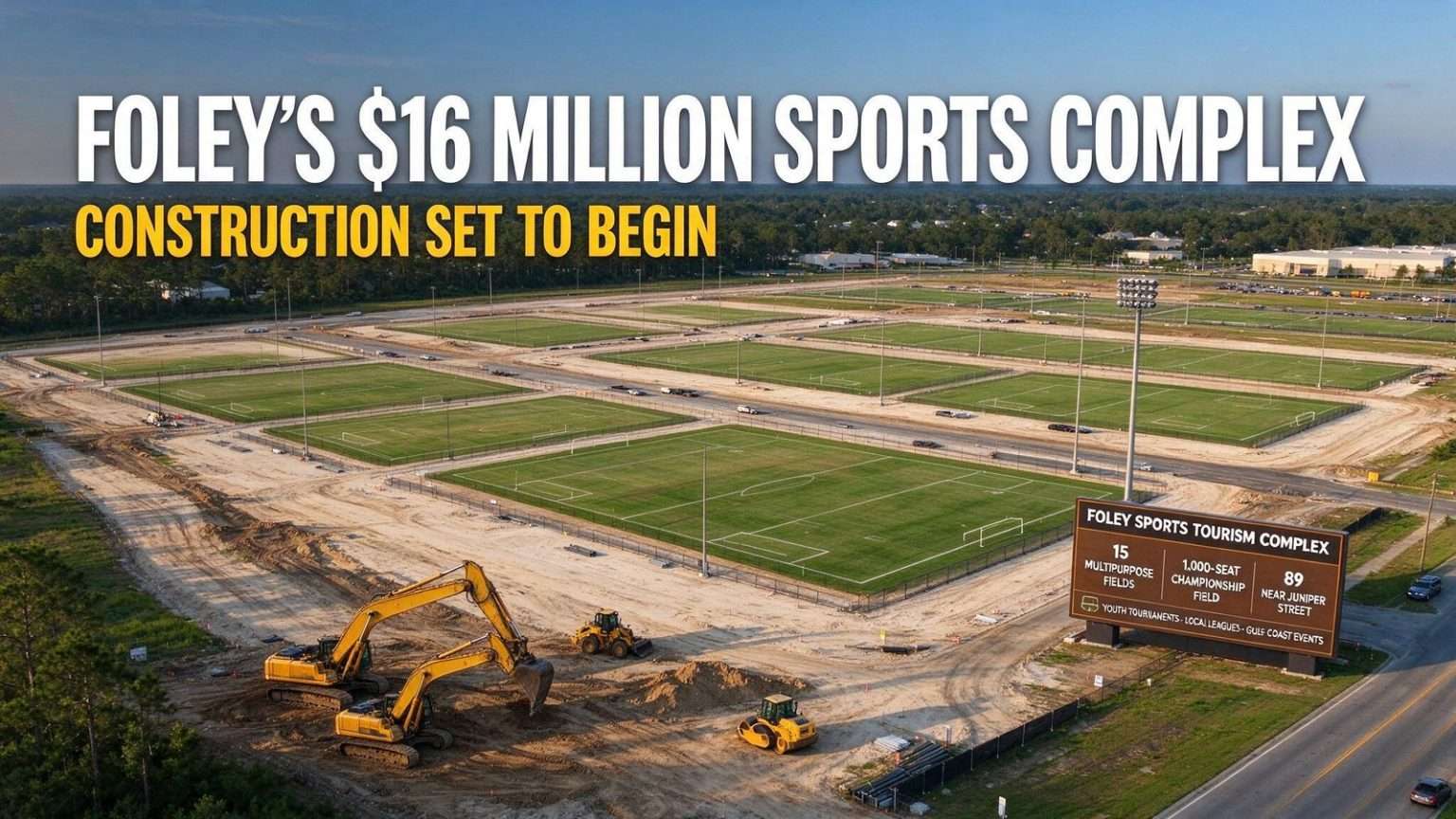
Construction crews are expected to begin reshaping 89 acres near Juniper Street in Foley within the next two weeks, after the city-created Public Athletic and Sports Facilities Cooperative District approved a construction contract to build the athletic fields portion of the long-planned Foley Sports Tourism Complex.
The finished project will include 15 multipurpose athletic fields and an adjacent 1,000-seat championship field, forming half of a larger sports and entertainment development planned north of Baldwin County 20 between Juniper Street and the Foley Beach Express. The other half of the site is set aside for a planned 104,000-square-foot Foley Events Center, which has not yet been approved for construction.
The complex sits next to the proposed $200 million Blue Collar Country entertainment development. The full sports complex is projected to cost about $27 million, with roughly $16 million dedicated specifically to the athletic fields and related amenities.
The scale of the field layout reflects the demands of youth sports tournaments, which have become a major economic driver for Gulf Coast communities. Multipurpose fields designed to convert between soccer, lacrosse, football and other uses allow a complex to host back-to-back weekend events across spring, summer and fall, keeping the grass in play and the visitors arriving. A championship field with permanent seating gives tournament organizers a showcase venue for finals, a requirement many national and regional sanctioning bodies look for when awarding events.
The Contracts Behind the Build
This week, the cooperative district approved a $9.5 million design-build contract with Missouri-based Killian Construction Company, along with a separate $1.94 million lighting contract with Iowa-based Musco Lighting.
The design-build approach bundles design and construction under a single contract, a structure cities increasingly favor for complex projects because it fixes responsibility in one place and compresses the schedule. Rather than completing architectural plans, bidding them separately and managing a designer-contractor split, the city’s district gets a single firm accountable for delivering the fields at the agreed price and date — an important protection when the goal is to have turf ready for a specific tournament season.
Lighting is no small piece of a tournament complex’s economics. Musco, one of the nation’s leading sports lighting firms, supplies systems that determine how many hours a day fields can be used; lighted fields can host evening games that multiply the number of teams a complex accommodates on a given weekend and keep visiting families in local hotels and restaurants later into the night.
The cooperative districts overseeing the project are quasi-governmental entities that let Foley borrow money and levy special fees for public projects while limiting the city’s direct financial risk. In late December, the Foley City Council approved loaning nearly $2.6 million to the districts to purchase 62 acres for the athletic fields and 17 acres for the events center from Blue Collar Destinations LLC, with bonds issued to cover the broader project cost.
The land purchase itself illustrates how carefully the project was staged. Buying the athletic fields acreage and the events center site in a single transaction preserved the unified master plan, keeping control of both halves under public ownership so that private development next door could not fragment the campus. The loan from the council bridged the districts’ immediate need while the bond structure put the long-term repayment on the revenue stream the complex is designed to generate.
The cooperative district structure is a familiar instrument in Alabama municipal finance. Under state enabling law, cities can create these districts to acquire land, issue bonds and collect dedicated fees — often hotel or lodging-related revenues within a defined district — to repay what is borrowed. Because the debt sits with the district rather than on the city’s general obligation books, a project can be financed against the revenue it is expected to generate, protecting taxpayers in the city’s general fund if projections fall short.
The city had already raised its municipal lodging tax from 4 percent to 7 percent back in August 2013 to help fund the eventual repayments. That linkage — visitor taxes paying for visitor-drawing facilities — is the core logic of sports tourism finance. Every tournament weekend fills hotels, restaurants and gas stations with out-of-town spending; taxing a portion of that spending to build the fields that attract it creates a cycle in which the facility largely pays for itself through the visitors it brings.
Foley’s position made the investment a natural fit. The city sits along the Beach Express corridor and U.S. 98 between Interstate 10 and the Gulf beaches, drawing on the enormous flow of summer traffic headed for Gulf Shores and Orange Beach. Families already passing through with weekends committed to travel sports provided exactly the audience a tournament complex needs, and Foley’s hotels and retailers stood to capture spending that otherwise would have rolled past on the way to the sand.
The city’s own history pointed the same direction. Foley grew up as a railroad and agricultural crossroads and remade itself over recent decades as the retail and service center of south Baldwin County, learning early that whoever provides the destination controls the traffic. The sports complex applies that lesson to a new generation of visitors: instead of depending on travelers already headed to the beach, Foley would become the reason for the trip on tournament weekends, with its name on the brackets and its hotels on the itineraries.
Mayor John Koniar said he was encouraged that construction and lighting contracts were finally in place after delays pushed the project’s timeline back, with field construction expected to bring the complex toward readiness for play the following year. The mayor’s optimism carried the weight of a project that had been talked about for years before equipment finally moved onto the site — a common arc for public-private developments of this scale, where land assembly, financing and planning must align before the first blade of grass is turned.
What the Complex Means for Foley
The economic arithmetic behind tournament complexes is well established across the Southeast. Weekend youth sports events bring hundreds of families who stay in hotels, eat in local restaurants and shop between games, and unlike one-time festivals, tournaments recur year after year on published schedules that make planning predictable for hotels and venues. A complex capable of running 15 fields simultaneously can draw thousands of visitors on a peak weekend, multiplying the effect of the lodging tax that funds it.
The unbuilt half of the plan — the 104,000-square-foot events center — remains the next decision point. Indoor event space of that size would let the complex operate through the summer heat and winter months when outdoor tournaments are impractical, hosting everything from conventions and trade shows to indoor sports and concerts. Approval for that phase had not yet come, and city officials have framed it as a separate decision to be made as the fields phase demonstrates the complex’s drawing power.
Its proximity to the proposed Blue Collar Country development adds a second layer to the site’s potential. The $200 million entertainment project, planned on adjacent land, was pitched as a destination mixing entertainment, dining and attractions — the kind of development intended to give travelers on the Beach Express corridor another reason to stop and stay. Sports tournaments and entertainment venues feed each other: visiting families with free evenings between games look for things to do, and destinations with attractions fill more hotel nights than bare tournament sites.
For local families, the complex promised a benefit beyond tourism dollars. Foley’s youth leagues have long competed for practice and game space against the city’s rapid growth, and a 16-field complex — 15 multipurpose fields plus the championship field — gives local programs access to first-rate facilities during the weekdays when tournaments are not running. The same fields that draw out-of-town visitors on weekends serve Foley’s own children after school, a dual use that strengthens the case for the investment in residents’ eyes.
The schedule pressure on the fields phase is real and specific. Turf establishment windows, irrigation installation and league calendars all constrain when grass can be grown and when it can bear traffic, and a missed growing season can push playable dates back a full year. Design-build delivery was chosen in part for that reason: with Killian responsible for both drawings and dirt work, sequencing decisions that would otherwise bounce between an architect and a contractor get made in one office, on one timeline.
As the crews move onto the 89 acres near Juniper Street, the project marks one of the largest single investments in Foley’s history and a bet on the continued growth of Baldwin County. The city that built itself into the commercial hub of south Baldwin County is now aiming to become a hub of the region’s fastest-growing industry — the business of bringing people to the Gulf Coast and giving them reasons to stay a little longer.