Investigation Underway Into Death of East Brewton Man Found in His Home
Alabama state troopers and local investigators are probing the death of a 32-year-old East Brewton man found dead this week inside his home on Forrest Avenue.
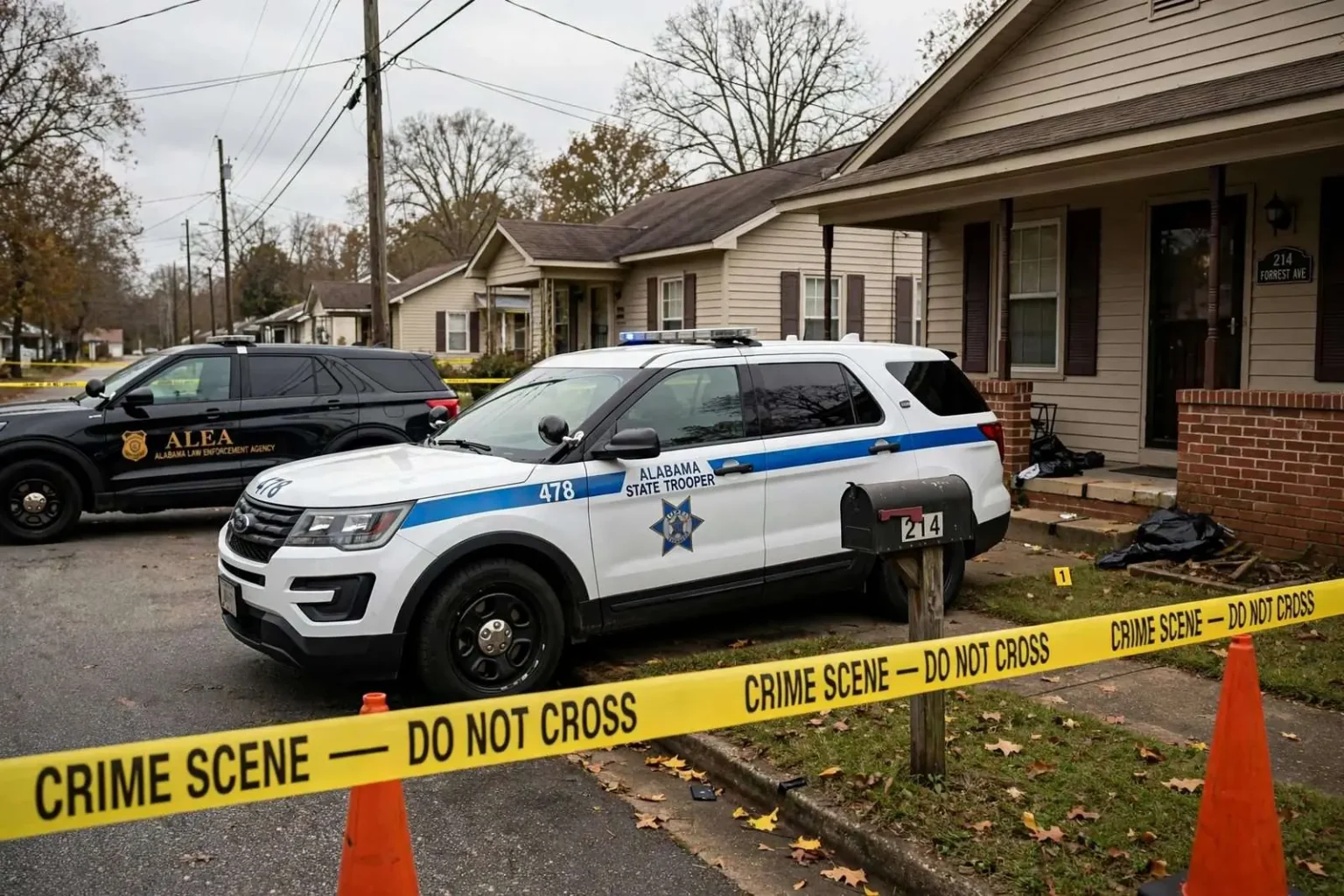
State and local investigators are working to determine what led to the death of a 32-year-old East Brewton man found dead inside his home, according to authorities. The victim was identified as Cory Brian Moncrief.
Alabama State Trooper Jamie Maloy said Moncrief was discovered in his home on Forrest Avenue after failing to show up for work, prompting a welfare check that led to the discovery. Court records show Moncrief had listed an address near Forrest Avenue and Mantel Street during a court appearance earlier this year.
Maloy declined to say definitively how Moncrief died but confirmed investigators do not believe the death was the result of natural causes. Local reporting indicated Moncrief appeared to have been shot, though state troopers had not formally confirmed that detail as of the latest update.
The case unfolded in a community unaccustomed to such investigations. East Brewton, a small city that sits just across the Conecuh River from its larger neighbor Brewton in Escambia County, has seen relatively few homicide investigations in recent years, and the case has drawn attention in the tight-knit community.
How the Investigation Began
The sequence that led to the discovery — an employee not appearing for work, followed by a request for a welfare check — is a common starting point in deaths that occur out of public view. When no one hears from a person who is reliably present, family members, employers or neighbors often call authorities to check on the residence, and officers arriving for that purpose are frequently the first to find the deceased.
Once investigators determined that the death was unlikely to be natural, the case moved into a different procedural lane. What began as a coroner’s removal becomes a crime scene: the residence is secured, investigators document the scene, and evidence teams collect whatever the interior and exterior of the home can yield. Maloy declined to release details about what investigators found, citing the ongoing inquiry.
Moncrief’s body was sent to the Escambia County Medical Examiner’s Office for an autopsy, and investigators said any evidence gathered during the inquiry will be turned over to the Escambia County District Attorney’s Office for review. The autopsy is expected to establish the official cause and manner of death — findings that will anchor the legal case if one develops.
The Alabama Law Enforcement Agency is assisting with the investigation alongside state troopers, and additional information was released as the inquiry progressed. ALEA’s involvement provides the kind of resources a small municipal police force rarely has on hand: crime scene specialists, intelligence analysts and investigative personnel who can sustain a case for weeks.
An Active Case in a Small City
As of the latest update, no arrests had been announced and authorities had not released a possible motive or suspect information. Investigators have kept most details of the case closed to the public, a posture that is standard in the early stages of a death investigation when disclosures could compromise interviews or evidence collection.
Trooper Maloy said the investigation remains active and additional details would be released as warranted, cautioning that early findings in death investigations can change as evidence is analyzed further. Autopsy results, forensic testing and witness interviews all take time, and investigators generally avoid locking onto a narrative before the science and the statements align.
The Agencies on the Case
The involvement of the Alabama Law Enforcement Agency reflects how smaller Alabama jurisdictions handle major cases. ALEA, the state’s umbrella law enforcement department formed to consolidate state-level policing functions, can offer municipal departments investigative support, forensic services and manpower that would otherwise come at prohibitive cost. When a death investigation exceeds a city’s capacity, state troopers and ALEA agents routinely join — and in some cases lead — the work.
The Escambia County District Attorney’s Office will ultimately review whatever the investigation produces. Prosecutors weigh the evidence for charges, guide investigators on what additional proof a case may need, and, if an arrest follows, take the matter to an Escambia County grand jury. The handoff from investigators to prosecutors is a running process rather than a single event, with detectives consulting the DA’s office as findings accumulate.
Autopsy findings from the medical examiner’s office are a linchpin in that chain. The report establishes cause and manner of death with the authority of a forensic examination, and its conclusions can confirm or redirect an investigation’s course. Toxicology testing, which frequently accompanies autopsy work in unexplained deaths, can add weeks to the timeline before final findings are issued.
A Community Taking Stock
East Brewton sits on the western bank of the Conecuh River, separated from Brewton by a stretch of water and the bridge that links the two communities. With a population measured in the low thousands, it is the kind of place where residents know one another’s families, and where a death under investigation in a residential neighborhood becomes the subject of conversation at grocery stores, churches and ball fields within hours.
Neighbors and local officials have not commented publicly on the investigation, and authorities have asked anyone with information to come forward as the case continues. In small communities, that appeal carries particular weight: the people most likely to have noticed something unusual are also the victim’s neighbors, and investigators depend on their willingness to share what they saw.
The case remains open, with investigators continuing to gather evidence and interview witnesses in the days following the discovery. Officials have not said whether they believe the death involved someone known to the victim, a detail that often shapes both the investigation’s direction and a small town’s sense of whether the danger has passed.
For East Brewton residents, the practical advice from authorities has been to report anything relevant rather than to speculate. Tips in cases like this one can come from fragmentary observations — a vehicle seen on the street, a stranger in the neighborhood, an overheard remark — and investigators emphasize that even minor details can prove significant once a fuller picture emerges.
As the inquiry proceeds, additional information will come through the troopers and ALEA officials coordinating the response, and any charges that follow will be handled through the Escambia County court system, where the case would join the county’s docket as its most recent major investigation.
What a Welfare Check Becomes
Deaths discovered through welfare checks follow a well-established procedural path in Alabama. The responding officers secure the scene and notify investigators, who must determine whether the circumstances warrant treating the death as a criminal matter. Statements from the person who requested the check — in this case, apparently an employer noticing an absence — become part of the timeline investigators reconstruct around the victim’s final days.
That reconstruction typically includes canvassing the neighborhood, reviewing the victim’s recent contacts and movements, and documenting anything in the residence that bears on the circumstances. Investigators will also seek records — phone, financial and otherwise — that can establish where the victim was and whom he spoke with in the period before his death. Each of those threads takes time, which is why cases of this kind often go days or weeks without public announcements.
The distinction between confirmed facts and unconfirmed detail has been a running theme in public discussion of the case. Local reporting that the victim appeared to have been shot has circulated widely, but troopers had not verified that account, and officials have urged restraint in drawing conclusions before the medical examiner’s findings are complete. In death investigations, premature certainty about the cause can shape witness expectations and complicate later proceedings.
Escambia County’s Investigation Landscape
Escambia County, with Brewton as its seat, stretches along the Alabama-Florida line in the state’s southwestern corner. Its law enforcement mix — the county sheriff’s office, municipal departments in Brewton and East Brewton, state troopers and ALEA — means major cases are almost always multi-agency affairs, with jurisdiction determined by where evidence and suspects lead.
Homicide investigations are rare enough in the county’s smaller communities that each one draws sustained public attention, and the pace of the justice process can test community patience. From the first discovery to autopsy results, forensic testing, arrest and trial, a resolved case typically takes many months, and authorities generally release information only as it becomes reliable.
The victim’s age, 32, places him in the middle of a working life, and the fact that his absence was noticed by an employer underscores how quickly a death in a small community registers across the institutions that knew him. Fellow workers, family members and neighbors have all been left to piece together the same question investigators are working formally to answer.
Authorities have not scheduled any public updates, but the standing request remains for anyone with knowledge of the case to contact investigators or leave information through the agencies coordinating the response. As with any open death investigation, officials say details will be released only when they will not jeopardize the inquiry — and in the meantime, the work continues out of public view, on Forrest Avenue and in the offices of the state’s forensic and prosecutorial systems.