Escambia County Crash Near East Brewton Kills Florida Driver
A young Florida driver died when her car ran off rural County Road 55 south of East Brewton late on a Friday night, Alabama troopers reported.
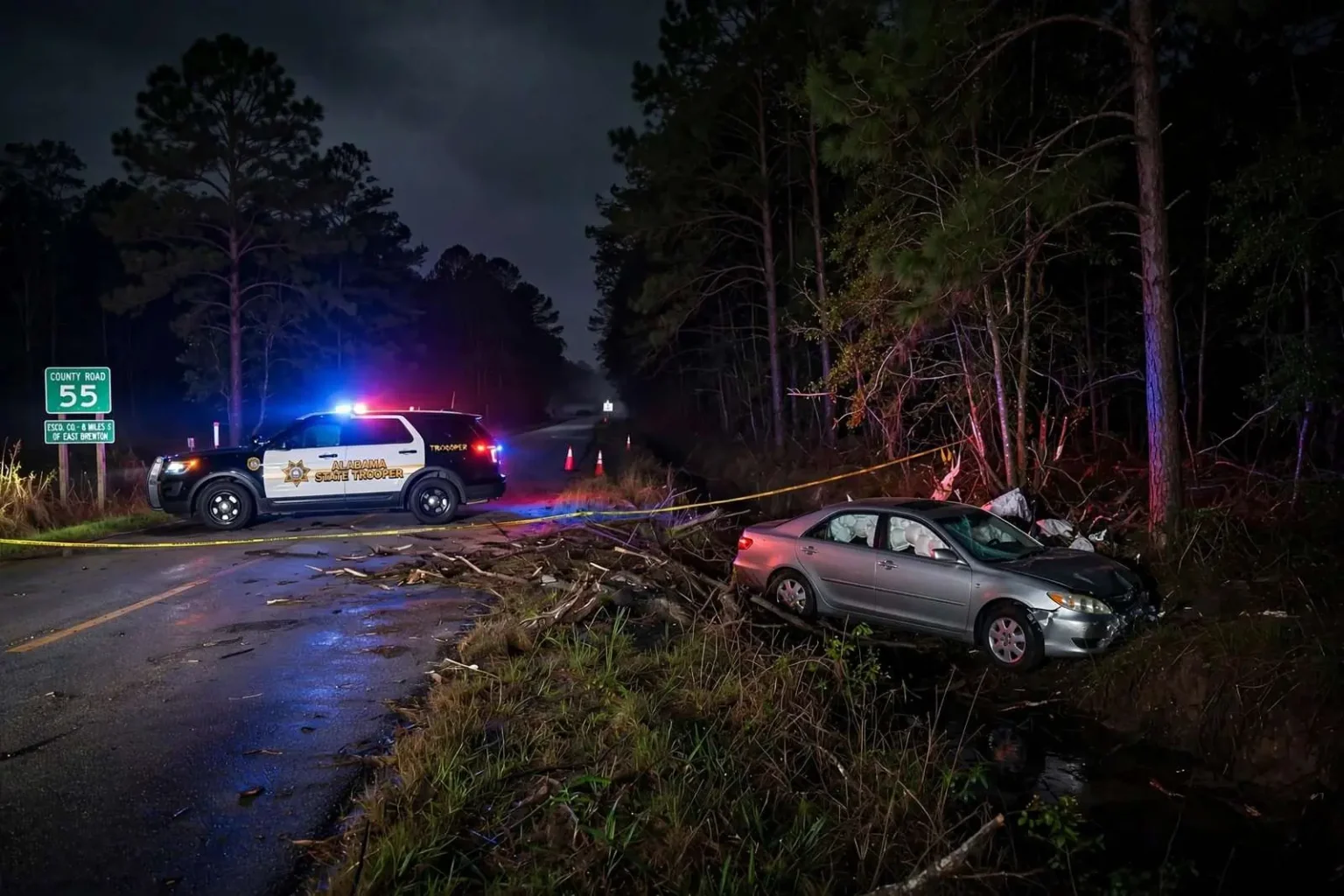
A single-vehicle wreck on a rural Escambia County road late on a Friday night killed a young Florida woman, according to Alabama troopers who continue to investigate the circumstances of the crash. The death adds another name to the toll on South Alabama’s rural two-lane highways, where darkness, narrow pavement and unforgiving roadsides leave little room for error.
Mary Emma Grace, 24, of Gulf Breeze, Florida, died after the car she was driving left the roadway on County Road 55, about eight miles south of East Brewton, state safety officials said. The wreck happened around 8 p.m. as Grace was behind the wheel of a 2003 Toyota Camry that ran off the road. She was pronounced dead as a result of injuries from the crash.
Alabama’s Department of Public Safety, which oversees the investigation through its Highway Patrol division, has not released additional details about what caused the vehicle to leave the road. Troopers will document the scene, examine the vehicle and interview anyone who saw the Camry before the wreck before drawing conclusions, a process that can take weeks in fatal cases. No other vehicles were reported involved in the crash.
A Rural Road With Little Margin for Error
County Road 55 winds through a mostly rural stretch of Escambia County south of East Brewton, an area popular with drivers moving between the Florida Panhandle and inland Alabama. Like many county roads in this part of South Alabama, it is narrow, largely unlit at night, and bordered by ditches and tree lines that leave little margin for a vehicle that drifts off the pavement, particularly after dark.
Roads of that design are common across the county, a patchwork of two-lane routes laid out generations ago to connect farm communities, sawmill towns and county seats. They were built for the traffic of their era — slow-moving local vehicles in daylight — but they now carry commuters, log trucks and out-of-state travelers, many of them after dark. A car that leaves the pavement on such a road rarely finds a shoulder; it finds a ditch, an embankment or a tree within seconds.
By 8 p.m. on a rural county road, full darkness has settled in for much of the year, and the mix of curves, junctions and unlit stretches demands full attention from drivers unfamiliar with the route. Drivers coming north from the Panhandle cross into Alabama on roads that shift from Florida state highway standards to county-maintained pavement, sometimes with little warning of the change in surface, width or lighting.
What Investigators Will Examine
Alabama’s Department of Public Safety has not released additional details about what caused the vehicle to leave the road. Single-vehicle wrecks on rural highways are frequently tied to factors such as driver fatigue, unfamiliarity with an unlit road, a momentary lapse of attention, or an animal darting into the roadway, though officials caution that no cause should be assumed before an investigation is complete.
Troopers investigating a fatal single-vehicle crash work through a standard sequence: measuring and photographing the scene, marking the vehicle’s path off the roadway, examining tire marks and point of rest, inspecting the car for mechanical failure, and reconstructing speed from the physical evidence. Toxicology results, ordered in all fatal crashes, return from the state laboratory over the following weeks and often determine whether impairment was a factor.
The findings matter to more than the case file. Cause determinations feed into the state’s crash data system, which county engineers and state safety offices use to prioritize projects — where to add signage, clear sight lines, pave shoulders or target enforcement. Every fatal rural wreck becomes a data point in that process, and patterns across a county’s roads often emerge only after several such investigations accumulate.
The Broader Rural Road Problem
The crash adds to a familiar concern among South Alabama safety advocates and county road departments: many of the two-lane routes connecting small communities like East Brewton to the surrounding countryside were built decades ago and have not been widened or resurfaced to modern standards even as traffic, including out-of-state visitors headed to and from the Gulf Coast, has grown heavier over the years.
Escambia County’s road network reflects its history. The county grew around timber, rail and the Conecuh River watershed, and its routes follow the geometry of those industries rather than modern engineering standards. Narrow lanes, minimal shoulders and sharp curves were acceptable when speeds and volumes were low; at today’s speeds, the same geometry multiplies the consequences of any mistake. County commissions across the region balance those legacy roads against budgets that must stretch across hundreds of miles of pavement.
Rural crashes also tend to be deadlier than urban ones for reasons that have nothing to do with driver behavior. Higher speeds, longer response times for ambulances and fire crews, and greater distances to trauma care all push fatality rates up. A wreck on a city street that might produce injuries can be fatal on a remote county road simply because help is twenty minutes away instead of five. Safety planners call this the rural fatality gap, and it persists nationally even though most driving happens in cities.
The traffic itself is changing, too. Escambia County sits along corridors that funnel Panhandle beach traffic to and from inland Alabama, and on summer weekends the roads between Brewton, Flomaton and the state line carry vehicles from across the Southeast. Drivers unfamiliar with a road at night are overrepresented in rural run-off-road crashes, a pattern that repeats wherever tourism routes cross sparsely populated country.
Local Efforts to Reduce the Toll
East Brewton and the surrounding Escambia County community have seen periodic reminders of the risks posed by driving after dark on rural roads, and local officials often use crashes like this one to renew calls for improved shoulder maintenance, reflective lane markers, and better lighting at the most hazardous curves and intersections.
Those measures are inexpensive by road-building standards. Restriping with wider reflective lines, cutting back vegetation at curves, adding chevrons on sharp bends and upgrading signage all cost a fraction of reconstruction, and county engineers prioritize them because the reductions in run-off-road crashes are well documented. Lighting is reserved for the most dangerous junctions, where the cost of electricity and maintenance is justified by the crash history.
County road departments also depend on state and federal safety programs that fund low-cost improvements on rural routes. Alabama participates in federal highway safety initiatives that target lane-departure crashes specifically, since running off the road is the dominant fatal crash type on rural two-lane highways. Applications for those programs typically begin with exactly the kind of investigation now underway on County Road 55.
Remembering the Victim
Grace was 24 and living in Gulf Breeze, the small coastal city across Santa Rosa Sound from Pensacola. Her death reaches two states’ worth of communities — the Panhandle neighborhoods she called home and the Alabama county where the crash occurred. Fatal wrecks on rural connector roads draw friends and families from both sides of the line to memorial services and to the roadside markers that soon appear where the vehicle left the road.
For the family, the investigative timeline can feel slow: weeks pass between the crash and the official findings, and the complete picture of what happened often arrives only when the reconstruction report is finalized. Troopers and coroner’s offices across Alabama encourage families to stay in contact with the investigating post, which can share updates as reports and lab results come in.
What Drivers Can Take From It
Troopers ask that any witnesses to the wreck who have not already spoken with investigators come forward. Even partial observations — a car seen earlier on the route, its speed, its lights, the conditions at the time — can help investigators fix the timeline in a crash that left no other witnesses on the scene.
Safety officials use crashes like this one to repeat familiar advice that applies on every unlit rural road: slow down below the posted limit after dark, watch for deer and other animals at dawn and dusk, keep full attention on the pavement edge, and never assume a curve will hold its line. On narrow two-lane roads, the margin between a scare and a fatality is measured in feet of pavement. Headlights reveal only a limited stretch of road ahead, and a driver traveling at night effectively commits to whatever lies beyond the beam.
The Alabama Department of Public Safety typically completes its full crash reconstruction and toxicology review over the following weeks. When that work is done, the findings will join the state’s record of rural road crashes — another entry in the case files that county engineers, safety advocates and troopers read together as they work to keep South Alabama’s two-lane roads from claiming more lives.