Mobile County Health Officials Confirm Human Case of Eastern Equine Encephalitis
A 66-year-old Mobile County man remains hospitalized after testing positive for Eastern equine encephalitis, a rare but severe mosquito-borne illness.
Health officials in Mobile County have confirmed a human case of Eastern equine encephalitis, a rare and potentially deadly mosquito-borne virus, after lab testing came back positive for a local resident. The confirmation puts one of the nation’s most dangerous mosquito-borne illnesses on the county’s doorstep and triggers the public health machinery that surrounds it.
The patient, a 66-year-old man who lives in the 36618 ZIP code area, remained hospitalized as of Friday, according to information released by the Mobile County Health Department. The ZIP code covers communities in the northern part of the county, where wooded neighborhoods and standing water give mosquitoes abundant habitat through the warm months.
County Health Officer Dr. Bernard Eichold described Eastern equine encephalitis, often shortened to EEE, as one of the most dangerous mosquito-transmitted illnesses found in the United States. The disease carries a mortality rate of roughly one in three among those infected, and survivors can be left with lasting brain damage, making it far deadlier than the West Nile virus that draws most mosquito-borne headlines in Alabama.
Eichold’s office stressed that while confirmed human cases are uncommon, the seriousness of the illness means residents should take the diagnosis as a reminder to stay vigilant about mosquito exposure. Human cases typically appear in late summer, when mosquito populations have peaked and the virus has had months to circulate between birds and insects.
How EEE Moves Through the Environment
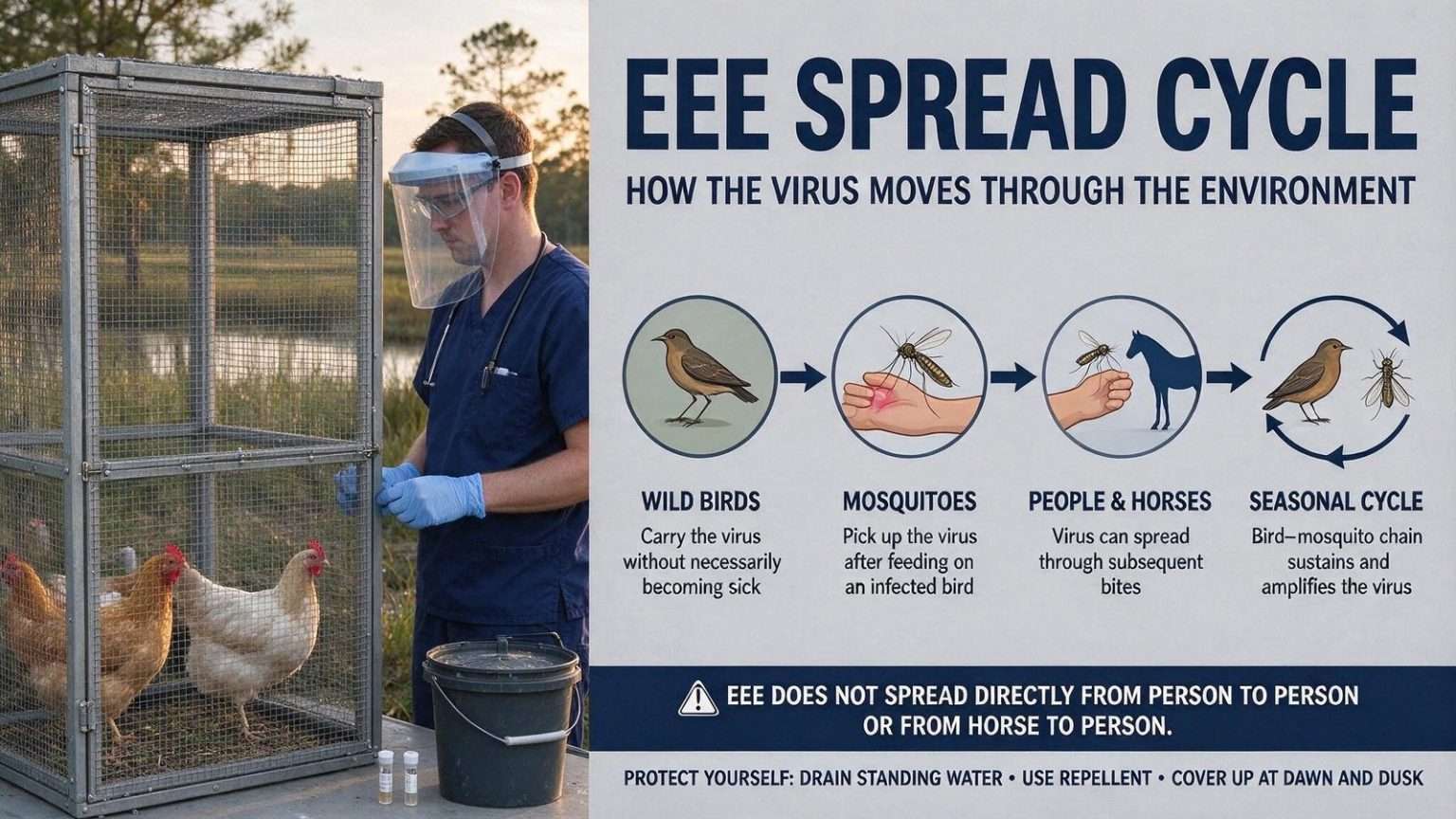
EEE spreads through a cycle that starts with wild birds, which carry the virus without necessarily getting sick from it. Mosquitoes pick up the virus after feeding on an infected bird and can then pass it along to other animals, including horses and humans, through subsequent bites. The virus overwinters in that bird-mosquito chain and intensifies as the season warms.
Importantly, health officials noted the virus cannot spread directly from an infected person or horse to another person, meaning transmission depends entirely on mosquito activity. A person caring for a sick relative or a horse with the disease faces no infection risk from contact, which is why health agencies respond to EEE with mosquito control rather than quarantine. The practical effect is that every precaution ultimately comes back to the same point: fewer mosquito bites means fewer chances for the virus to jump from its bird reservoir into people.
Horses are particularly vulnerable to the disease, and outbreaks among equines often serve as an early warning that the virus is active in an area. Unlike humans, horses can be vaccinated against EEE, and veterinarians across south Alabama routinely include the shot in spring vaccination schedules for that reason. The distinction matters for the county’s large rural and semi-rural properties, where horse owners are often the first to sound the alarm when mosquitoes turn dangerous. A cluster of sick horses in one area tells health officials that infected mosquitoes are feeding there, and it allows Vector Control to target its response before a human case occurs.
There is currently no vaccine available to protect humans from the disease, making prevention the primary defense. Treatment is supportive — managing the swelling of the brain and the complications that follow — which is why public health agencies put so much emphasis on avoiding the bite in the first place. Patients who survive severe cases often face months of rehabilitation, and some are left with permanent neurological impairment, outcomes that shape how seriously health departments treat even a single confirmed case.
How the County Watches for the Virus
To track the threat, the county’s Vector Control division maintains a network of sentinel poultry flocks stationed at points around Mobile County. These birds are periodically tested, giving health officials an early warning system for mosquito-borne viruses circulating in the area. Sentinel chickens cannot pass the virus along to mosquitoes or people, which makes them a safe and reliable biological monitor.
Vector Control crews also trap mosquitoes throughout the county and test the samples for EEE, West Nile virus and St. Louis encephalitis, allowing the department to track which viruses are active in a given season. A single positive pool can prompt targeted spraying in the surrounding area, concentrating resources where the risk is highest rather than spreading them countywide.
The surveillance network has become especially valuable along the Gulf Coast, where a long warm season and abundant wetlands give mosquito-borne viruses a nearly year-round foothold. Mobile County’s system of flocks, traps, and laboratory testing is among the most established in Alabama, and its data feed into state and federal tracking of mosquito-borne disease.
On the ground, inspectors focus much of their effort on eliminating mosquito breeding grounds before adult populations can grow. Standing water is the primary target, since that’s where mosquitoes lay eggs, and crews use both portable equipment and truck-mounted sprayers to apply larvicide treatments in identified problem areas.
Officials say this approach is generally more effective and cost-efficient than trying to control adult mosquito populations after they’ve already emerged. Killing larvae in a ditch or a flooded yard costs far less than spraying entire neighborhoods, and it prevents the next generation of mosquitoes from ever taking flight — a strategy that pays off most in the months when populations build fastest.
Residents who want their property checked for standing water or mosquito breeding sites can contact Vector Control directly, though officials caution that response times vary. Because the division fields a high volume of calls, service requests are handled on a first-come, first-served basis, and some residents may wait a few days before an inspector arrives.
Inspectors typically look for the ordinary culprits: clogged gutters, neglected birdbaths, old tires, buckets, and anything else that holds water for more than a few days after a rain. Mobile County’s climate makes those small reservoirs productive mosquito nurseries almost year-round, and eliminating them on private property is the single most effective thing a homeowner can do to protect the surrounding block.
The larvicide programs target the specific mosquito species that breed in standing water, including some of the varieties implicated in virus transmission. Traps and sentinel flocks tell the department where the threat is; the field crews are the ones who act on it, and their work is timed to the mosquito life cycle, which in south Alabama can turn a week of rain into a surge of new adults in a matter of days.
What Residents Should Do Now
In the meantime, health officials recommend the same basic precautions that guard against all mosquito-borne illnesses: draining standing water around the home, using insect repellent, and dressing to minimize exposed skin during peak mosquito activity, especially around dawn and dusk. The mosquitoes that carry EEE are most active in those low-light hours, which makes early morning and evening the highest-risk windows for anyone outdoors.
Repellents containing DEET, picaridin, or oil of lemon eucalyptus are the standard recommendations for skin protection, and officials urge residents to apply them whenever they will be outside for extended periods during mosquito season. Screens on windows and doors, air conditioning where available, and long sleeves in the yard round out the standard defense, particularly for older residents, who face higher risks from the disease. People over 50 and those with weakened immune systems are generally considered the most vulnerable to severe outcomes when mosquito-borne viruses strike, which makes the precautions around homes and gathering places where older adults spend time especially important.
Parents are also urged to watch children’s mosquito bites for signs of secondary infection that may require a doctor’s attention. Scratching can introduce bacteria into otherwise harmless bites, and health officials want families to distinguish between the ordinary nuisance of mosquito season and the rare but real possibility of serious illness. Any child or adult who develops high fever, severe headache, stiff neck, or confusion after mosquito exposure should be seen by a doctor promptly, since those symptoms can signal encephalitis and require immediate evaluation.
The confirmed case in Mobile County serves as the kind of reminder health officials would prefer not to need. EEE remains rare in humans even in the Gulf South — most mosquitoes never carry the virus, and most bites carry no disease — but the county’s environment and the severity of the illness mean the surveillance system, the spraying crews, and the sentinel flocks will keep working through the season, and residents are being asked to do their part in their own backyards.
For now, the health department’s guidance amounts to a short list: drain what holds water, wear repellent, cover up at dawn and dusk, and take seriously any fever that follows a mosquito-heavy week outdoors. In a county where mosquito-borne viruses circulate every summer, those habits remain the difference between a nuisance season and a dangerous one.