Alabama Supreme Court Declines New Hearing in Eight Mile Abuse Case, Chief Justice Dissents
Alabama's high court denied a new hearing for an Eight Mile man convicted of sexual abuse, prompting a pointed dissent from the chief justice.
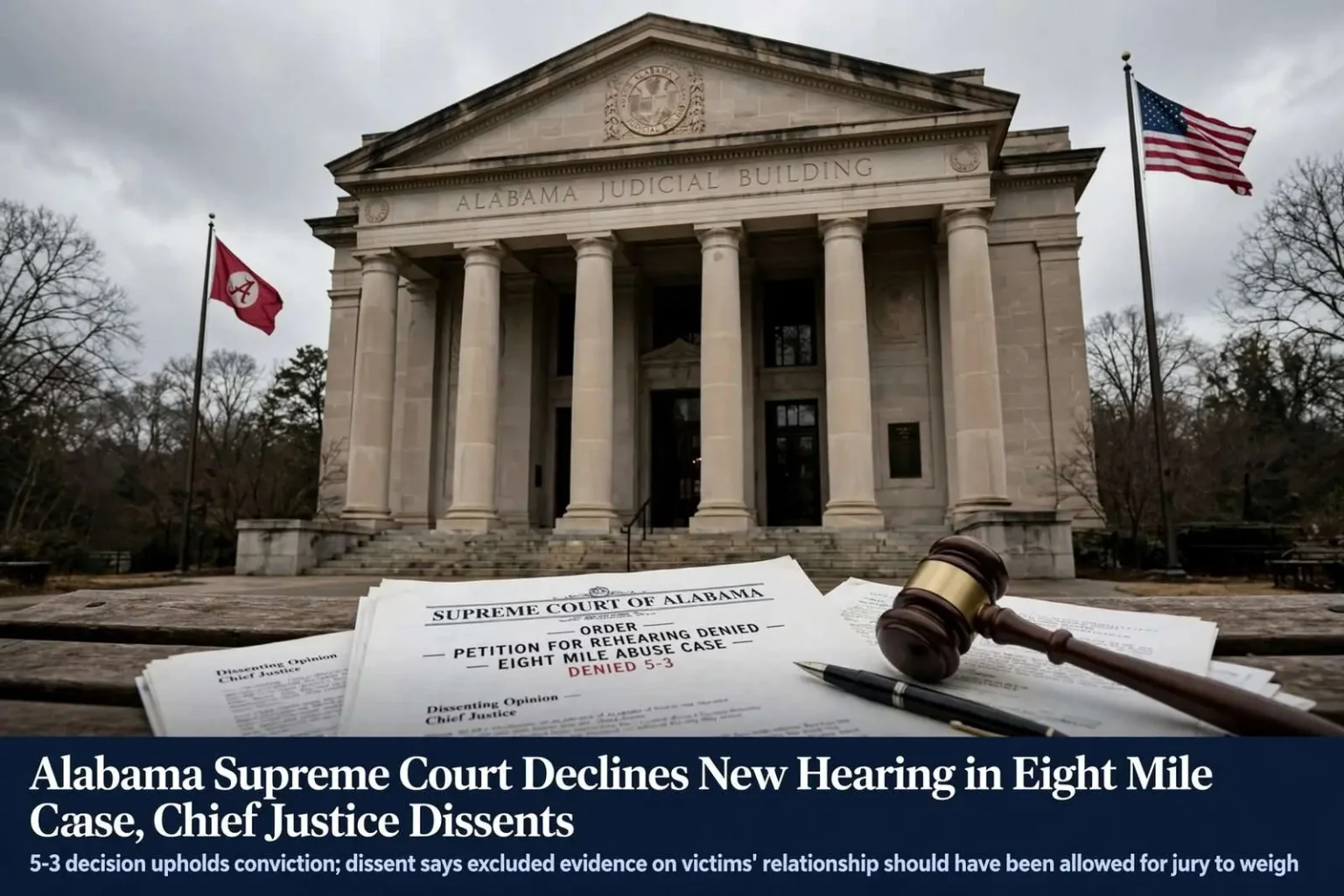
The Alabama Supreme Court has declined to grant a new hearing to an Eight Mile man convicted of sexually abusing two teenage girls, a decision that drew a sharp dissent from the state’s chief justice.
The defendant, now 37, had worked with young people through a Mobile-area youth mentoring program. According to trial testimony from 2013, he used that position to abuse two 15-year-old girls enrolled in the program. A jury convicted him, and a circuit judge sentenced him to eight and a half years in prison in February 2013.
At trial, the judge had ruled that testimony about a romantic relationship between the two victims could not be introduced as part of the defense. Attorneys for the defendant argued on appeal that the exclusion was improper, saying the relationship was relevant to questions of possible bias or a fabricated account. The state’s Court of Criminal Appeals rejected that argument, and the Alabama Supreme Court likewise declined to take up the case for further review.
A 5-3 Split Over What the Jury Should Have Heard
The vote among the justices was 5-3. In his dissent, the chief justice wrote that he believed the excluded testimony could have supported the defense’s argument that the girls had reason to coordinate their allegations, and that jurors should have been allowed to weigh it.
Three justices, including the chief justice, dissented from the denial, while five others concurred with letting the conviction and the lower court’s rulings stand. The split means the case ends at the state level with a majority content to leave the intermediate court’s ruling in place and a minority willing to revisit whether the trial judge drew the line on evidence in the right place.
The evidentiary question at the center of the dispute is a recurring one in criminal trials. Evidence rules allow defendants to cross-examine witnesses about possible bias, motive, or interest, on the theory that jurors are entitled to judge credibility with the full picture in front of them. But trial judges also hold broad discretion to exclude material whose potential for confusion or unfair prejudice outweighs its value, and in cases involving minors that balancing is often struck against the defense. Whether a prior relationship between two witnesses goes to genuine bias or merely invites speculation about their motives is precisely the kind of judgment appellate courts are usually reluctant to second-guess.
Under Alabama’s appellate structure, the Court of Criminal Appeals handles every criminal appeal as a matter of right, while the Supreme Court reviews only the cases it chooses to hear. A denial of review carries no implication that the justices agree with the lower court’s reasoning — only that a majority did not find the kind of unsettled legal question or probable error that would justify the court’s time. Dissents from a denial, like the chief justice’s here, are the mechanism by which justices signal that they see the case differently.
The Defense’s Position
The defendant’s trial attorney said he welcomed the dissent but remained frustrated with the outcome of the broader appeals process. He argued that the courts’ unwillingness to allow the contested testimony reflected discomfort with the underlying allegations rather than a straightforward legal judgment, and he maintained his client’s defense team had raised a legitimate evidentiary question rather than an attempt to attack the victims.
The attorney also said he did not believe the excluded evidence pointed to a specific motive for revenge, but said the issue was whether the relationship between the two girls gave them an opportunity and an incentive to align their accounts — a question, in his view, that belonged to the jury rather than the judge. In his telling, the defense never sought to try the victims’ characters; it sought to test the consistency of two accounts that formed the entirety of the case.
Prosecutors, for their part, treated the relationship as collateral in every sense — personal history between the witnesses that had no bearing on whether the abuse occurred, and material whose admission would have turned the trial into a referendum on two teenagers rather than on the defendant’s conduct. The trial judge’s exclusion, affirmed by the Court of Criminal Appeals, embodied that view, and the Supreme Court’s majority declined to disturb it.
The dissent argued the balance had been struck wrongly. In the chief justice’s view, evidence that two complainants knew each other well — and, beyond that, had been romantically involved — was not speculative character material but the raw stuff of cross-examination: an inquiry into how two accounts came to exist in the form the jury heard. A jury permitted to hear that evidence might have concluded it meant nothing at all, he suggested, but it was the jury’s conclusion to reach, not the court’s.
The three dissenters’ position places them on the side of a minority view within the courts that have handled the case, but it is not a fringe one among evidentiary scholars. The right of confrontation protected by the Sixth Amendment has long been read to include meaningful cross-examination about bias, and judges who exclude such material risk, in the dissenters’ framework, substituting their own credibility assessment for the jury’s. The counterweight is the trial judge’s control of the courtroom — the principle that some lines have to be drawn before trial begins if the process is to remain orderly, particularly when minors are involved.
The Community and the Program
Eight Mile is an unincorporated community north of Mobile, along the corridor between the city and the Saraland line, and the case drew attention locally in part because of the setting: a youth mentoring program whose stated purpose is to give young people guidance and safe adult relationships. Programs of that kind operate across the Mobile area through churches, schools, and community organizations, and they depend on the trust of the families whose children enroll. An abuse case arising inside one inevitably raises questions about screening and oversight that extend past a single defendant.
Those questions are answered in practice by the systems programs adopt — background checks, policies against one-adult-one-child contact, mandatory reporting training — and by the courts when those systems fail. The conviction in this case came from those facts reaching a jury: testimony in 2013 established that the defendant used his position in the program to gain access to the two girls, both 15, and the jury’s verdict reflected its conclusion that the abuse occurred.
What Remains
With the Supreme Court’s denial, the state-court process is exhausted on the evidentiary issue, leaving the conviction and the eight-and-a-half-year sentence in place. The sentence, imposed by a circuit judge in February 2013, fell within the range available to the court for the offenses of conviction, and the appellate courts made no adjustment to it.
For the defense attorney, the closing of state review leaves the dissent as the document that best captures his client’s argument — a sitting chief justice’s written conclusion that the jury should have heard the excluded testimony. He said he hoped the dissent would at least stand as a record that the evidentiary question was real, even if a majority of the court chose not to answer it. For the state, the outcome is simpler: the judgment stands, as do the vast majority of judgments, because appellate courts reverse only a fraction of the cases placed before them and disturb trial rulings even less often.
The case now stands as an example of the limits of appellate review in evidentiary disputes — where the question is not whether a trial was perfect but whether it was fair enough that a court should leave the verdict alone, and where five justices on Alabama’s highest court decided it was, over three who wrote to say the jury should have been trusted with more.
The path the case traveled is worth tracing, because it explains both the outcome and the dissent’s sharpness. From the circuit court, the conviction went automatically to the Court of Criminal Appeals, which reviews claims of trial error and the sufficiency of the evidence. When that court affirmed, the only remaining step in the state system was a petition for a writ of certiorari to the Alabama Supreme Court — a request that the state’s highest court take the case despite having no obligation to do so. The petition framed the exclusion of the relationship testimony as a question worth settling statewide; the majority’s denial left the intermediate court’s ruling as the last word.
Denials of this kind happen far more often than grants, and for reasons that have little to do with the merits of any single case. The Supreme Court takes cases where a lower court erred on an issue of broad importance, where two divisions of the state courts disagree, or where a rule needs clarifying for future trials. An evidentiary ruling exercised within a trial judge’s discretion — the category this one occupied — sits near the bottom of that priority list, which is why dissents from denials tend to focus less on the law’s content and more on the court’s choice not to engage.
The Broader Context for Youth Programs
Outside the courtroom, cases like this one have shaped how mentoring organizations operate across the Mobile area and the country. National youth-serving organizations adopted standardized screening and two-adult policies after a series of abuse scandals in past decades, and local programs now routinely document background checks, train volunteers to recognize warning signs, and require that interactions between adults and minors remain observable by others. Courts, meanwhile, treat a position of trust as an aggravating feature of abuse rather than a mitigating one, reflecting the judgment that exploiting a mentoring relationship harms not only the direct victims but the community institutions families rely on.
The 2013 trial testimony in this case — that the defendant used his program role to access two girls enrolled in it — is what placed the case in that category. The jury heard the accounts, weighed them, and convicted; the sentencing judge imposed eight and a half years the following month. Nothing in the appellate rulings disturbed those facts. The dispute that reached the Supreme Court was strictly about the second layer of the trial: what the defense could ask, and about whom, in testing those accounts.
That distinction is why the case can end with both a final conviction and a genuine legal disagreement. Five justices concluded the trial was fair within the rules; three concluded a fair trial required more. The defendant’s remaining options now lie outside the state courts, and the eight-and-a-half-year sentence stands as the operative fact in a case whose legal questions drew more lasting attention than its outcome.