
Mobile Bar Association Poll Favors Brooks and Graddick in Spring Races
A preference poll of the Mobile Bar Association gave state Sen. Ben Brooks the edge over Eaton Barnard for circuit judge and overwhelmingly backed Charlie Graddick for chief justice ahead of the March primary.
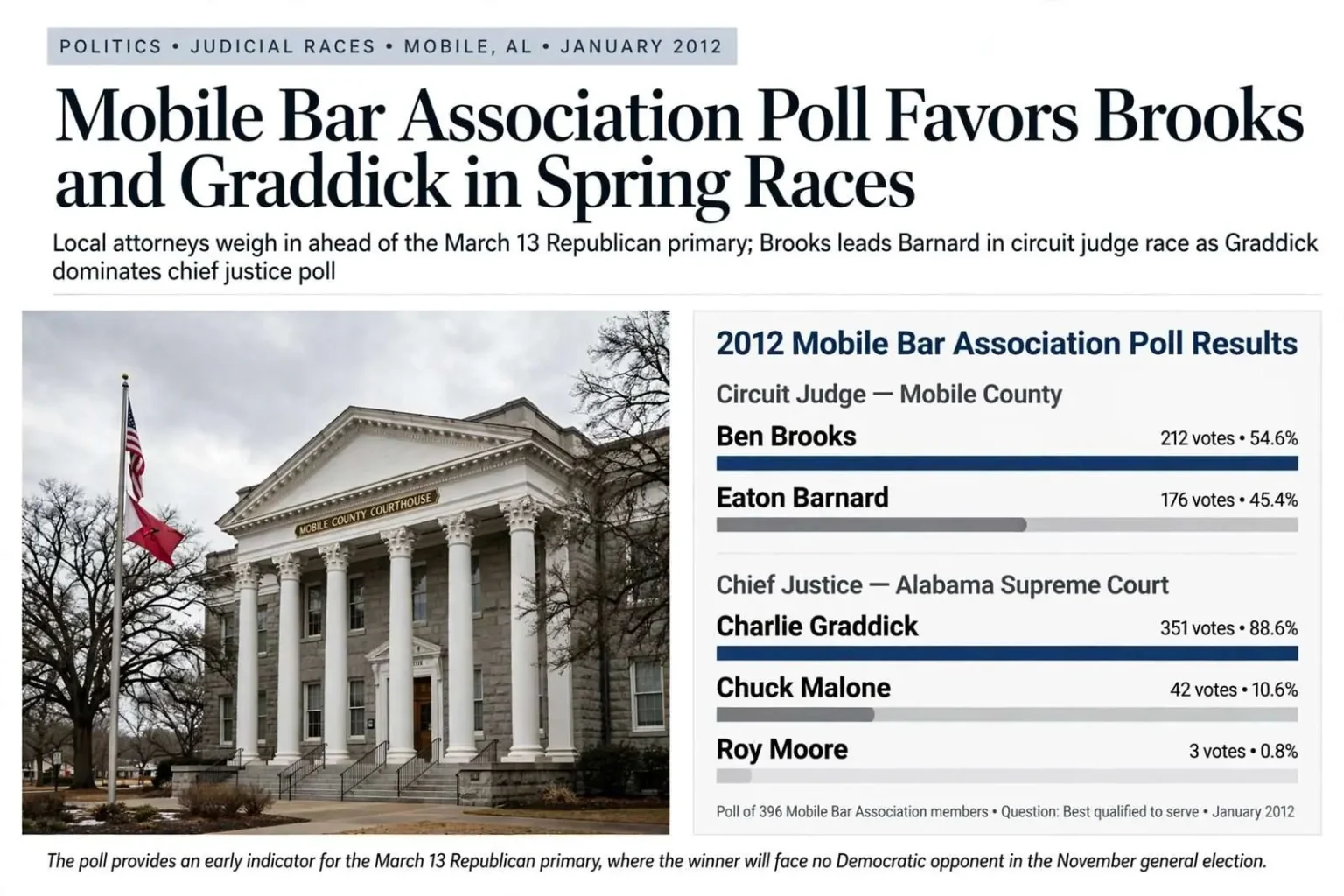
Local attorneys weighed in on the coming judicial races through a preference poll of the Mobile Bar Association, and their choices offered an early read on contests that would be decided in the March 13 Republican primary. Judicial races are among the least visible on any ballot — few yard signs, fewer television ads — which is precisely why the bar’s annual poll draws attention from campaigns and voters alike.
A close call for circuit judge
In the race for a Mobile County circuit judgeship, bar members gave state Sen. Ben Brooks the edge over Mobile attorney Eaton Barnard, 212 to 176. The two Republicans were vying to succeed the retiring Judge Jim Wood, and with no Democrat in the field, the primary was effectively the deciding contest. Whoever emerged from March would take the bench without facing an opposition ballot in the fall, making every vote in the primary — and every signal before it — that much more consequential.
The poll asked members to identify the candidate they considered “best qualified to serve” — a standard that carried particular weight coming from the lawyers who practiced before the court and knew the candidates professionally. Circuit judges in Alabama preside over felony trials, major civil disputes and the full range of the county’s serious litigation, and the attorneys who argue before them see up close how a candidate manages a courtroom, applies the law and treats the parties whose futures hang on their rulings.
The margin — 36 votes across a pool of hundreds — suggested a genuine contest rather than a consensus. Brooks brought the profile of an active legislator with years of legal and public-service experience in Montgomery, while Barnard represented the practicing-bar route into a judgeship, a path many Mobile attorneys know well. Bar polls do not decide races, but a strong showing for either candidate becomes talking material for campaign literature and a marker of where the city’s legal establishment leans.
A landslide for chief justice
The bar’s preference for chief justice of the Alabama Supreme Court was far more lopsided. Presiding Circuit Judge Charlie Graddick, a familiar figure in the Mobile courthouse, romped with 351 votes to incumbent Chuck Malone’s 42 and former Chief Justice Roy Moore’s 3. The overwhelming margin underscored Graddick’s deep support in his home legal community, where his years on the bench had made him a known quantity.
For a statewide candidate, such a decisive showing among the lawyers of his own county amounted to a strong vote of confidence. Statewide races in Alabama are won and lost across 67 counties, and no single county’s bar speaks for the state — but a 351-to-42 rout in the candidate’s home jurisdiction, against a sitting incumbent no less, was the kind of early headline campaigns build on.
The contest itself was one of the more unusual on the 2012 ballot: an incumbent chief justice who had been appointed to the seat rather than elected to it, running against two rivals with deep name recognition of their own. Malone had been appointed to the state’s highest judicial office and inherited the advantages of incumbency, while Moore was mounting his latest campaign for the office he once held — a candidacy guaranteed to draw attention statewide. Graddick, running from his Mobile base, built his case on his record as a trial judge and prosecutor’s-office veteran in the state’s busiest circuit.
The near-total absence of Moore support among Mobile’s attorneys was itself a striking data point. Moore’s political identity had been forged in national controversies, and his campaigns relied on a base that extended far beyond the legal profession; among the Mobile lawyers who rated candidates on professional qualifications, that base amounted to almost nothing — three votes in a poll of hundreds.
Other results
In the race for an associate justice seat on the high court, bar members favored Tommy Bryan over Debra Jones by a two-to-one margin, 212 to 106. Bryan’s showing reflected the same dynamic that ran through the poll’s bigger races: when lawyers rate lawyers, courtroom experience and professional reputation tend to carry the day over campaign visibility.
Preference polls of a bar association are not binding and do not always predict outcomes, but they carry a certain authority: the respondents are the professionals most familiar with how judges and would-be judges conduct themselves. Other states and cities have their versions of the tradition, and in Alabama — where judicial elections are partisan, contested and frequently decided in low-turnout primaries — the bar’s verdict is often the only professional evaluation voters ever see.
As the March primary approached, the results signaled that Brooks and Graddick entered the home stretch with the backing of many of the attorneys who knew the candidates best, adding a measure of momentum to campaigns already underway. Endorsement dynamics matter in judicial races precisely because information is scarce: a candidate who can say the county’s lawyers rated them best qualified has a claim that costs opponents real ground to rebut.
The poll’s timing, weeks before the primary, made it a fixture of the campaign season’s final stretch. Candidates cite it in debates and mail pieces; local media report it as the closest thing to an expert forecast the race offers; and voters who fill out a long judicial ballot with little to guide them often lean on exactly such signals. Campaigns that fare poorly in the poll tend to discount it publicly while privately recalculating where their remaining votes must come from.
What bar polls can and cannot tell voters
For all their authority, bar polls come with well-known limitations. Respondents are not a random sample of the electorate — they are practicing attorneys concentrated in one county, with their own professional relationships and perspectives. A candidate popular with trial lawyers may fare differently with the broader public, and name recognition among attorneys does not always translate to the voting booth. History offers examples in both directions: candidates who won bar polls and lost elections, and candidates who ignored the legal establishment and won anyway.
Still, the poll’s core question — who is best qualified to serve — addresses the one dimension of a judicial campaign that campaign advertising rarely illuminates. Alabama elects its judges in partisan contests, meaning voters choose a party label first and a candidate second, and the candidates’ professional qualifications get compressed into whatever space remains on the ballot. A poll of the lawyers who appear before those candidates fills part of that gap, imperfectly but with substance.
For Mobile County, the 2012 results also documented a moment of transition: a retiring circuit judge whose seat would change hands, a presiding circuit judge from the local courthouse seeking the state’s highest judicial office, and an incumbent chief justice defending an appointed seat at the ballot box. The bar’s preferences, delivered by hundreds of its members, gave the campaigns their early shape heading into March — Brooks ahead but tested, Graddick dominant at home, and Bryan with a clear edge — and gave the county’s voters one more piece of evidence to weigh in races that are otherwise among the quietest on the ballot.
The circuit judgeship race carried particular local weight because of what the seat represents. Mobile County’s circuit bench handles the county’s most serious dockets — murders, major felonies, large civil verdicts and family litigation with lasting consequences — and an open seat caused by a respected judge’s retirement drew a field of credentialed hopefuls. Brooks’s decision to leave his Senate seat ambitions on the table long enough to seek the bench was itself a statement about the office’s appeal, and Barnard’s candidacy gave the practicing bar a homegrown alternative.
Turnout math hangs over every such race. Primaries in March, in a year with a presidential contest on the same ballot, draw larger and broader electorates than the off-cycle judicial races of years past, but most voters still arrive at the judicial section of the ballot with little information. That is where the accumulated signals — bar poll results, endorsements from law enforcement and civic groups, campaign signs in courthouse squares — do their quiet work.
The chief justice race played out on a much larger stage. Graddick’s road ran through every county in Alabama, against rivals whose names were known in every living room in the state. His Mobile bar numbers gave his campaign proof of a professional constituency behind his candidacy; whether that translated to votes in the Wiregrass, the Tennessee Valley and the Black Belt would be decided in the weeks of travel and retail politics between the poll and the primary.
Malone’s challenge was the classic appointed-incumbent dilemma: an officeholder with a record to defend but no prior statewide campaign to build on. Moore’s challenge was the inverse — vast name recognition and a devoted base, with the legal community’s skepticism an open question he needed not to answer but only to outlast. The Mobile poll suggested how far the gap ran within at least one professional community, whatever the wider electorate decided.
As election day neared, the campaigns folded the bar’s verdict into their closing arguments, and Mobile’s voters headed to the polls with more professional evidence about the judicial field than most counties see. In a state where judges stand for election and the public pays little attention until the ballot is in hand, that may be the bar poll’s real function: not prophecy, but testimony — hundreds of professionals, on the record, about who among the candidates they would trust with the bench.


