Pittman Bill Aims to Shield Teacher Insurance Plan From Costly Drug Litigation
The Alabama Senate passed a bill by Sen. Trip Pittman of Montrose clarifying the law so the state teacher insurance plan could negotiate prescription drug rates, a move backers said could save hundreds of millions of dollars.
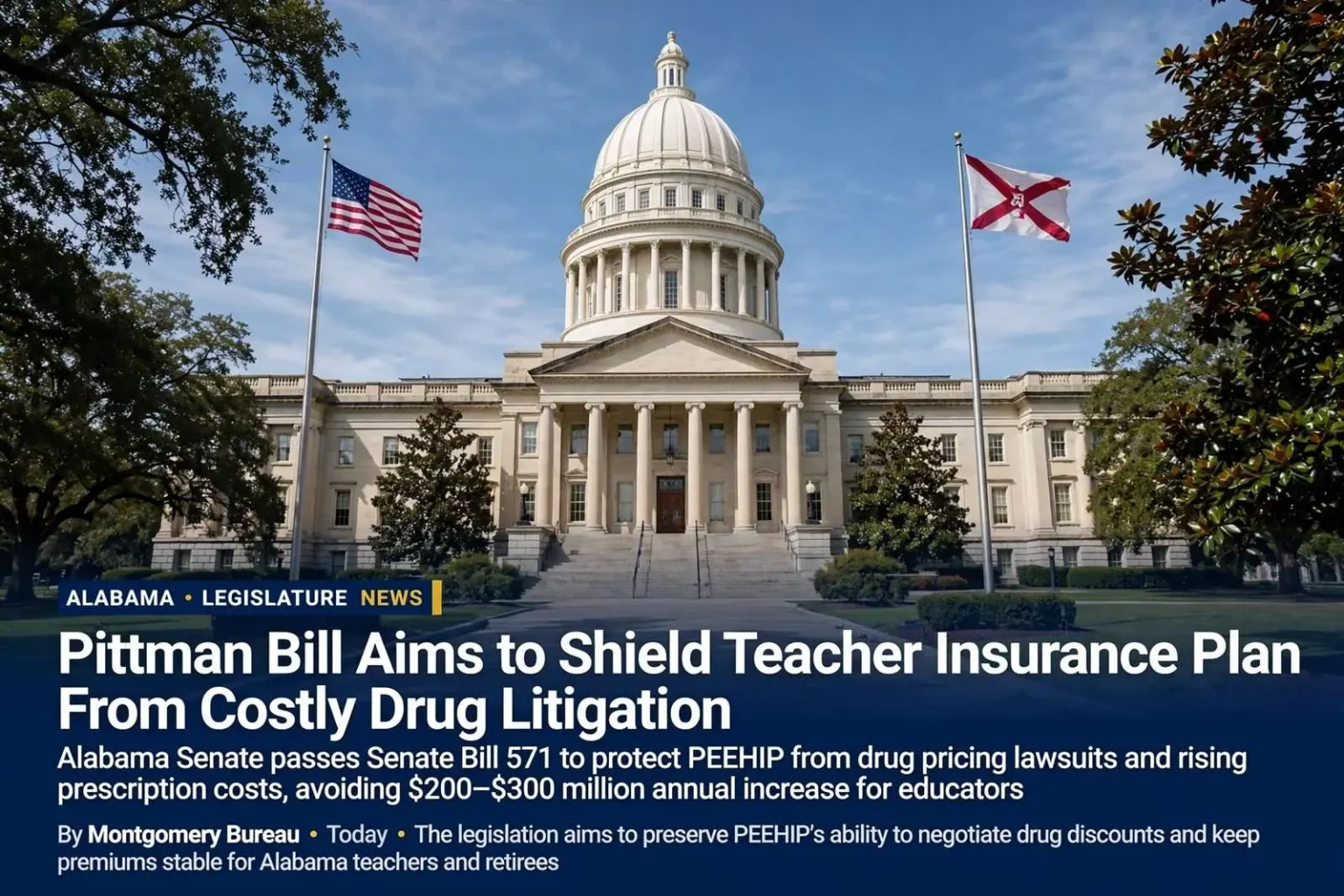
The Alabama Senate passed legislation sponsored by Sen. Trip Pittman, R-Montrose, aimed at protecting the state’s teacher insurance program from costly litigation and preserving its ability to hold down prescription drug costs. The bill moved through the upper chamber with the backing of Senate leadership, who framed it as a quietly urgent fix rather than a routine technical correction.
Closing a gap in the law
Senate Bill 571 clarified a section of existing Alabama law to allow the Public Education Employees’ Health Insurance Plan, known as PEEHIP, to negotiate favorable prescription drug rates. The change aligned the teachers’ plan with other state health insurance programs, such as Medicaid and the State Employees’ Insurance Board, which already operated with that authority.
Without the clarification, backers warned, PEEHIP could face costly litigation and ultimately absorb an increase of at least $200 million to $300 million annually in prescription drug costs. If forced to bear those costs, the plan would have little choice but to raise member premiums — by an estimated $100 to $200 a month for individual and family coverage.
Those figures explain why lawmakers treated the bill as more than a drafting exercise. PEEHIP’s finances are perpetually tight, with the legislature voting in most years to appropriate additional money to keep the plan solvent, and a quarterly increase of that size in drug spending would have overwhelmed the budget lines that support it. Negotiated rates — the discounts and rebates large plans extract from drug manufacturers and pharmacy benefit managers — are among the most important tools any health plan has for controlling that spending, and the statute had been silent on whether the teachers’ plan could use them.
Support from Senate leaders
Senate President Pro Tem Del Marsh praised the measure as a timely fix. “I’m pleased that we were able to catch this discrepancy in the law while we were in session,” Marsh said. “This situation is one that could easily have bankrupted PEEHIP or forced teachers to pay unbearable premiums.” He credited Pittman for bringing the bill, saying the teachers’ insurance board would now be able to continue negotiating reasonable rates and providing affordable coverage.
Pittman framed the legislation as a matter of avoiding an unnecessary fight. “This bill will help the state avoid costly and prolonged litigation to resolve an issue we can very easily resolve through legislation,” he said.
The bipartisan-sounding support reflected the plan’s constituency. PEEHIP covers the state’s education workforce — active teachers and support staff, retirees and their families — in every one of Alabama’s 67 counties, so any threat to the plan’s solvency lands on a constituency that touches nearly every community. Lawmakers from both parties frequently hear from education employees about health insurance costs, making a fix that prevents premium increases politically attractive even in a lean legislative session.
A stake for south Alabama educators
For teachers and school employees across Baldwin County and the rest of south Alabama, the outcome carried practical significance. PEEHIP covered a broad swath of the education workforce, and any sharp increase in premiums would have landed directly on the paychecks of teachers, bus drivers, cafeteria workers and aides — employees whose salaries are set by school boards and the legislature, not by the insurance plan.
Baldwin County’s school system is one of the largest employers on the Alabama Gulf Coast, and along with Mobile County’s schools it anchors the south Alabama education workforce that PEEHIP insures. Pittman, whose district includes portions of Baldwin County, and neighboring legislators would have faced the effects in their own districts: a $100-to-$200 monthly premium increase is, for many school employees, the equivalent of a significant pay cut, and one arriving on top of years of rising out-of-pocket health costs.
Retirees had perhaps the most at stake. PEEHIP’s retired members live largely on fixed pensions, and the plan has historically been among the more generous public plans in the region for retiree coverage. A litigation loss that forced hundreds of millions in new annual drug costs onto the plan could have cascaded into benefit changes and premium categories hitting pensioners hardest — the group least able to absorb them.
How the plan works
PEEHIP is administered through the Retirement Systems of Alabama, which manages the state’s public pension systems and the education employees’ health plan under the oversight of a board that includes education representatives. The plan’s board sets premiums, benefit levels and the pharmacy benefit design, but its statutory authority to conduct certain business — including negotiating with pharmaceutical interests — depends on what the legislature has written into law. That dependency is precisely what the discrepancy at the heart of Senate Bill 571 exposed.
Drug cost negotiation has become a central battleground in American health care. Large plans obtain discounts in exchange for placing drugs on preferred lists, steering volume to certain manufacturers and pharmacies, and agreeing to rebate arrangements that are often confidential. Plans that lack clear statutory authority to enter those arrangements can find them challenged in court, and the possibility of a legal challenge — with PEEHIP’s leverage frozen while litigation runs its course — was the scenario lawmakers moved to foreclose.
The legislature’s role in teacher health coverage
Unlike employer health plans in the private sector, PEEHIP’s structure is largely what the legislature says it is. Lawmakers set the state’s contribution toward premiums, approve supplemental appropriations when the plan runs deficits, and write the statutes defining what the plan may do. That arrangement gives education employees a direct line to the Statehouse on health insurance matters — and gives legislators like Pittman and Marsh a recurring role in the plan’s finances, whether the issue is a budget shortfall or, as here, a statutory gap discovered before it could do damage.
The bill’s path through the Senate also illustrated how technical changes can carry the largest price tags. Nothing in the public debate suggested disagreement about the goal of negotiated drug rates; the dispute the bill pre-empted was with pharmaceutical interests over whether the plan’s authority was airtight. Catching that kind of discrepancy while the legislature is in session, as Marsh put it, spared the plan years of courtroom uncertainty that could have rendered its negotiating leverage worthless while the case was pending.
What happens next
With Senate passage, the bill moves through the legislative process, where the House of Representatives would need to concur before any change reaches the governor’s desk. The plan’s administrators, meanwhile, can proceed with the negotiating posture the legislature intends to protect — contracting for discounts and rebates the way Medicaid and the State Employees’ Insurance Board long have.
For education employees watching the process, the practical takeaway is that the premiums they pay into PEEHIP remain tied to decisions made in Montgomery, from the pharmacy benefits the plan designs to the statutory authority behind its contracts. The episode also served as a reminder of how drug costs, a line item most members never see, sit underneath every conversation about teacher pay and benefits: had the gap not been closed, the estimated consequences — $200 million to $300 million a year in added costs and premiums up as much as $200 a month — would have reshaped the take-home math for every educator on the plan.
The episode fits a broader pattern in Alabama state government, where health plans covering public employees have become the state’s largest purchaser of medical care and, by extension, one of its most powerful negotiators. When a plan of that size negotiates drug rates, the savings flow back into premium stability and benefits rather than shareholder returns — which is why legislative authority to negotiate is treated as a core asset, not a formality. The same logic drove the clarifications that already protected Medicaid and the State Employees’ Insurance Board, and Senate Bill 571 simply extended the equivalent protection to the education workforce.
Lawmakers’ estimates of the stakes also illustrate how drug pricing works in bulk. A plan covering the education workforce fills prescriptions in enormous volumes, and even modest percentage discounts on each claim compound across millions of fills a year. The difference between negotiating and paying list price can therefore be measured in the hundreds of millions — the range the bill’s backers cited — and, at the member level, in the $100-to-$200 monthly premium range that would have translated those costs onto individual paychecks.
For now, educators in Mobile and Baldwin counties and across the state can watch the bill’s progress with the reassurance that both chambers’ leadership understood the problem and moved to fix it during the session. The plan’s board, the Retirement Systems of Alabama and the legislative allies of the education workforce all converged on the same conclusion: an avoidable litigation risk to a plan covering the state’s teachers was worth resolving immediately, and at minimal cost, rather than testing in court at the expense of the members the plan exists to serve.