

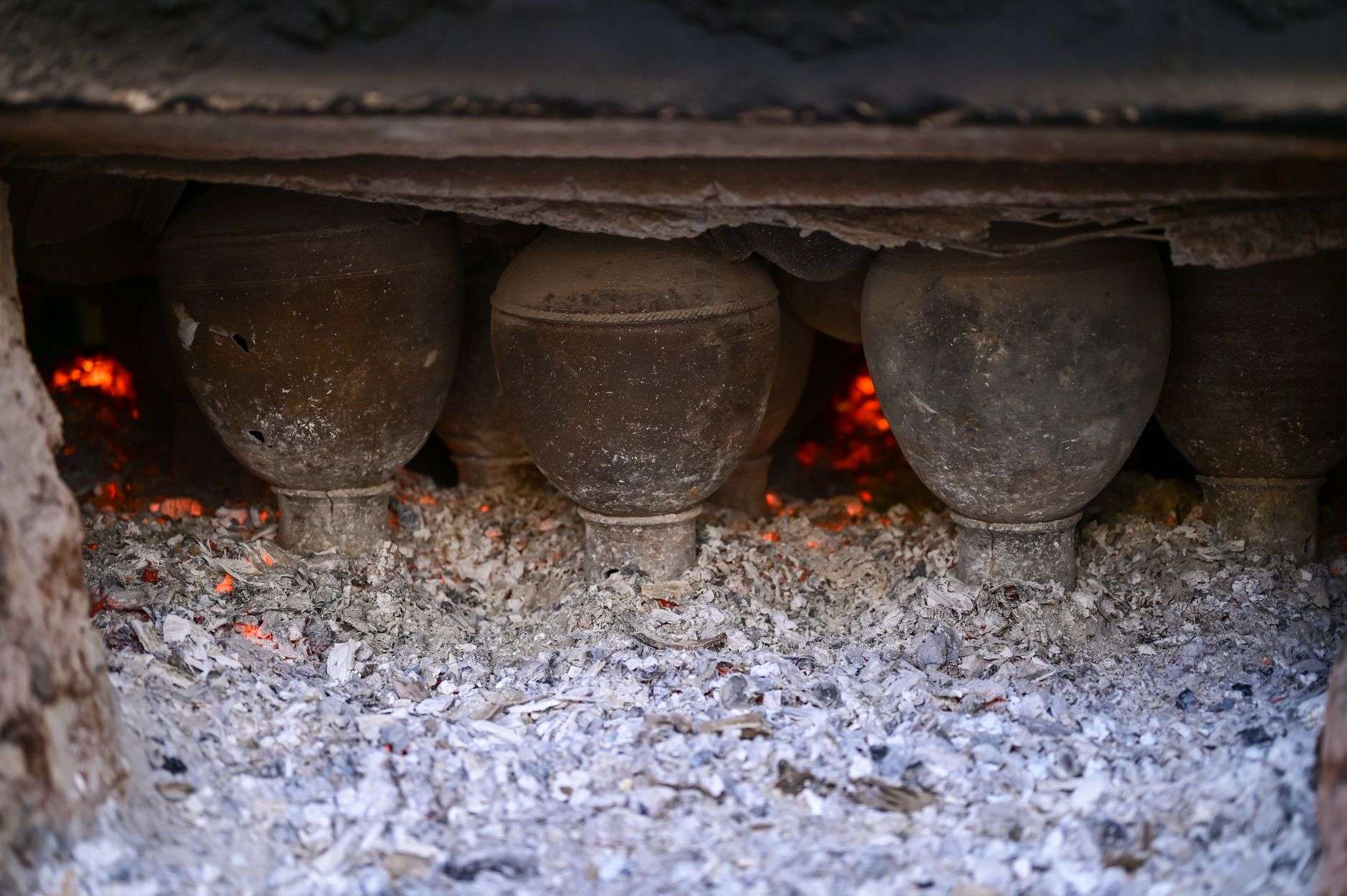
“I have lived on the bluffs of Montrose for 40 years, and it is my inspiration to make things that reflect the geological wonder of where we live.” That is how Montrose potter Shelley Leigh sums up the source of her work. For years she has gathered wild clay from the shoreline beneath the bluffs of Mobile Bay’s Eastern Shore, shaped it largely by hand and fired it in wood-burning kilns, where ash, flame and chance decide much of how each piece turns out.
Her vessels have become treasured gifts among friends, and in July 2024 her barnacle-like candle holders, made of wild Ecor Rouge clay and wood-fired with an ash glaze, served as table decor for the Red, White, and Rosé wine dinner at Char 32 Restaurant & Bar in Point Clear. Asked on short notice for something to decorate the tables, with no time to make anything new, she generously offered pieces she already had on hand.
The Clay Beneath the Bluffs
The clay Shelley works with comes from one of the most distinctive landscapes on the Gulf Coast. Ecor Rouge, French for “red bluff,” rises above Mobile Bay at Montrose, between Daphne and Fairhope. French explorers named the bluff for its striking red and orange layers, and it is often described as the highest coastal elevation on the Gulf between Mexico and Maine. Locals have long called it the “Clay Mountain.” Along the beach below the bluffs, layers of colorful clay and sand are exposed by erosion, and generations of Eastern Shore families have scooped up handfuls of it to mold into shapes while spending lazy afternoons by the water.
For Shelley, collecting that clay became a habit long before pottery became her passion. “Even before, whenever I walked along the Bay with my kids and grandkids, I would carry a backpack and collect clay from the beach and we would make things,” she says.
Montrose itself is one of the oldest communities on the Eastern Shore. The small, unincorporated village sits along Scenic Highway 98 on the bluffs, with shaded streets, historic homes and a quiet character that has changed little even as the cities around it have grown. It is easy to see how living there for four decades could shape an artist’s sense of place.
An Artist’s Upbringing and a Search for Community
Shelley was raised in New Jersey by parents who were both painters, so art was a part of her life from the beginning. She and her late husband, Chris, moved to Mobile as young adults. In the 1970s, she took art classes from Bea Tucker, and those classes gave her something she had been missing.
“We had lived in Mobile for 10 years and I was still searching for a sense of community. The classes brought that sense of community I was looking for,” she says.
After the family moved from Mobile to Montrose, Shelley taught art at Bayside Academy, the independent school in Daphne, for a while. She stepped away from teaching to raise her children and kept making art as a hobby when time allowed.
Falling for Pottery at The Kiln
Around 2014 or 2015, Bea Tucker’s daughter, Frances Fuller, moved from Tampa to Fairhope, and the two women decided to take a pottery class together at The Kiln Studio and Gallery in Fairhope. That class changed everything.
“I fell in love with pottery and was always working in the studio,” Shelley says. “I found myself spending more and more time in the studio experimenting and immersing myself with local wild clay.”
She still has the first vessel she made: a small clay vase with pebbles worked into it, finished with a wood-fired glaze. These days she continues to create with both wild local clay and porcelain. She does not throw on a potter’s wheel as much as she once did; most of her work is now hand-built. She draws inspiration from other artists and spends a great deal of time thinking through what she will make next and how she will fire it.
The Unpredictable Art of Wood Firing
Wood firing is one of the oldest ways of making ceramics, with roots in East Asian traditions stretching back many centuries. Rather than relying solely on glazes mixed and brushed on beforehand, wood-fired pottery is shaped in large part by the kiln itself. As wood burns for hours or days, flame travels through the kiln and ash settles on the pots, melting at high temperature into a natural glaze. Where a piece sits in the kiln, which way the flame moves and what kind of wood is burned all affect the result.
Shelley explains it this way: “Different colored glazes are created by the natural process of burning different kinds of wood in a wood-fired kiln. It is used to flux (to melt) the rawness of the clay because it adds a natural finished glaze to the pottery.”
One of her favorites is nuka glaze, a Japanese-style ash glaze traditionally made with rice husk ash. It can be as simple as wood ash and clay. “I sometimes burn rice hulls from Louisiana or take ash from my fireplace,” she says. “Nuka can be sumptuous, complimenting white over the dark of our wild clay. When wood-fired with a significant amount of pine ash, it adds a beautiful subtle green. I do a lot of research before firing my work. It is far from an exact science, and I’m always surprised by the result.”
That uncertainty is part of the appeal. “There is something infinitely curious and interesting about wood-fired pottery. There is no terminal point where you are certain how a finished piece will look. The more you work at it, the better you are at creating the look you seek.”
The process is long. From start to finish, a piece can take a month or more, with many variables along the way. “I feel like every person that places a stick in a wood-fired kiln has contributed to the art that comes out at the end,” she says. “I always want to know more, and that drives me. That is the essence of creating pottery that keeps me interested. Thinking about the process and the different elements involved.”
A Clay Community Across State Lines
Because wood kilns are large and firing them is labor-intensive, wood-fire potters often work together, sharing kilns and taking turns stoking the fire around the clock. Shelley and her kiln friends have traveled to Mississippi, Louisiana, Massachusetts and Florida to fire their work.
“Each firing is a clay community effort, sometimes taking weeks to complete,” she says. “There is a social aspect to it all.”
She credits her close friend Susie Bowman, a local potter who formerly owned The Kiln in Fairhope, with building a “clay community” that crosses state lines. For an artist who once took art classes in Mobile specifically to find a sense of belonging, that community is part of what keeps her coming back to the kiln.
Advice for Would-Be Potters
For anyone who has thought about trying pottery but held back, Shelley has encouraging words, along with a warning that it takes a stubborn soul to keep at it through all the trial and error.
“What stops people from getting into pottery is the feeling that they have to be good,” she says. “Once I started making mugs, it took making bad mugs at first, before they became better. I like being a beginner. Have the fearless mindset of a 9-year-old. Permit yourself to do bad art.”
For Eastern Shore residents who want to follow her advice, the area offers several ways to get started:
- Take a class: Local studios and art centers in Fairhope and elsewhere on the Eastern Shore offer beginning pottery and hand-building classes. Check with studios directly for current schedules.
- Start with hand-building: Pinch pots, coil building and slab work require no wheel and are how many potters, including Shelley in much of her current work, create pieces.
- Expect imperfection: Early pieces rarely turn out as planned, and that is part of learning.
- Respect the bluffs: Ecor Rouge is an eroding natural landmark, and much of the land along the bluffs is private. Anyone interested in local clay should be mindful of property boundaries and avoid disturbing the bluff face.
Art Without Pretension
Shelley’s relationship with her work is refreshingly unpretentious. She is content to give her pieces to friends, who invariably appreciate them. Studying a vessel she picks up from a table, she can still become absorbed in the colors and textures that the firing drew out of the clay.
“I’ve always had a studio of sorts,” she says. “I never have taken myself too seriously.”
That combination of curiosity, patience and humility is perhaps the best lesson her work offers. The clay beneath the Montrose bluffs has been there for ages. In Shelley Leigh’s hands, and in the unpredictable heat of a wood-fired kiln, it becomes something new each time, and she is happy to be surprised by what comes out.