

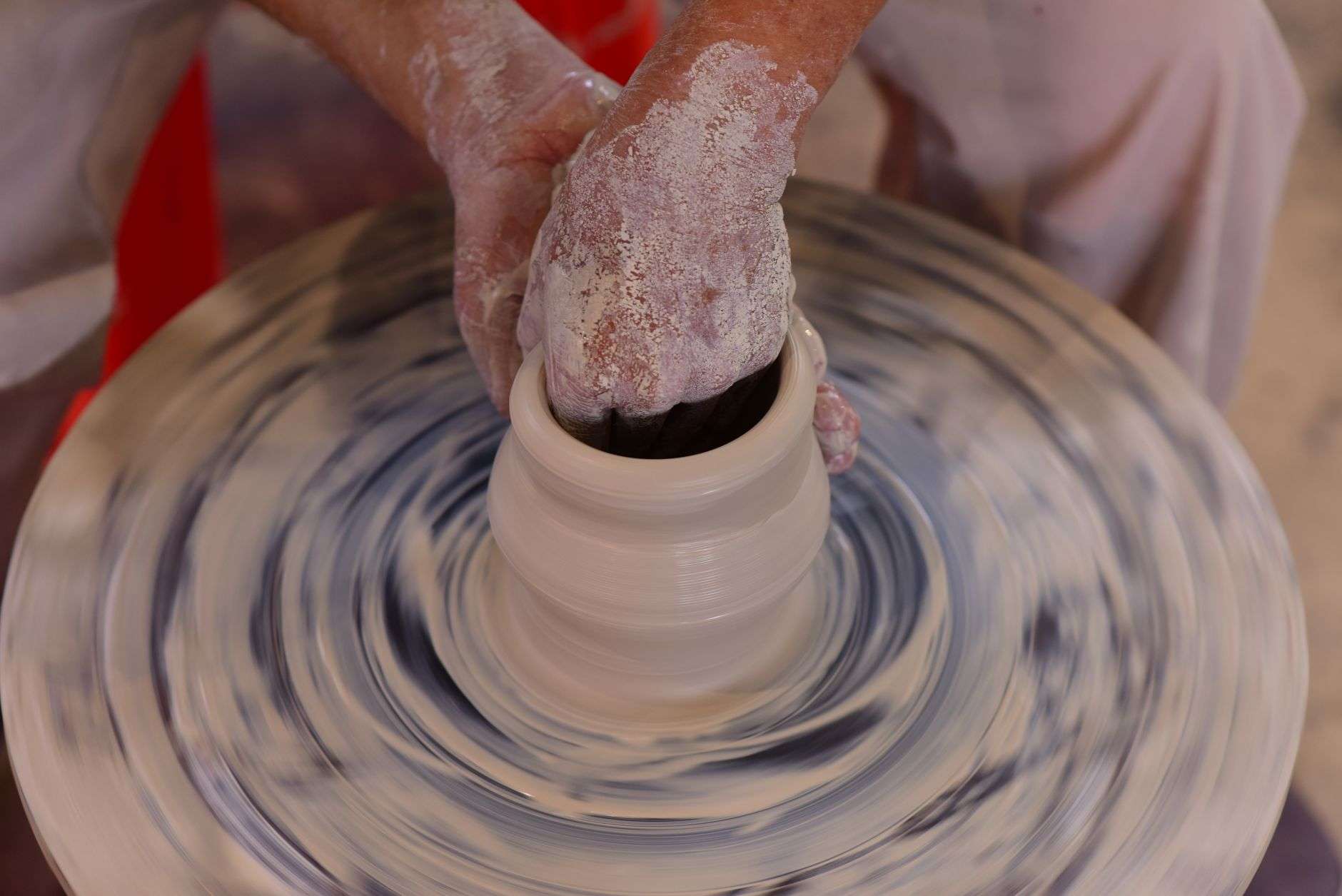
“Allow yourself to be a beginner.” That is the first lesson Megan Shifflett gives every student who walks into The Kiln Studio and Gallery on Church Street in Fairhope, whether they have never touched clay or have spent years at the wheel. A teacher at heart, Shifflett brings an infectious enthusiasm to the pottery studio she has owned since 2019, and her students, members and fellow instructors describe the place in one word more than any other: family.
From Long Beach to Montevallo
Shifflett’s path to Fairhope covered a lot of ground. Born and raised in Long Beach, California, she moved with her family at age 13 to Yankeetown, Florida, a small community on the Withlacoochee River along Florida’s Nature Coast.
She attended the University of Montevallo in central Alabama, earning her degree in painting and ceramics. Montevallo has a long-standing reputation for its art program, and it was there that her life took several important turns. She met her future husband at a mall in Birmingham while in school, and she met Susie Bowman, the woman who first opened and ran The Kiln in Fairhope.
The connection came through a very particular piece of equipment. The University of Montevallo had the only anagama kiln in the area, and Bowman often brought her work there to be fired. An anagama is a traditional Japanese-style wood-fired kiln, typically built as a long, sloping tunnel. Firings can last for days and require a crew to feed the fire around the clock. As wood ash drifts through the chamber and melts onto the pottery, it creates natural glazes and unpredictable surface effects that many potters prize. Kilns like that tend to draw ceramic artists together, and the friendship between Bowman and Shifflett would prove important years later.
Dirt and Power Tools
After Montevallo, Shifflett earned her master’s degree in 2010 from the Rochester Institute of Technology’s School for American Crafts in New York, one of the country’s well-known graduate programs in craft media. Her thesis, titled “As I Recall,” told stories from her own life.
After finishing her master’s degree, she was offered a position at the University of South Alabama in Mobile teaching ceramics and 3-D design. She sums up the job with a grin: “It was about dirt and power tools.”
While she taught at South, she and her husband, James, also ran a business in Ocean Springs, Mississippi, selling clay, glaze and equipment, giving her a view of the ceramics world from the supply side as well as the classroom.
Buying The Kiln
Bowman kept up with Shifflett over the years, and when she decided to sell The Kiln, she reached out. “I think you’d be great at this,” Bowman told her.
Shifflett bought the studio in 2019, just before the COVID-19 pandemic. She and James moved to Fairhope’s Fruit and Nut neighborhood, the charming residential district known for streets named after fruits and nuts, right before Hurricane Sally struck the Alabama coast in September 2020. It was hardly an easy start for a new business owner.
But The Kiln was already an established studio, and Shifflett says she has had strong support from its members since taking over. Members are artists who have taken classes and pay a monthly fee for access to everything the studio offers, from wheels and work space to kiln firings. “Members help a lot,” she said. “A few were already teaching classes when we took over.”
Teaching the Language of Clay
Shifflett loves teaching, and she approaches it seriously. She wants her students to learn the language of ceramics so they can speak intelligently about their own work.
“Lines, texture, value, shape, and color,” she said. “How you order the elements is important. I want my students to understand the elements of design and composition as they work on their projects.”
The studio’s instructors share that encouraging spirit. Claire Lawry, one of the teachers, tells students to “allow yourself to be a child again,” especially when they start with wheel-throwing classes. Donna Kemp teaches hand-building, which involves molding, sculpting and shaping clay by hand.
For those new to pottery, the two approaches offer different experiences:
- Wheel throwing means shaping a spinning lump of clay on a potter’s wheel. It takes practice to center the clay and pull up even walls, but it is the classic way to make bowls, mugs and vases.
- Hand-building uses techniques such as pinching, coiling and working with slabs of rolled clay. It is often more approachable for beginners and children and allows for sculptural forms.
In either case, finished pieces typically go through a drying stage, a first “bisque” firing, glazing and a final glaze firing before they are ready to use.
The studio’s two most popular offerings are its nighttime wheel-throwing and hand-building classes. Kids’ hand-building birthday parties, for children ages 8 and up, are also a hit, with young guests making trays and tumblers and getting their hands in the clay.
A Place for Groups, Families and Date Nights
The Kiln works well for all kinds of gatherings. It has hosted family groups, date nights, team-building events, Christmas parties, bridal showers and college reunion get-togethers. It also offers private lessons, and grandparents sometimes bring grandchildren in when they are visiting town.
“I love meeting new people and watching them discover their creativity,” Shifflett said.
The studio doubles as a gallery. The Kiln represents more than 20 local and nationally known ceramic artists, and every piece is one of a kind, with no reproductions. That fits comfortably within Fairhope’s long tradition as an arts town, home to the Eastern Shore Art Center, the monthly First Friday Art Walk and the long-running Arts and Crafts Festival each March.
Bowls for a Cause
The Kiln’s biggest charitable effort supports the annual fundraiser for Loaves & Fishes, the Mobile nonprofit that serves homeless and needy residents. Local artists create bowls that are sold to raise money for the organization.
In fall 2022, Shifflett said members had already made more than 70 bowls for that year’s event. “Last year we donated over 120 bowls and then had a big party afterward,” she said.
“We Are Definitely a Family”
That family feeling is something members bring up without prompting. During one visit, member Sue Thompson, busy on a project, chimed in: “Feels like a family. People care about you here. You are a part of something. Everyone is nice and you make a lot of friends.”
Shifflett experienced that support firsthand. She was diagnosed with malignant melanoma and had surgery in 2021, followed by another surgery in 2022. “Everyone bonded together and supported me with food, babysitting my two children, and kept the Kiln going while I was recovering,” she said.
For Shifflett, the studio is more than a business. “This is my happy place, my endgame. I love teaching people to love clay,” she said.
Her favorite moment is the one every teacher lives for. “Watching someone get into it is so cool. If a student is struggling at the wheel, and suddenly it clicks, or they get something out of the kiln and realize: I made this! You can see it in their eyes!”
Getting Started at The Kiln
If you have been curious about pottery, a few tips can help:
- Start with a beginner class or a one-time experience before committing to a membership.
- Wear clothes you do not mind getting muddy, and keep fingernails short for wheel work.
- Expect a wait between making a piece and taking it home, since drying and firing take time.
- Consider booking a private session for a birthday, date night or team outing.
- Contact the studio directly for current class schedules, pricing and membership options.
Most of all, take Shifflett’s advice to heart. Allow yourself to be a beginner.