

Two of the coastal area’s most quietly accomplished artisans anchor this look at holiday-worthy local work: a Point Clear potter whose wood-fired vessels are fired in the region’s only anagama kiln, and an Andalusia floral artist whose faux evergreen designs have made her workshops the hottest ticket of the season. Both carry family histories that reach back generations into Alabama craft, and both do their best business between Thanksgiving and Christmas.
Zach Sierke and the Oyster Bowl
Zach Sierke is the epitome of a local artisan. His grandfather was a potter, and when Zach began his own path in clay, he became enamored with the history of the local clay itself — its properties, and the stories it tells about the natural world of Mobile Bay. The turning point came when he discovered his grandfather’s kiln nearby, which he describes as divine intervention.
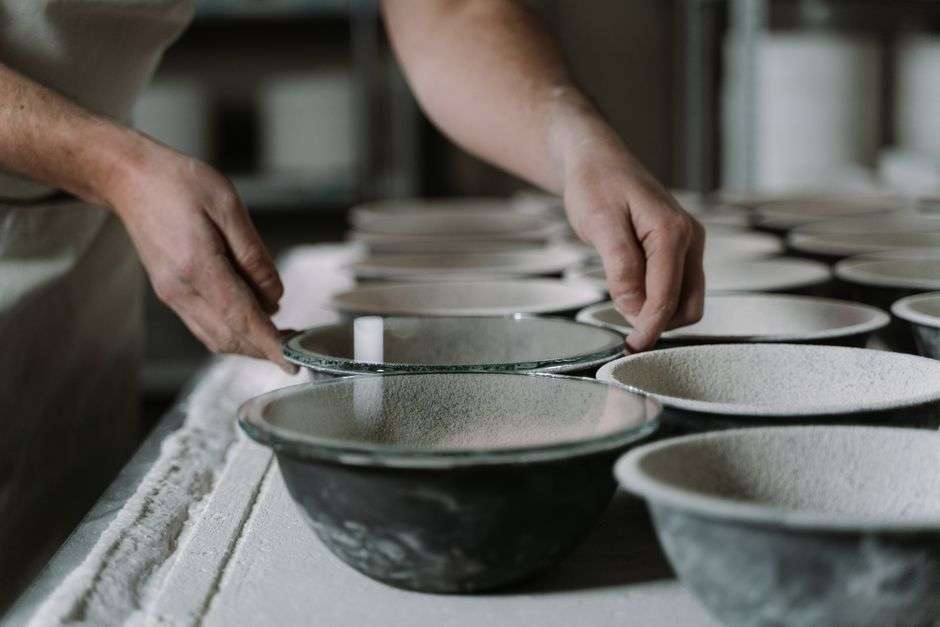
At his studio in Point Clear, Sierke built a wood-fired anagama kiln — a Japanese design dating to the fifth century, and the only one of its kind along the coastal area. Anagama firing is a multi-day ordeal: the kiln is fed wood around the clock, ash settles on the pots, and the results are never exactly what the potter plans. Each Thanksgiving week, a team of potters from across the country travels to Point Clear to take part in the week-long firing.
“Coffee mugs are personal,” Sierke says. “It’s a time in the morning when you reflect and plan your day. Knowing that each morning is embraced with the knowledge that you’re drinking from a vessel harvested from local clay and fired in a time-honored tradition that this area surrounding Mobile Bay is known for just makes the day better.”
For the 2025 holiday season, Sierke produced a limited edition that distilled the region into a single object: a hand-built oyster bowl, fired in an electric kiln, with a portion of its clay harvested from beneath local natural oyster beds. Each piece carries his studio mark and the 2025 date; one hundred were to be made, with the first twenty-five ready before Christmas and the rest shipped by April 1, 2026. No two are alike — each one a small geology of Mobile Bay.
“Since I was a young boy, my father instilled in me a love for the oyster,” Sierke explains. “They have been a part of the culture here since the beginning of time. Oysters have sustained populations well before the Europeans came to the New World. Oysters are part of the natural history of our area, and have been a part of my personal mythology since I was a boy.”
Allie Nielsen and Vine + Branch
Across the Bay in Andalusia, Allie Haynes Nielsen built Vine + Branch the way many beloved businesses begin: as a side project to express a creative side that a demanding day job couldn’t hold. Hers was lung-transplant nursing — rewarding, as she says, but demanding and stressful. Creativity runs in the family; her grandmother, aunt, and mother are renowned in the Birmingham area for floral design and party planning.
Marriage added another layer. Her husband Will Nielsen runs the Knud Nielsen Company, the dried-floral business his family founded in Evergreen, Alabama in 1913 — more than a century of Alabama flower trade. When the couple moved to Andalusia, Allie finally had the space, and access to the finest floral ingredients, to exercise her own talents: permanent faux-flower arrangements built to the standard of works of art.
“I’ve always enjoyed creating with my hands,” she says. “When we moved to Andalusia, I finally had the space to express my creativity, and I had access to the finest floral ingredients. I use my own designs to accent any home decor.”
Six years on, Vine + Branch has grown into a leading resource for custom-designed floral pieces for home decor, with sold-out workshops and pop-up shops throughout the coastal area. The holiday season is its showcase: seasonal wreaths, garland, and accessory floral art pieces, plus fresh-pulled smilax, preserved bell balls, paper whites, and gift packages built for shipping to friends and family.
Why Local Craft Matters at the Holidays
Both artisans make the same quiet argument: that the objects we live with should come from somewhere, made by someone, in a tradition worth keeping. Sierke’s bowls are literally made of Mobile Bay — clay dredged from under the oyster beds that fed the region for centuries. Nielsen’s arrangements continue a 112-year-old family floral trade that most customers never knew started in Conecuh County.
Gift-buying from local makers also keeps money circulating where it lives. A $125 oyster bowl or a handmade wreath does more per dollar for the regional economy than a mass-produced equivalent, and neither can be found in a big-box aisle. In an era when a “handmade” tag can mean anything, knowing the maker — meeting Zach at the kiln, or Allie at a pop-up — is the whole difference.
The two artisans also represent different poles of Gulf Coast craft. Sierke’s work is anchored in materials and place — local clay, local fire, local history — while Nielsen’s is anchored in family lineage and reinvention, taking the dried-floral trade her in-laws built and remaking it in permanent botanicals for modern homes. Between them, they sketch the range of what the region’s maker economy now looks like.
For shoppers planning a coastal holiday — or a gift that says “here” instead of “anywhere” — both studios belong on the list. Sierke’s Point Clear studio takes visitors by appointment, and Vine + Branch’s seasonal pieces and workshops are announced on its social channels, with pop-up shops appearing across the coastal area through the season.
A Studio Visit at Point Clear
What a visitor notices first at Sierke’s studio is the kiln itself — a long, low wood-fired anagama built by hand, with a firebox that runs for days at temperatures past cone 10. The Thanksgiving firing is a community event as much as a technical one: potters fly in from across the country, split the stoking shifts around the clock, and camp out around the kiln for the week. The ash that settles on each pot during the burn becomes the glaze; no two firings, and truly no two pots, come out the same. Pieces that survive the process carry ash runs, ember marks, and clay bodies that hint at where the local material was dug.
That provenance is the point of the oyster bowl edition. Clay harvested from under natural oyster beds carries the bay’s chemistry into the object — a dinner vessel whose raw material spent centuries filtering the same estuary the meal on it likely came from. Collectors who ordered from the 2025 edition received numbered pieces, each stamped with the studio mark and the year.
Wreaths With a Family Tree
Nielsen’s work, meanwhile, carries a Century of Alabama commerce in it. The Knud Nielsen Company, founded in Evergreen in 1913, grew into one of the country’s major dried-floral operations — the kind of business that supplies designers nationwide and stays almost invisible at home. Allie’s studio work brings that supply chain into view: preserved bell balls, smilax pulled fresh for garlands, and faux arrangements built to survive years of seasons without a drop of water.
Her workshops — which sell out — walk participants through building a piece of their own under instruction, and her pop-ups through the coastal area have become seasonal landmarks in their own right. The holiday line is announced in late fall and tends to sell through; followers track it on Instagram.
Between the two studios, the coastal area’s gift economy has a distinctly local answer for the season’s hardest names on a list: the person who has everything, and the person who wants something that means something. Both find their answer here.