Bidding Closes on Fairhope’s Round House Move, Setting Up City Council Vote
The City of Fairhope has closed bidding on relocating the historic Round House, or "Hermit Hut," clearing the way for a City Council vote on moving it to Flying Creek Nature Preserve.
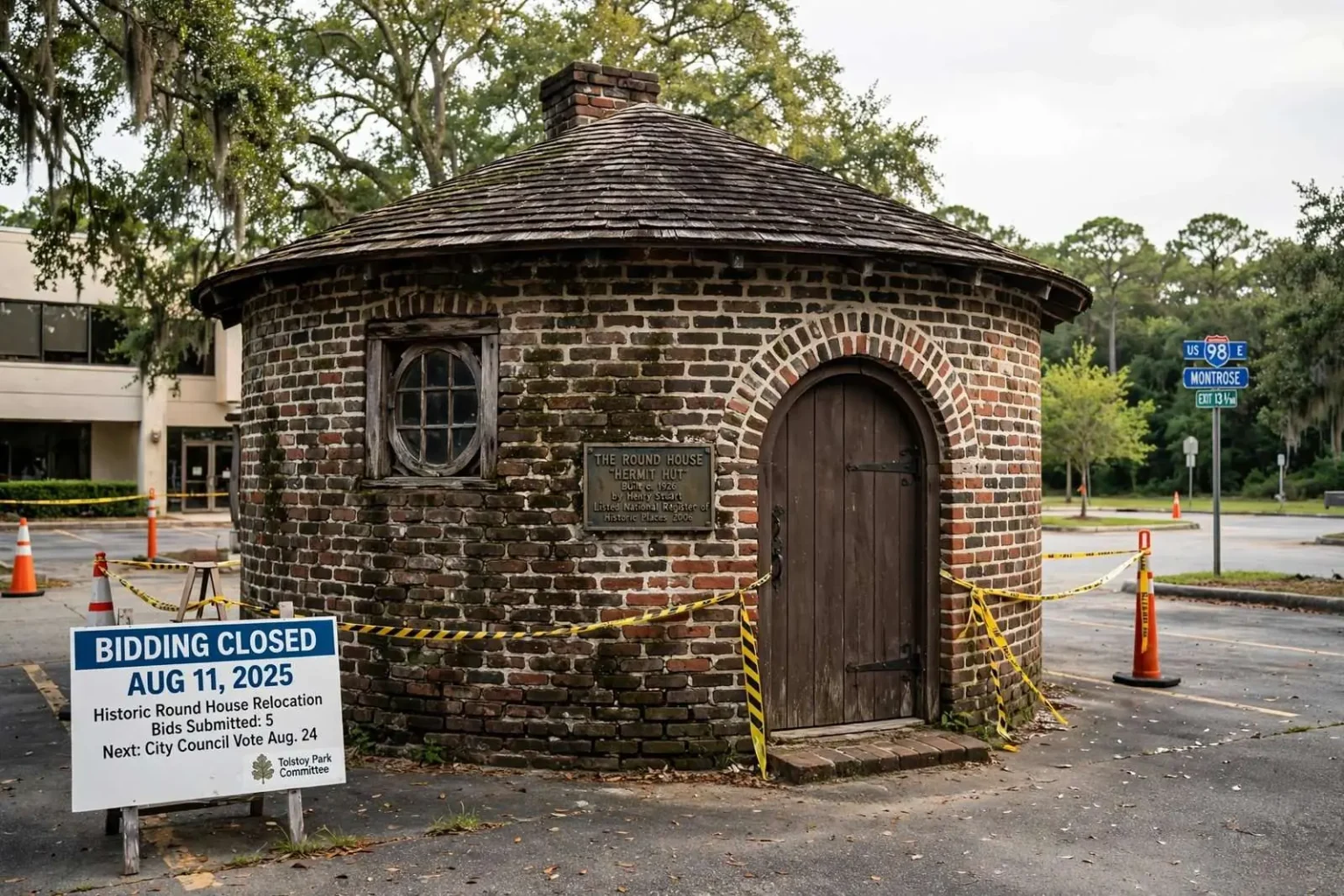
The long-running effort to relocate Fairhope’s historic Round House cleared a major hurdle on Tuesday, Aug. 11, when the City of Fairhope closed the bidding process for the project, moving the beloved local landmark one step closer to a new home.
The Round House, often called the “Hermit Hut,” currently sits in an office building parking lot along U.S. 98 East in Montrose. It was built nearly a century ago by Henry Stuart, an Englishman who immigrated to the United States as a child and later lived out his later years in the small, circular structure in the Fairhope area then known as Tolstoy Park. Though Stuart lived as a recluse, he was hardly isolated: more than 1,300 visitors are said to have stopped by during his years there. The Round House earned a spot on the National Register of Historic Places in 2006.
A Community-Driven Push to Save a Landmark
The relocation project is being led by the Tolstoy Park Committee, a community organization co-chaired by Fairhope author Sonny Brewer, who wrote the 2005 novel “The Poet of Tolstoy Park” based on Stuart’s life and his time in the Round House. The committee reached its fundraising goal of $369,000 in November 2025 after roughly two years of community fundraising efforts.
The push to move the structure comes as the 100th anniversary of the Round House’s completion approaches. Stuart is said to have set the last brick on Oct. 23, a milestone the committee hopes to honor as the relocation moves forward. The plan calls for the Round House to be moved to the Flying Creek Nature Preserve, located on the east side of Main Street in Fairhope, giving the historic hut a permanent and publicly accessible home.
Five Bids, One Clear Choice
The City of Fairhope began accepting bids for the physical move on June 12, with the window closing Aug. 11. In a newsletter sent to supporters on Aug. 12, Brewer described the moment the bids were opened, saying the city clerk unsealed letters from five different companies proposing to relocate the structure.
“I was nervous,” Brewer wrote in the newsletter. “Sometimes, in my passion and intensity to save it, I have to be reminded that I am not Henry Stuart, and the Round House is not mine. So, with Bobby at my feet under the conference table, I held my breath as the city clerk’s letter opener came out to get inside the sealed envelopes.”
Of the five proposals, Brewer said the third bid, submitted by an undisclosed Fairhope-based company, stood out immediately. “Right on the money!” he called it in the newsletter.
“This move is going to happen,” Brewer said. “After two years of fundraising efforts — with a company from Fairhope, mind you! — a contract can be signed to ‘get’er done.’”
What Comes Next
With the bidding process complete, the project now heads to the Fairhope City Council, where Brewer expects a vote as soon as the council’s next meeting on Aug. 24. City leaders have previously expressed support for relocating the Round House, and a favorable vote would clear the way for a contract to be signed and the physical move to begin.
For a structure that has stood along U.S. 98 for generations, the move to Flying Creek Nature Preserve would mark a new chapter — one that supporters hope will preserve Stuart’s unusual legacy for future generations of Fairhope residents and visitors alike.
The Round House’s unusual history
The structure slated to move is no ordinary shed. Henry Stuart, an Englishman who came to America as a child, built the circular “Hermit Hut” nearly a century ago in the community then known as Tolstoy Park, and lived there as a recluse whose solitude was anything but lonely — more than 1,300 visitors are said to have called on him during his years in the hut. The round form, the hand-set brick and the eccentric owner made the building a local curiosity long before it earned a National Register of Historic Places listing in 2006. Moving it is less a public-works project than a small act of cultural conservation, preserving a piece of Fairhope’s unconventional past that a parking lot could not.
Tolstoy Park and the committee that saved it
The relocation is the work of the Tolstoy Park Committee, co-chaired by Sonny Brewer, the Fairhope author whose 2005 novel “The Poet of Tolstoy Park” fictionalized Stuart’s life. That literary connection is part of why the effort drew community fundraising rather than merely municipal budgeting: the Round House is a story people already cared about. The committee’s $369,000 goal, reached in November 2025 after about two years of grassroots effort, shows how a beloved local landmark can be saved by small donations and persistent volunteers when a city might not prioritize it. Brewer’s newsletter account of the bid opening captures the emotional weight the project carries for those who fought for it.
Why Flying Creek Nature Preserve
The planned new home — Flying Creek Nature Preserve on the east side of Main Street — gives the Round House what its current parking-lot site cannot: a permanent, publicly accessible setting where visitors can encounter it in context rather than beside an office building. A nature preserve is also a fitting resting place for a structure built by a man who sought quiet and open sky, and it ties the hut to the kind of green space Fairhope has worked to protect as the city has grown. The move, if the council approves, would let the 100th anniversary of Stuart setting the last brick — said to be Oct. 23 — be marked at a destination rather than a roadside.
What the council vote means
With bidding closed and a Fairhope-based mover’s bid described as “right on the money,” the project’s next gate is the City Council vote expected as soon as Aug. 24. Council support has been signaled before, so the vote is likely a formality, but it is the formal step that lets a contract be signed and the physical relocation begin. For a structure that has anchored a corner of U.S. 98 for generations, the move to Flying Creek would open a new chapter and, supporters hope, secure Stuart’s odd legacy for the next century of Fairhope residents and visitors.
The engineering of a move
Relocating a century-old brick structure is a specialist’s job, not a ordinary hauling task. A round building of hand-set brick must be stabilized, likely cribbed and braced, then lifted onto a transporter and carried — slowly — to a new foundation engineered to receive it, all without cracking the masonry that has survived a hundred years. That is why the committee cared which bid won and why a Fairhope-based mover “right on the money” was cause for relief: local knowledge of the structure and the route matters when the cargo is irreplaceable. The council’s vote unlocks that careful work, and the anniversary timing gives the move a deadline with meaning.
A landmark’s second life
If the council votes yes, the Round House will trade a parking lot for a preserve, and a roadside curiosity for a destination. That is the arc the Tolstoy Park Committee has pursued for two years: not merely to save a building but to give it a life, where visitors can stand inside the circle Stuart built and feel the quiet he sought. The 100th anniversary of the last brick, near Oct. 23, would be a fitting moment to mark the move, and Flying Creek offers the public access the current site lacks. For Fairhope, the relocation is a small victory for the unconventional past that gives the city its character, and a sign that a committed few can move more than a building.
What residents can do now
With the council vote expected by Aug. 24, Fairhope residents who care about the Round House have a clear, near-term way to be heard: show up, write, or simply pay attention to the meeting where the contract is authorized. The committee’s two-year campaign shows that public will, expressed steadily, moves a city — first to fund, then to bid, then to vote. If the relocation proceeds, the next chapter will be the move itself and the hut’s reopening at Flying Creek, and the same supporters who filled the fundraising jars will be the first through the gate. A landmark saved by a community tends to be loved by that community all the more.
Fairhope’s habit of saving its past
The Round House effort fits a pattern in Fairhope, a city with a long, sometimes contentious relationship with its own history and a civic culture that organizes to protect what it values. From downtown storefronts to waterfront views, residents have shown a willingness to fundraise, lobby and show up when a piece of the past is at risk, and the Tolstoy Park Committee’s success is the latest instance. The council’s expected vote is the formal cap on two years of that energy, and a favorable outcome would add the Round House to Flying Creek as one more place where Fairhope’s unconventional heritage stays alive and open to the public.