

FAIRHOPE — The little concrete house built by a man who came to Baldwin County to die, and then lived another 23 years, is one step closer to a new home in the woods.
The Fairhope City Council voted Monday night to approve a $421,050 contract with Fairhope Building Company to relocate the home of poet Henry Stuart — known locally as the Hermit Hut — to the Flying Creek Nature Preserve. The work is expected to begin either late this year or early next.
The contract approval comes roughly nine months after community organizers finished raising the money to move the structure, capping an effort that began several years ago when local author Sonny Brewer, who wrote a novel inspired by Stuart’s life, began advocating to relocate the building to Fly Creek.
A move paid for entirely by donations
The city’s involvement came with a condition. In 2024, the Fairhope City Council agreed to move the structure — but only if no tax dollars were spent on it. Brewer’s group gathered hundreds of small donations before finally reaching the required amount through several large anonymous gifts.
The money, the logistics and the paperwork are now all in place. What remains uncertain is the schedule: city officials have not said exactly when the structure will be moved or when it could reopen to the public at its new site in the 104-acre preserve at the northern edge of Fairhope’s park system.
The man who moved to Fairhope to die
The story of the building begins in 1923, when Henry Stuart received a fatal prognosis from his doctor. Born in England in 1858, Stuart had lived in Ohio, Washington, D.C., and Idaho over a life that had already stretched past 60 years. Told he was dying, he decided to spend his final days someplace warm, bought 10 acres north of what is now downtown Fairhope, and started work on what he believed would be his final project: a round concrete hut, 14 feet tall and 14 feet wide, built by hand from concrete blocks he stacked himself.
He christened his final home “Tolstoy Park,” after the Russian novelist Leo Tolstoy, his favorite writer.
The prognosis proved wrong. Stuart lived for more than two decades in Baldwin County, gardening in what he called his “concrete garden,” weaving rugs on a loom inside the round house, recording daily temperatures and weather in meticulously kept diaries, and receiving a steady stream of curious visitors drawn by the handmade “Ye Olde Weaver” sign he posted along the road between Daphne and Fairhope. Far from the recluse his “hermit” nickname suggested, he counted the visiting lawyer Clarence Darrow among the notable figures who stopped by, and he regularly walked into town for lectures and dinners connected to Fairhope’s founding Single Tax Colony.
In 1944, at 86, Stuart moved to Oregon to live with one of his sons. He died in 1946 at age 88 — 23 years longer than his doctor had expected.
From dense pines to a parking lot
The round house still stands, but the world around it changed completely. The dense pine forest Stuart knew is gone, replaced by a small office complex and a parking lot in the Montrose area between Fairhope and Daphne. The building, listed on the National Register of Historic Places, is the only surviving portion of his original 10 acres.
In recent years the hut has drawn a steady trickle of visitors, many of them readers of Brewer’s 2005 novel “The Poet of Tolstoy Park,” which fictionalized Stuart’s life and renewed local interest in the property. Stuart’s descendants later donated three of his diaries and a scrapbook of photographs to the Fairhope Museum of History, and the diaries have been digitized and made available online through the Fairhope Single Tax Corporation archives — a trove that continues to add detail to what is known about his two decades on the property.
What the move means for Fairhope
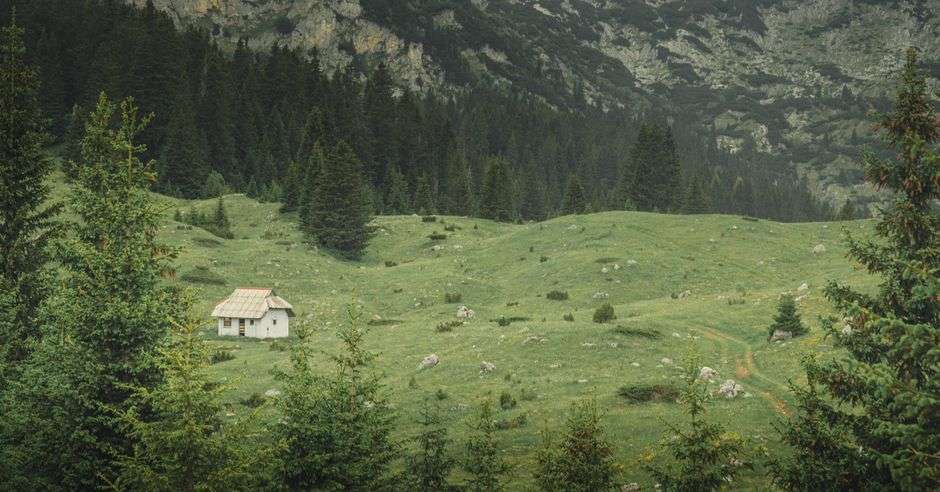
Organizers of the move argue that relocating the hut to Flying Creek Nature Preserve will put it back in a wooded setting closer to the one Stuart chose for himself, while creating a new cultural attraction for the city. The preserve is already the northern terminus of Fairhope’s park system, and supporters of the project have said the hut will add educational and cultural programming opportunities there.
It is not clear when exactly the structure will be moved or when it could be reopened to members of the public. Moving a 100-year-old concrete building is a delicate engineering job; the plan calls for the structure to be lifted intact and transported to the preserve, where a foundation will be waiting.
For now, Fairhope has a contract, a budget and a builder. The hermit’s last house, which he built expecting to use it for a few months, is about to begin its second century — this time in the trees.
How Sonny Brewer Found the Round House
Brewer, who insists the building is properly called the Round House rather than a hermit’s hut, has been telling Henry Stuart’s story for roughly four decades. “I’ve been talking about Henry Stuart for 40 years, and he wasn’t a hermit, and it wasn’t a hut!” he has said.
His connection began in 1982, when he signed up for a real estate class held at the office next to the abandoned structure. The windows were boarded up and the door padlocked. Someone at the office showed him a framed newspaper story about the “odd little round house in Montrose.” “Reading the article, I fell in love with the idea of telling Henry’s story and needed to know more. It captured me!” Brewer said. He skipped class that night; a carpenter at the time, he pried the door open with a hammer and pry bar from his toolbox and found an interior littered with pizza boxes and leaves, its concrete walls covered in graffiti.
For about 20 years afterward he wrote newspaper and magazine pieces about Stuart while the Round House stayed boarded up. When he pitched a novel to an editor at Random House with only 20 pages written, the publisher made an offer on the condition that he deliver 95,000 words within seven months. Brewer credits his former wife, Diana, for supporting him through the work.
To write, he arranged with Ken Neimeyer, who with partners owned the office development built around the structure, to lease the Round House for nine years at $9 a month, fixing it up at his own expense. He installed new windows and doors, found a 1927 pot-bellied stove, pressure-washed the graffiti off the walls, hung curtains and furnished it. “Ken deserves all the credit for preserving it in the first place, as the office development was built around the historical structure,” Brewer said. He finished the manuscript in six months and hand-delivered it to Random House in New York.
When Page & Palette kicked off his book tour, readers wanted to see the building, so Brewer took off the padlock and opened it to the public. “Henry would have never locked his house, so we wanted visitors to come anytime,” he said. The novel went through two hardcover printings, an audio version and a large-print edition, was a Book Club of America pick and a Ballantine Reader’s Circle book, and its film rights were acquired.
The Road to Fly Creek
The relocation effort gained city backing when Councilman Kevin Boone got involved and Mayor Sherry Sullivan agreed the city could provide a site. Neimeyer made a legal conveyance of the structure, conditioned on its being moved to public property where it would always be open to visitors. Sites behind the Fairhope Visitor Center and at the edge of Knoll Park were discussed before the Flying Creek Nature Preserve came up. “Henry would have walked barefoot through that area on his way to town. This location is sacred to the memory of Henry,” Brewer said.
Under the arrangement, the city agreed to provide the site, utilities, signage and security, while the cost of the move was to come from private donations. In fall 2025 the relocation was estimated at close to $369,000; the Fairhope Single Tax Corporation provided a $184,000 matching grant, and a Tolstoy Park Fundraising Committee was formed. At that point, Brewer said, about $150,000 was still needed. Interest in the site remained strong: in 2025 alone, more than 2,000 visitors from 25 states and five foreign countries had signed the Round House guest book by that fall.
Brewer on the Builder and the Book
In an earlier interview, Brewer described what first drew him to the structure. “When I first encountered Henry Stuart’s round-house in Montrose, I knew there was a story behind it. I mean, who would hand-pour 80-pound concrete blocks and stack them in a 13-foot circle, add six windows and a door, a dome-shaped concrete roof, and call it home?”
“The more I learned about Henry over 20 years, the more determined I became to write his story,” he said. The long life of the novel surprised him: “I never thought the novel would make such an impact on so many people. I’m deeply grateful readers have kept the book going for so long.”
At its current site near the intersection of Parker and Greeno roads, the Round House has been furnished with period furniture, books, photographs and other artifacts, and it has long drawn local writers, musicians and artists looking for inspiration. Stuart named the property for Leo Tolstoy, and locals still sometimes call him the “Hermit of Montrose.”