Flying Creek Nature Preserve Phase III: Fairhope Accepts $2.5 Million GoMESA Grant for Bike Trails, Pump Track and Playground
Fairhope accepted a $2.5 million GoMESA grant to build mountain bike trails, a pump track, an adventure playground and more on the 36-acre south parcel of the Flying Creek Nature Preserve.
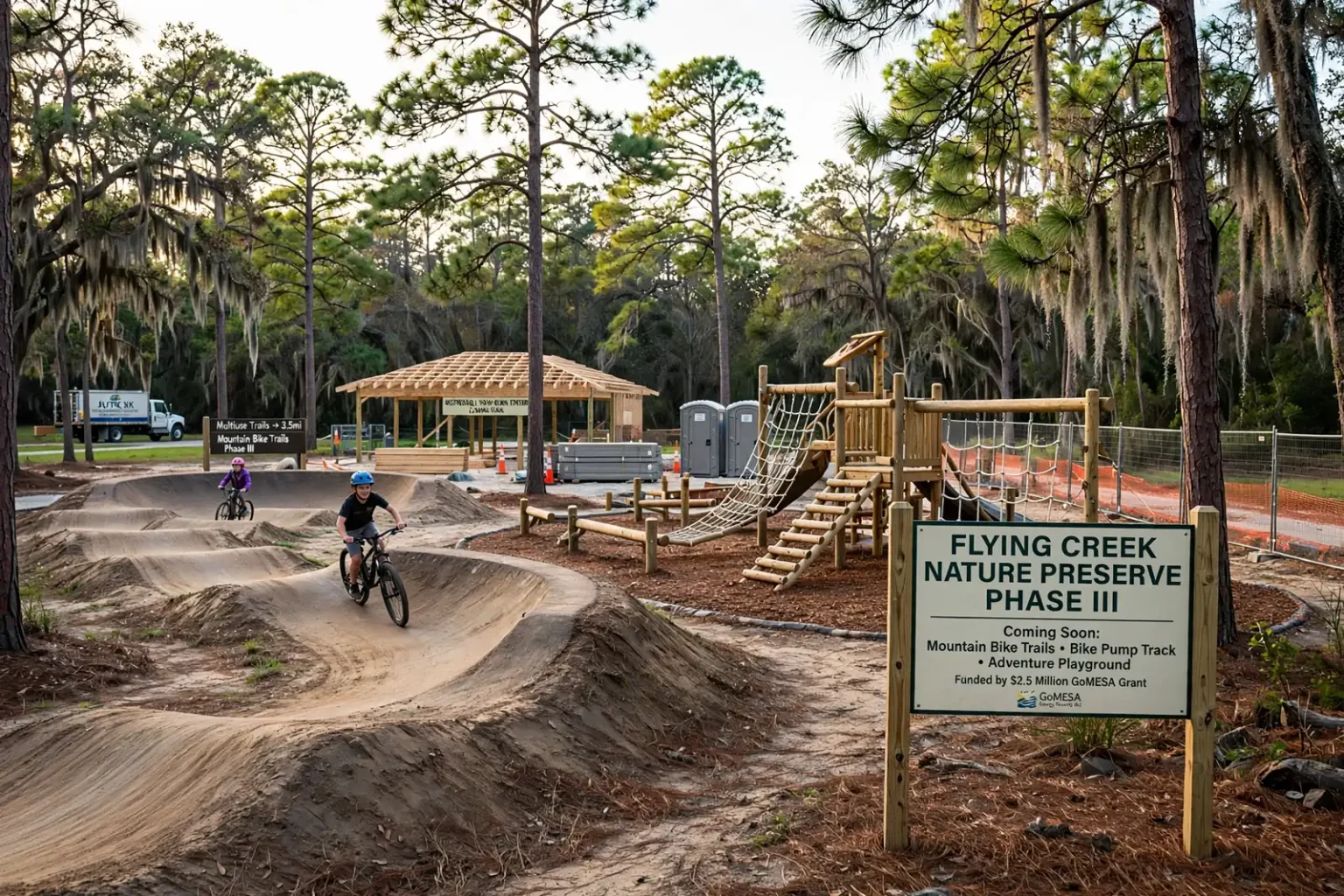
FAIRHOPE, Ala. — Mountain bike trails, a bike pump track and an adventure playground are coming to the southern side of the Flying Creek Nature Preserve after the Fairhope City Council formally accepted a $2.5 million GoMESA grant for the park’s third phase of development.
Council members accepted the money during their meeting Monday, Oct. 12. The grant will pay for Phase III of the preserve, the long-planned “active” side of the property, which covers a triangular 36-acre parcel bordered by Veterans Drive, U.S. Highway 98 and State Highway 104.
The award comes from the Gulf of Mexico Energy Security Act, known as GoMESA. It is part of a $52 million package of GoMESA funding that Gov. Kay Ivey announced in August, which will pay for more than 20 projects across coastal Alabama.
What Phase III will bring
The first two phases of the preserve focused on quiet, nature-based recreation on the larger northern tract. Phase III shifts the emphasis to more active uses on the south parcel. According to the city, the planned work includes:
- Multiuse trails
- Mountain bike trails
- A bike pump track
- An adventure playground
- A wash-down area
- A new restroom
- A pavilion
- Additional amenities
A pump track is a looped course of rollers and banked turns that riders move through by shifting their weight and “pumping” with their arms and legs rather than pedaling. Pump tracks are popular with young riders and beginners because they build bike-handling skills in a compact space, and they also draw experienced cyclists looking for a workout. A wash-down area gives riders and hikers a place to rinse mud from bikes and shoes before heading home, a practical addition for a park with dirt trails in a rainy coastal climate.
The adventure playground is aimed at families, giving younger visitors a place to play near the trailheads while older children and adults ride or walk.
How the grant money will flow
City documents show the state will release the $2.5 million in two installments. The first, $156,300, will cover engineering, design and permitting. The second and much larger installment, $2,343,700, is set aside for construction.
Splitting the money this way is common for grant-funded public works. Design and permitting must be completed and approved before construction begins, and the funding is released to match each stage of the work. The city has not announced a construction timeline for Phase III.
A preserve built in phases
Flying Creek Nature Preserve opened in August 2025, and the city has developed it in stages, each paid for largely with GoMESA dollars.
Phase I, funded with about $1 million in GoMESA money, covered the 72-acre property on the northern portion of the preserve. That work included an outdoor classroom, multiuse trails and a pedestrian tunnel.
Phase II, funded with about $1.3 million, added more outdoor classrooms along with a canoe and kayak launch, overlooks along the creek, and wayfinding and interpretive signs.
With Phase III, the city’s total GoMESA investment in the preserve’s amenities will reach roughly $4.8 million across the three phases.
The pedestrian tunnel built in the first phase was designed with the third phase in mind. As South AL News described in a look at the preserve after it opened, the Tunnel Trail ends at a lit concrete underpass decorated with a colorful mural, built to one day connect the passive side of the park to the active side across the road.
‘One of my top priorities’
City Council President Jimmy Conyers said protecting the land has been a personal focus during his time on the council.
“That 108, 109 acres has been one of my top priorities on city council,” Conyers said. “Just really glad to have preserved it for long term and for multiple different opportunities. Walking, hiking, biking. Just a great facility so I’m looking forward to seeing what they bring to us.”
From ‘the Triangle’ to a nature preserve
For decades, the wooded property at Fairhope’s northern gateway was known locally as “the Triangle,” a stretch of trees that drivers passed on their way in and out of town. The city bought the land from the Dyas family in 2013 for $8.75 million, a purchase made to keep it from becoming a high-density subdivision.
The preserve takes its name from the waterway along its northern edge, long known as Fly Creek. City officials chose the name Flying Creek as a translation of Bayou Volante, the name early French explorers gave the creek, likely a reference to its swift current.
Today the northern side of the preserve offers about three and a half miles of dirt and crushed-stone trails under a canopy of hardwoods and pines, along with a nature center, a covered pavilion, a creekside outdoor classroom and educational signs identifying native trees. Seven acres are being restored as longleaf pine forest, the ecosystem that once covered much of the Gulf Coastal Plain. The preserve’s entrance is at 22430 Main St., on Scenic U.S. 98 near the traffic circle at the city’s northern entrance, and the grounds are open daily from dawn to dusk.
The preserve is also set to become home to a piece of Fairhope history. The council has also approved a $421,050 contract to move the Hermit Hut, the round house built by poet Henry Stuart, to the preserve, with the cost covered by donations.
What GoMESA is and how Alabama uses it
Congress passed the Gulf of Mexico Energy Security Act in 2006. The law shares a portion of the federal revenue from offshore oil and gas leases in the Gulf with the four producing states along its coast: Alabama, Louisiana, Mississippi and Texas, along with their coastal counties and parishes.
Under the law, the money can be used for coastal conservation and restoration, hurricane protection, mitigating damage to fish and wildlife and natural resources, and related purposes. In Alabama, the state’s share is administered through the Alabama Department of Conservation and Natural Resources, and the governor announces the projects selected each year.
The August round that funded Flying Creek also benefited other Baldwin County communities. Across Mobile Bay’s Eastern Shore, Daphne received $5 million in GoMESA money toward a new 1,200-foot pier at Bayfront Park. Statewide, the $52 million package covers more than 20 projects, making GoMESA one of the steadiest sources of money for public access and conservation projects on the Alabama coast, alongside funding tied to the 2010 Deepwater Horizon oil spill.
Green space in a growing county
The investment comes as Baldwin County continues to add residents at a rapid pace, putting pressure on open land along the Eastern Shore. Fairhope’s founders, who established the town in 1894 as a single-tax colony, set aside public land along the bayfront that remains open to residents today, and supporters of Flying Creek have often described the preserve as an extension of that tradition.
By keeping the 108-acre property in public hands and building it out gradually, the city has created a park that serves two kinds of visitors: those seeking quiet walks and birdwatching on the northern side, and, once Phase III is complete, cyclists, families and trail runners on the southern parcel.
What comes next
With the grant accepted, the next step is engineering, design and permitting for the south parcel, funded by the first installment. Construction will follow once plans are complete and approved. Residents can follow the project’s progress through Fairhope City Council meetings, which are held on the second and fourth Mondays of the month.
In the meantime, the northern side of the preserve remains open, with its trails, outdoor classrooms, kayak launch and creek overlooks available to visitors every day from dawn to dusk.