

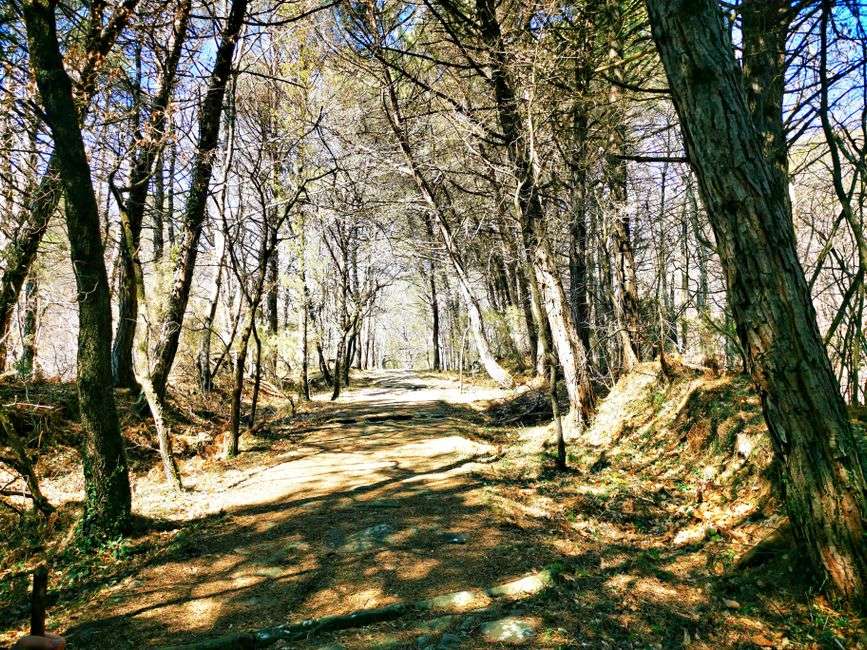
For decades, the wooded tract at the northern gateway to Fairhope was known simply as “the Triangle” — a quiet green backdrop that generations of residents drove past without a second glance. Today it is Flying Creek Nature Preserve, just over 100 acres of protected woods, creek bottom and trail that put a century-old conservation idea back at the center of the city’s identity.
Where to Find It
The entrance sits on the east side of Main Street — Scenic U.S. 98 — as you head from Fairhope toward Montrose, on the northwest side of the new traffic circle connecting old 98 with Veterans Boulevard and Triangle Drive/Highway 104, opposite the floral clock landmark. From downtown, it is only a couple of miles.
Turn off Scenic 98 and a new two-lane blacktop leads to parking and an information kiosk, then circles to a split-level Nature Center with public restrooms, two classrooms and a broad wooden deck overlooking the forested creek bed. You may not hear rushing water from the deck, but you will get the point: stillness, birdsong and shade.
Why ‘Flying’ Creek?
The preserve’s name sends newcomers to the dictionary. The waterway forming the park’s northern edge is the creek everyone calls Fly Creek — but city officials went back further, to the name early French explorers gave it centuries ago. “The term ‘Flying Creek’ is a direct translation of the French name Bayou Volante,” the city’s project background explains, “bestowed by early French explorers who settled along the Gulf Coast after the Spanish. The name likely described the swift current of the creek, a notable feature that would have been significant for navigation and settlement.”
What’s There Now
The opening phase dedicates 72 acres to so-called passive recreation — walking, birding, quiet enjoyment — while another 36 acres across Veterans Boulevard is planned as the “active” parcel, geared toward hikers and mountain bikers. Inside the woods, three-and-a-half miles of trails, some dirt and some crushed stone, wind under a canopy of hardwoods and pines.
The terrain rolls gently and rewards slow walkers. Educational placards identify the tree species: laurel oaks, beech, black gums, silver maples, sparkleberries and devil’s walking stick — the last with, as one sign warns, “viciously sharp thorns.” A covered pavilion with heavy rustic tables and a free-standing restroom encourage longer stays, and a creekside clearing with stump-and-log seating runs several degrees cooler than the uplands; it was designed as an outdoor classroom.
Trails carry names with local resonance — Connector, Primitive, Feeder, Gully, and the Carriage Trail, which follows the route a century-old carriage would have taken to town. The Tunnel Trail ends at a lit concrete pedestrian underpass decorated with a colorful mural, built to one day connect to the active side of the park.
Restoration in Progress
The land is being actively restored, not just preserved. Seven acres are being re-established as a longleaf pine forest — the ecosystem that once dominated the coastal plain — and other zones are managed to attract birds and butterflies. Walking through, you are watching an ecosystem being rebuilt.
What It Cost, and Why It Matters
The preserve carries a big price tag for open space: Fairhope purchased the property from the Dyas family for $8.75 million in 2013 specifically to block a high-density subdivision. Construction of the amenities has been supported by the Alabama Department of Conservation and Natural Resources plus $2.3 million in grant funds through the Gulf of Mexico Energy Security Act (GOMESA).
Critics have asked whether that kind of money should go to land that will remain mostly wild. The crowds at the grand opening ceremony suggested the answer: Fairhope was founded 131 years ago by conservation-minded colonists as a single-tax colony with public greenspace at its heart, and the preserve carries that founding philosophy forward in the most literal way possible.
If You Go
Flying Creek Nature Preserve is at 22430 Main St. in Fairhope and is open daily from dawn to dusk. The John Martin Nature Center, once fully complete, will be open 7 a.m. to 5 p.m. Bring walking shoes — the crushed-stone trails are easy, but the Gully and Creek trails will make you work a little. That is rather the point.