Judge Rejects Bid to Halt SS United States Sinking; Liner Still Set to Leave Mobile Monday as Group Refiles
A federal judge denied a preservation group's emergency request to block the tow and sinking of the SS United States, and Okaloosa County says the liner will leave Mobile on Nov. 9 as planned.
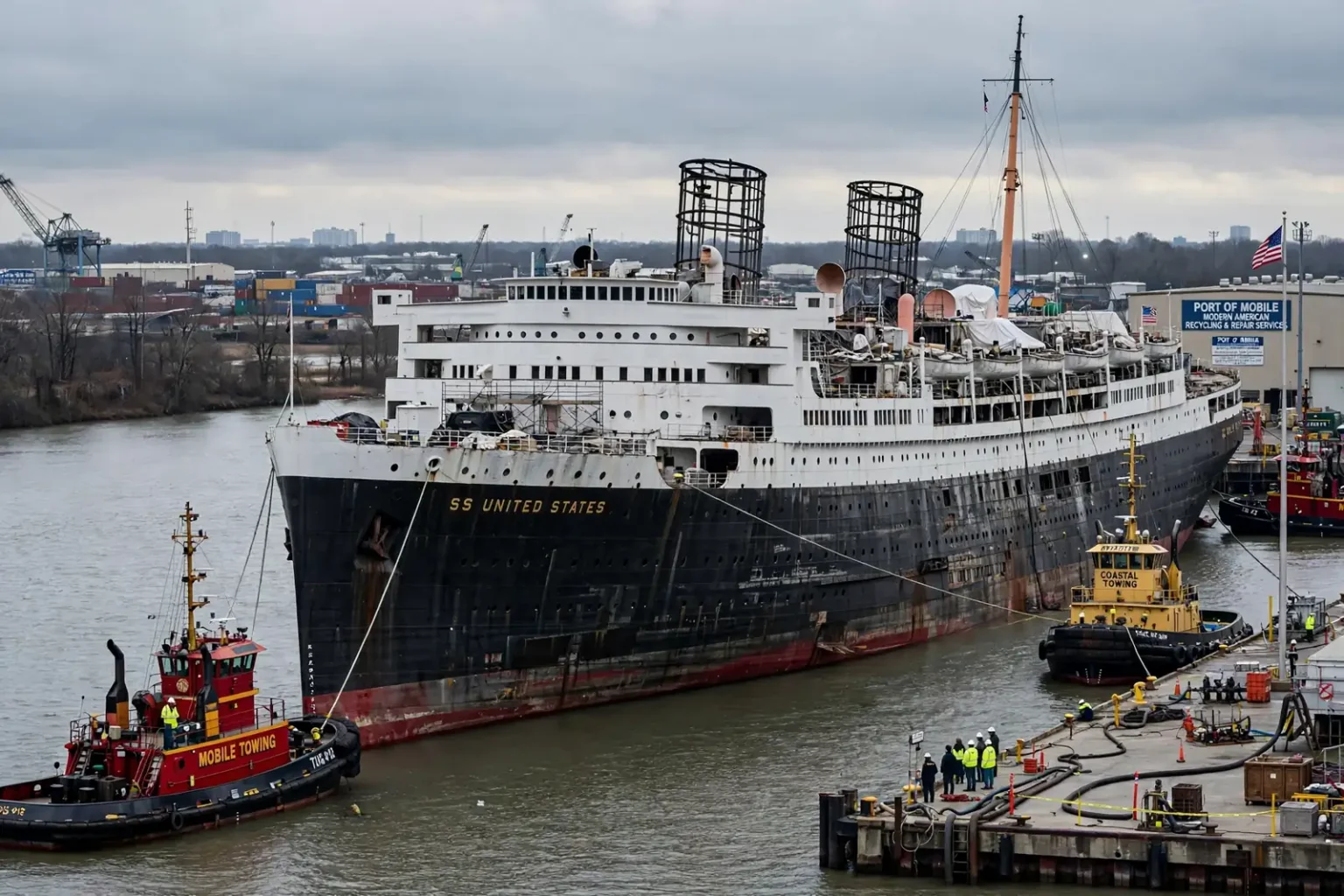
MOBILE, Ala. — A federal judge on Friday turned down an emergency request to stop the SS United States from being towed out of Mobile and sunk in the Gulf next week, keeping the historic ocean liner on schedule to leave the Port City on Monday after 20 months on the Mobile River.
U.S. District Judge M. Casey Rodgers of the Northern District of Florida denied the SS United States Preservation Foundation’s motion for a temporary restraining order, finding that the group had not backed up its request with the kind of sworn evidence the court requires. The denial was without prejudice, meaning the foundation can try again, and it did: the group filed a new motion later Friday, along with an affidavit from its co-founder.
For now, Okaloosa County, Fla., which owns the ship, says its plans have not changed. The 990-foot liner is scheduled to depart Mobile at 9 a.m. Monday, Nov. 9, and to be sent to the bottom of the Gulf about 22 nautical miles southwest of Destin-Fort Walton Beach on Thursday, Nov. 12, where the county intends to make it the world’s largest artificial reef.
What the judge found
The foundation and Steven Perry, a co-founder and longtime student of the ship, filed suit Tuesday, Nov. 3, in the court’s Pensacola Division, as South AL News reported Thursday. The defendants are the U.S. Army Corps of Engineers, two Corps officers, Acting Secretary of the Navy Adam R. Telle and Okaloosa County. On Wednesday, Nov. 4, the plaintiffs asked for an emergency restraining order to block the tow.
In her ruling Friday, Rodgers said the request was missing a basic building block.
“Here, the docket is void of a verified complaint and/or any affidavit attesting to the truthfulness of the facts set forth in the complaint and motion,” she wrote.
The motion had been filed with several exhibits, including expert testimony from a Florida professor. Rodgers appeared to set those aside in a footnote: “Sworn statements must be based on personal knowledge; the Court will not consider any subsequent filing in support of a TRO that contains hearsay.”
The judge also faulted the request for ignoring what it would cost to hold the ship in place. The motion, she wrote, “fails to recognize the obvious substantial expense associated with the injunction it requests; i.e. berthing, mooring, docking, storing, etc. a vessel as large as the SS United States.” The plaintiffs had asked the court to waive the security bond or set a minimal one.
Rodgers left the door open to another attempt but set a condition. “Any subsequent TRO motion must propose a bond amount sufficient to cover these expenses, supported by a reasonable factual basis,” she wrote.
The underlying lawsuit remains active. As of Friday, the court record did not show a formal response from the defendants or any scheduled hearings. According to the foundation’s new filing, a lawyer for Okaloosa County returned a call from the group’s counsel and indicated that the county opposes both a temporary restraining order and a preliminary injunction.
A second try
The foundation filed an amended emergency motion Friday, accompanied by an affidavit from Carlos Camacho Jr., the organization’s co-founder. The court had not ruled on that motion as of Friday’s reports.
Camacho has argued that sinking the ship as it is risks an environmental disaster. “There’s a possibility of having a serious potential for a Superfund site out in the Gulf, and Gulf seafood could be a risk,” he said.
Attorney Matthew Farmer, who represents the plaintiffs, declined to comment on the judge’s decision.
What the lawsuit claims
The suit accuses the Corps of approving the reef project without adequately examining environmental risks or complying with historic preservation requirements, in violation of the National Environmental Policy Act and the National Historic Preservation Act. It asks the court to set aside the Corps’ permit modification and its finding of no significant impact, and to bar the tow and sinking until the agency complies with both laws.
The environmental claims center on hexavalent chromium, a toxic heavy metal found in zinc chromate primer that was applied to the ship’s steel during construction in the early 1950s. The foundation estimates that about 59,000 pounds of zinc chromate primer was used, based on historical painting specifications, and says lab testing found hexavalent chromium in coatings sampled aboard the vessel.
“Over time, seawater exposure, corrosion, deterioration of the ship’s hull and coatings, according to scientist’s opinions as stated above and attached, may cause zinc chromate-containing paint to deteriorate, detach, and release chromium and zinc into the surrounding marine environment,” the complaint states. It argues the sinking “presents a reasonably foreseeable risk of introducing hexavalent chromium, zinc, and potentially chromium-containing paint particles into ocean waters and surrounding marine sediments.”
On the historic preservation side, the suit claims the Corps left Alabama’s state historic preservation officials out of conversations about the ship’s fate. The liner was listed on the National Register of Historic Places in 1999. The complaint also notes that the funnels, radar mast, last propeller, portholes and windows were removed during remediation, which it describes as “anticipatory demolition” before the reefing project was approved.
The suit also argues that putting the ship on the seafloor would cut most Americans off from it. “If the SS United States is sunk, the Foundation loses its sole reason for existence,” it states. “If sunk, the vessel will no longer be directly accessible to the general public. Direct, in-person access will be limited to individuals capable of undertaking the necessary offshore shipwreck dive.” The filing cites an estimate that about 2.7 million Americans, less than 1% of the population, went scuba diving in 2022.
Questions about the paint have followed the project for months and drew the attention of environmental activist Erin Brockovich earlier this year. Okaloosa County has said it followed all state and federal guidelines in preparing the ship, including removing materials containing PCBs and flaking exterior paint, and that zinc chromate is not federally regulated as a material requiring removal. The Corps has concluded the project would not cause significant environmental harm.
County: ‘She’s still currently scheduled to leave Monday’
Okaloosa County spokesman Nick Tomecek said Friday that the county is pressing ahead.
“We’re going to continue to take steps to follow through with our plans,” he said. “She’s still currently scheduled to leave Monday from Mobile. The USS Enterprise is coming in on the 13th, so we want to make sure we get out of her way.”
The former aircraft carrier Enterprise is on its final voyage from Virginia to Mobile to be dismantled.
Tomecek said some of the ship’s tanks have already been filled with water, and more will be flooded on the morning of Nov. 12. He said the sinking should take about 45 minutes and that the wreck will be open to divers the next day.
The county expects the reef to draw many thousands of visitors a year. “The news about this artificial reef has gone worldwide,” Tomecek said. “So we’re gonna see visitors to this area that we’ve never seen before just because of the ship. There’s a lot of folks interested not only in having a great wreck to dive but learning about the history of the ship and all the memories that were made aboard the vessel.”
Coast Guard: give the ship room
U.S. Coast Guard Sector Mobile has been working with Okaloosa County and the Corps on the transit and will enforce a moving safety zone around the liner and its tugs once it gets underway Monday morning.
“We’re going to be maintaining various crews through the entire process from Monday all the way to the 12th,” said Juan Ros, a public affairs officer for Sector Mobile. “Our job is to maintain the evolutions in maritime safety and respond to any emergency that may arise through the whole transit.”
The Coast Guard has set a 100-yard buffer around the ship and its towing vessels, but Ros asked recreational boaters who want to watch to give it much more room than that.
“We want everybody to stay clear at least one nautical mile just to make sure they don’t get hurt or anything like that. I’m sure there’s going to be a lot of vessels out there that want to experience this significant event,” he said.
Boaters should follow instructions from Coast Guard crews and monitor VHF Channel 16 for updates during the transit.
A farewell cruise from Mobile
People without a boat of their own still have a way to see the departure up close. The Perdido Queen, which has carried thousands of sightseers past the ship during its time in Mobile, is offering a farewell cruise Monday morning and plans to follow the liner out.
“We’re truly going to give the SS United States an honorable farewell,” said Blake Turner, a tour guide aboard the Perdido Queen. “We’re going to follow her out. We have some special guests on board. Lots of information. Pictures.” Among them, he said, is a guest who has joined the boat’s tours throughout the ship’s stay and who once sailed aboard the liner as a passenger.
Turner has spent months telling the ship’s story to visitors and said the goodbye is getting harder.
“It’s becoming more and more emotional the closer that we get, simply because of everyone’s attachment to the ship. And it can be from all walks of life, all kinds of different people. And that’s become a beautiful thing,” he said.
How to follow the final days
- Monday, Nov. 9: The ship is scheduled to leave Mobile at 9 a.m., weather permitting. Boaters should stay well clear of the moving safety zone.
- Wednesday, Nov. 11: Okaloosa County will host a public celebration of the ship’s history at 1:30 p.m. on Veterans Day at the Destin-Fort Walton Beach Convention Center in Fort Walton Beach, as previously announced.
- Thursday, Nov. 12: The deployment ceremony is set for 10 a.m. A viewing party with a live feed from the site is planned at AJ’s Seafood and Oyster Bar in Destin beginning at 9 a.m., and the county has said a virtual viewing link will be posted before the event.
- Friday, Nov. 13: The wreck is expected to open to divers, according to the county.
Any of those dates could still change if the court grants the foundation’s renewed request or if weather intervenes.
From record-setter to reef
Built at Newport News, Va., and placed in service in 1952, the SS United States is the largest ocean liner ever built entirely in the United States. On its maiden voyage that year it crossed the Atlantic in three days, 10 hours and 40 minutes at an average of more than 35 knots, a record for a passenger liner that still stands. It was withdrawn from commercial service in 1969 and spent decades laid up as a string of owners tried to revive it.
Okaloosa County bought the ship from the SS United States Conservancy in 2024 for $1 million and spent about $10 million moving it from the East Coast. It arrived in Mobile on March 3, 2025, for remediation at Modern American Recycling and Repair Services, where crews removed fuel tanks, windows, large amounts of paint and the ship’s two 65-foot smokestacks. The smokestacks are being kept for a planned land-based museum in the Destin-Fort Walton Beach area.
This is not the first legal fight over the liner’s fate. A suit filed in March 2025 by the New York Coalition to Save the Steam Ship United States was dismissed.