Preservation Group Sues to Stop SS United States Sinking as Coast Guard Sets Moving Safety Zone for Monday Tow From Mobile
A federal suit claims the Army Corps of Engineers did not adequately study the risk of zinc chromate paint, while the Coast Guard prepares a 100-yard buffer for the liner's departure on Nov. 9.
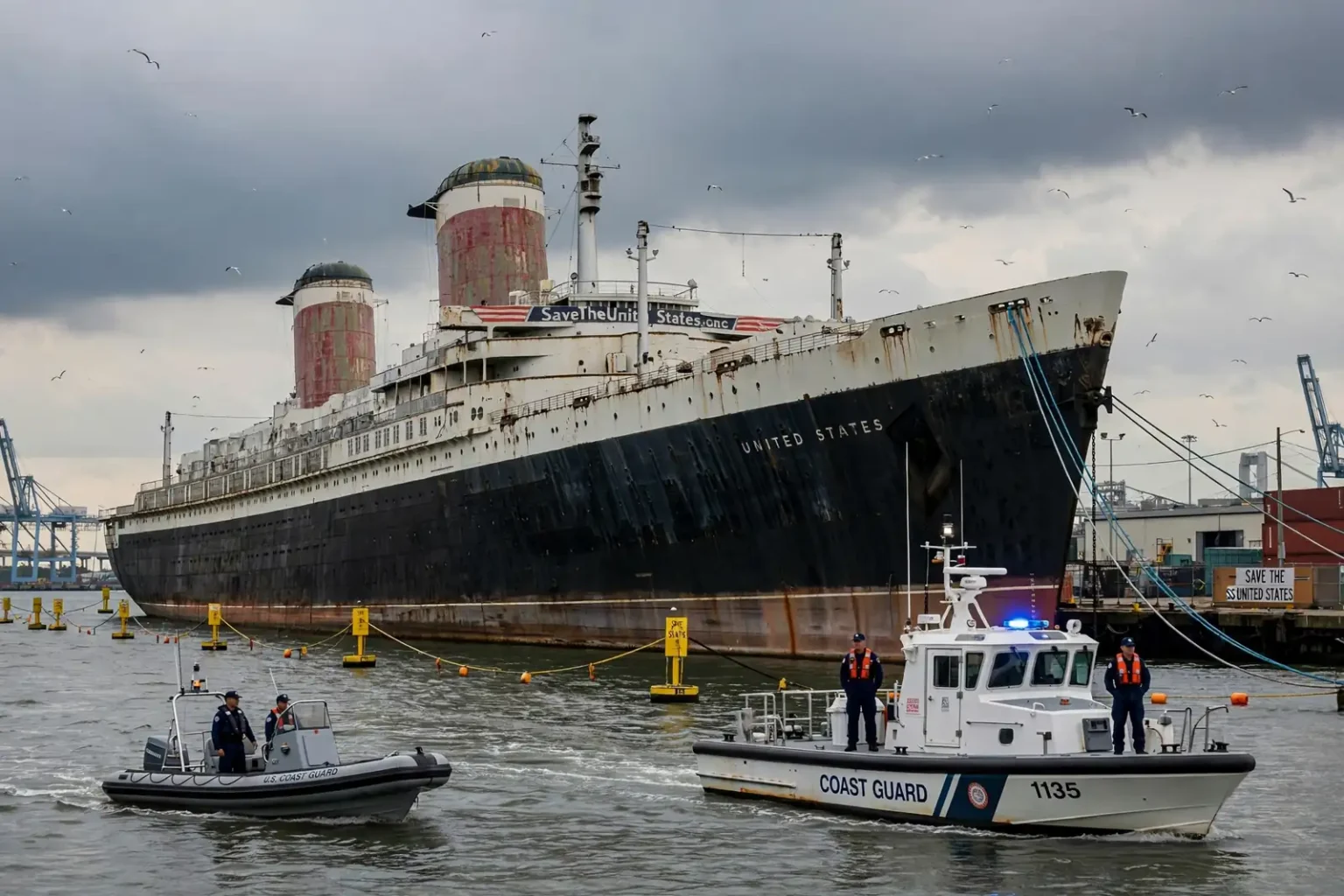
MOBILE, Ala. — A preservation group has gone to federal court in a last-ditch effort to stop the sinking of the historic ocean liner SS United States, even as the Coast Guard makes final preparations for the ship to leave Mobile on Monday.
The SS United States Preservation Foundation filed suit Tuesday in U.S. District Court for the Northern District of Florida. The defendants are the U.S. Army Corps of Engineers, two Corps officers, Acting Secretary of the Navy Adam R. Telle and Okaloosa County, Fla. The foundation has also filed an emergency motion for a temporary restraining order.
The filing does not by itself halt anything. Stopping the sinking would require an order from the court, and as of early Thursday afternoon the court record did not show a response from any of the defendants.
The schedule
The ship is expected to be towed from Mobile on Monday, Nov. 9, weather permitting, reach its offshore site on Nov. 10, and have sinking operations start at 10 a.m. Nov. 12. The location is about 22 nautical miles southwest of Destin-Fort Walton Beach, where Okaloosa County plans to make it the world’s largest artificial reef.
Boaters: stay 100 yards away
U.S. Coast Guard Sector Mobile is setting up a moving safety zone around the liner for the trip. The 100-yard buffer around the ship and its towing vessels takes effect Monday morning.
Officials said the zone is meant to protect mariners and keep local boat traffic at a safe distance as the ship moves through the bay and out to sea. Boaters are urged to stay clear, follow Coast Guard instructions and monitor VHF Channel 16 for updates.
What the lawsuit claims
The foundation said in a statement Thursday that it sued because the Corps “approved the project without adequately examining environmental risks or complying with historic preservation requirements.”
The suit accuses the Corps of failing to prepare an environmental impact statement, performing an incomplete historic preservation review and moving ahead with dismantling the ship while that review was under way. It also says the Corps was slow to provide requested information about its environmental study. The Corps has concluded the project would not cause significant environmental harm.
“Serious questions remained unresolved while the sinking moved forward,” said Matt Lesiw, foundation secretary and former chief science officer of the New York Coalition to Save the SS United States. “Proceeding with an irreversible sinking while those scientific questions remain unanswered sets a troubling precedent. The potential consequences for the marine environment and the risk of human exposure through Gulf seafood consumption are too serious to ignore.”
The paint dispute
The environmental complaints center on zinc chromate paint remaining on the ship. The foundation cites expert testimony that the paint contains hexavalent chromium, which one expert described as “extremely toxic to aquatic organisms.” The group has raised those concerns before the Okaloosa County Board of Commissioners.
Environmental activist Erin Brockovich weighed in earlier this year, saying, “Clean your ship up before you sink her … or be stupid, do it, harm thousands, and spend hundreds of millions cleaning up your crap for the next twenty years.”
Okaloosa County has said it followed all state and federal guidelines in preparing the ship. Those preparations included removing materials containing PCBs and flaking exterior paint. The county has said zinc chromate “is not federally regulated as a material requiring removal,” that it is treated similarly to lead-based paint and asbestos, “both of which are explicitly permitted to remain on (a) vessel when intact,” and that “zinc chromate in ocean environments is significantly different than closed or groundwater systems.”
What federal guidance says
The EPA’s “Best Management Practices for Preparing Vessels Intended to Create Artificial Reefs” does not directly address chromium. PCB cleanup is among its top concerns, and coatings containing zinc chromate are not discussed.
The guide generally says flaking paint should be removed, but intact paint does not need to be removed unless it includes PCBs. Antifouling paints used below the waterline may contain toxic materials, including zinc, the EPA says, but its guidance is that no remediation is necessary if those paints appear worn out, such as when they are very old or covered with marine growth.
The suit points out that the same guide says antifouling paints on sunken ships may “pose a substantial risk of both acute and chronic toxicity and other adverse impacts to ecologically and economically important non-target marine organisms,” and that such coatings can be reactivated by physical disturbance or biological degradation.
A long saga
The liner entered service in 1952 and was recognized as the fastest ocean liner in the world. She remained one of the most prestigious until 1969, when her original operator withdrew her from service and sold her.
The ship arrived in Mobile for preparatory work in early 2025 and quickly became a waterfront landmark and a small tourism boom. Operators of the Perdido Queen riverboat recently estimated they have carried more than 30,000 people to see it. It has now spent about 20 months in the city.
This is not the first court fight. A suit filed in March 2025 by the New York Coalition to Save the Steam Ship United States was dismissed.
Steven R. Perry, a foundation co-founder also listed as a plaintiff, is described in the suit as a marine engineer, former member of the Merchant Marine and retired naval reservist who has “studied and conducted technical work about and aboard the SS United States for 35 years, including planning and redevelopment efforts in 2016.”
“She was built to sail these waters, not be sunk beneath them,” Perry said. “You honor a flagship by giving future generations the chance to stand on her decks and understand what she represents.”
Asked about the suit, an Okaloosa County spokesman said, “Okaloosa County continues to move forward with this historic moment and we are excited to allow divers on this reef when she is fully deployed.”
The ship’s departure will also make room on the Mobile waterfront for another famous vessel, with the former USS Enterprise expected around Nov. 13 for dismantling.