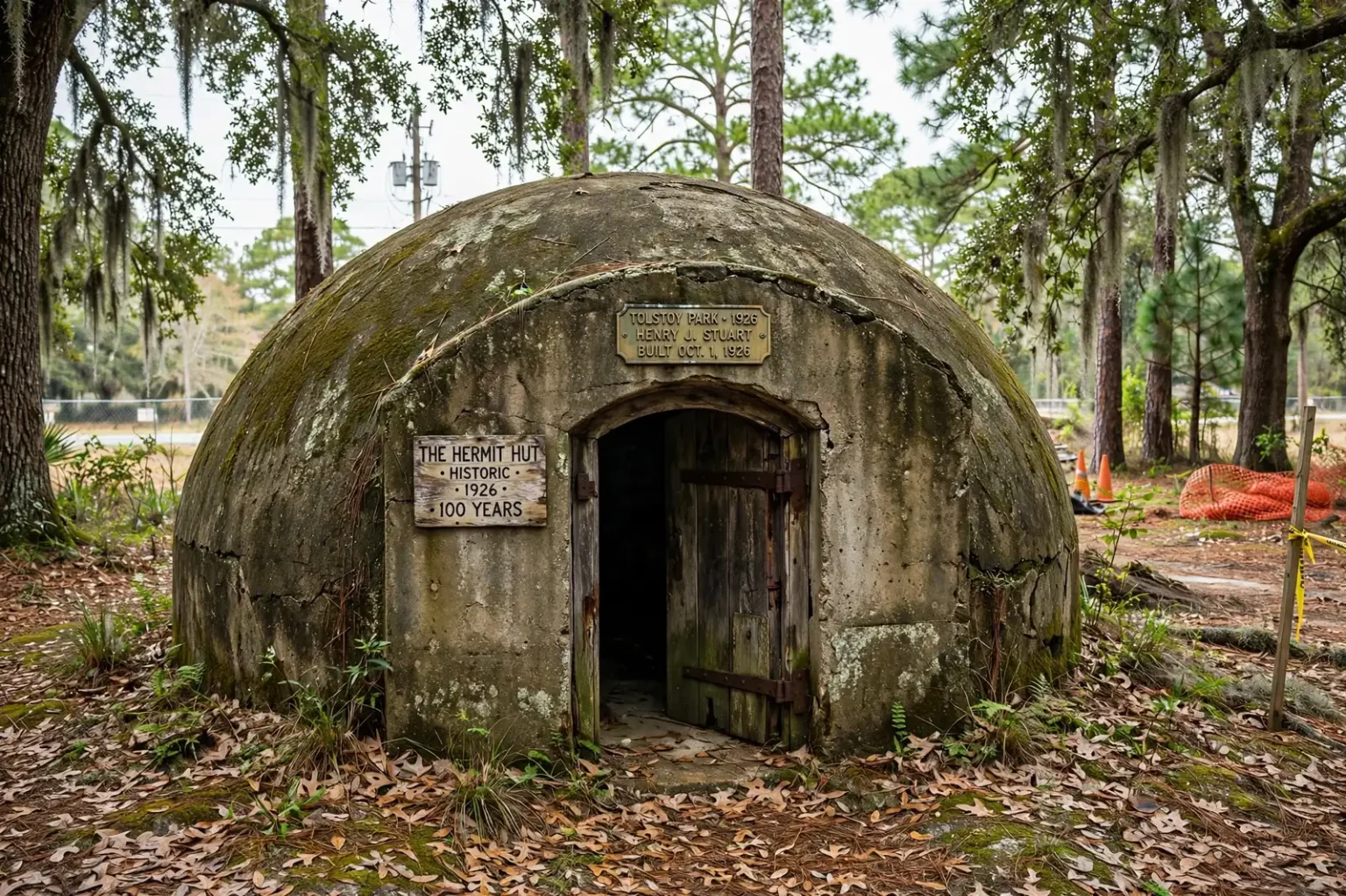
FAIRHOPE, Ala. — A hand-built concrete dome that has stood on the same patch of Eastern Shore ground for 100 years is weeks away from a careful trip across town. Henry Stuart’s Fairhope roundhouse, the tiny home at the heart of one of Baldwin County’s most enduring local legends, is set to be lifted from its original site and relocated to Flying Creek Nature Preserve, where city leaders plan to protect it as a permanent landmark.
The move follows years of grassroots fundraising, a city contract worth more than $400,000 and a quiet act of generosity from a donor who, until now, preferred to keep her name out of the story.
A blessing marks 100 years
On Oct. 1, exactly a century after Stuart set the final stone on his round house, a small group gathered at the structure’s original location for what may be the last ceremony held there. Father John Gilchrist offered a blessing of the soil, and author Sonny Brewer reflected on the importance of the milestone. Stuart completed the dome on Oct. 1, 1926.
Among those in attendance was Gaye Lindsey, a Spanish Fort resident who lived in Fairhope for many years. The blessing was new to her.
“I had never heard of a blessing of the soil,” Lindsey said. “I thought it was very interesting. It’s a concept that I thought was beautifully done.”
To Brewer and the handful of people closely involved in saving the roundhouse, Lindsey’s presence carried special weight. Her donations are a major reason the structure is being preserved at all.
The man behind the hermit hut
Henry James Stuart ranks among the more colorful figures in the history of Fairhope, a town founded in 1894 as a single-tax colony by followers of economist Henry George and long known for attracting independent thinkers, artists and reformers.
Stuart was in his 60s and living in Idaho when he was diagnosed with tuberculosis and told he had about a year to live. Hoping a warmer climate would help, he left his family and headed south in 1923. He eventually settled just north of Fairhope in what is now Montrose, the small community along the bluffs of Mobile Bay.
There, working by hand, he spent one year and 16 days building a 14-foot concrete dome. He lived in the unusual home for nearly two decades before moving to Oregon in 1944. He died in 1946 at the age of 88, long outliving the grim prognosis that first sent him to the Gulf Coast.
Stuart named his property Tolstoy Park, a nod to Russian author Leo Tolstoy and the philosophy of simple living associated with him. Locals came to call the structure the “hermit hut,” a reference to the solitary circumstances that brought Stuart to Alabama and the spare lifestyle he adopted there.
The nickname stuck, but Stuart was hardly a recluse. He saw his neighbors daily, walked into Fairhope to visit friends, attended lectures and dinners and welcomed a steady stream of visitors to his small round home. His guest records reportedly held roughly 1,300 signatures, including that of famed attorney Clarence Darrow. Darrow is best remembered for the 1925 Scopes “Monkey Trial” in Dayton, Tennessee, in which he defended a teacher prosecuted for teaching evolution.
From novel to preservation campaign
Much of the modern interest in Stuart can be traced to Brewer, whose 2005 novel “The Poet of Tolstoy Park” is based on Stuart’s true story. Brewer has spent years keeping that story alive, first on the page and more recently through a campaign to save the house itself.
The need became more urgent as the neighborhood changed around the dome. A property that was secluded a century ago now sits amid commercial development near busy U.S. 98. The idea of relocating the roundhouse surfaced in 2022, when Brewer approached local leaders and began building support for moving it to Flying Creek Nature Preserve, a quieter, wooded setting that more closely resembles the environment Stuart chose for himself.
The relocation is being paid for through private sources, including individual donations and money from the Fairhope Single Tax Corporation, the organization that grew out of the town’s founding colony. The Tolstoy Park Committee, working alongside Brewer, has helped bring the fundraising effort to public attention.
A donor steps forward
Lindsey first heard about Brewer’s effort several years ago during a visit to the Fairhope Public Library. She initially gave $100,000, hoping her gift would inspire others to match it. When that did not happen, she contributed another $50,000 and later $55,000 more, providing much of the private funding needed to move the project forward.
She had wanted to remain anonymous.
“I have been fortunate to be able to support a number of worthy causes,” Lindsey said, adding that she prefers to give without recognition. “This is the one exception I’ve made because of the significance to the community.”
Lindsey said she hopes the roundhouse will help tell the larger story of the people who shaped the town.
“I hope its legacy will be a major story of the history of Fairhope and the kind of people who created Fairhope,” she said. “They were free thinkers. They were not average people. There were a lot of characters from Fairhope in the olden days, and they should all be remembered. This is a great way to do it for this particular one.”
She is quick to redirect credit to Brewer. In some ways, Lindsey said, the author has come to resemble the man he has written about for so long: a free thinker, a conversationalist and a memorable personality.
“That is Sonny,” she said. “What little I’ve known of him, and when I got to know him two years ago, he’s a fascinating character. Someday, we’ll be writing about him.”
How the move will work
The Fairhope City Council authorized the relocation in August, awarding a $421,050 contract to Fairhope Building Company LLC. The company will lift the structure from its foundation and slowly truck it along U.S. 98, through the roundabout near the city’s well-known floral clock and down Main Street to the nature preserve. No exact date has been announced.
Brewer and other supporters had hoped to mark the occasion with a second-line procession, the New Orleans-style parade tradition, escorting the roundhouse into the preserve. Fairhope Mayor Sherry Sullivan turned down the idea, citing the need to keep spectators clear of what is expected to be a complicated operation.
“We need to keep people out of the way as much as possible and be efficient and timely with the move,” Sullivan said. “We are trying not to impact school traffic. You have St. James (Episcopal) Church there, and we’re trying to move it from 9 a.m. to 2 p.m.”
The relocation will still be documented. Filmmakers who have followed the project are expected to capture the move for a future documentary.
Residents eager for a closer look will need to be patient. Sullivan said the roundhouse’s new site is fenced off, and even after the structure is set in place, visitors will not be “automatically let in” until both the site and the dome are secured.
“We want to preserve this for future generations and tell the story of Henry Stuart,” Sullivan said.
Flying Creek Nature Preserve keeps growing
The roundhouse’s new home is in the middle of its own expansion. At its meeting Tuesday, the City Council accepted an additional $2.5 million in funding through the Gulf of Mexico Energy Security Act, known as GOMESA, to continue developing Flying Creek. The federal program, created in 2006, shares a portion of revenue from offshore oil and gas leasing in the Gulf with Gulf Coast states and their coastal communities for projects such as conservation, coastal protection and restoration.
Sullivan said the city has now received a little more than $4.8 million in GOMESA money for the preserve.
The 108-acre preserve, a wooded tract between Veterans Drive and Fly Creek that was once known as the “Triangle Property,” officially opened Aug. 23, 2025, with the completion of its first phase. That phase included multi-use nature trails and other outdoor amenities. According to the city, the name traces back to “Bayou Volante,” the French name early explorers gave to what is now Fly Creek.
The second phase will add more outdoor classrooms and trails, Sullivan said. A third phase is planned to include additional multi-use trails for hiking and mountain biking, a playground and a pavilion. The full project is expected to be finished by the end of 2027.
The city is also preparing the specific spot inside the preserve where Stuart’s roundhouse will rest. Once it arrives, the 100-year-old dome will once again sit in a quiet, natural setting, much like the one a determined man from Idaho chose when he came south looking for more time and found a lasting place in Fairhope history.
What comes next
- The relocation is expected to take place within weeks, during daytime hours planned to avoid school traffic. No firm date has been set.
- The route will follow U.S. 98, the floral clock roundabout and Main Street to Flying Creek Nature Preserve.
- The roundhouse will not be open to visitors right away; the city plans to secure the site and structure first.
- Development of the preserve’s later phases is expected to continue through the end of 2027.
Residents with questions about Flying Creek Nature Preserve can contact the City of Fairhope through its website, fairhopeal.gov.