Fairhope Wins Immunity Ruling as Alabama Justices Toss Developer’s Negligence Claim
The Alabama Supreme Court ruled Fairhope and its Planning Commission are immune from a developer's negligence claim over two rejected townhome projects, though other challenges remain pending.
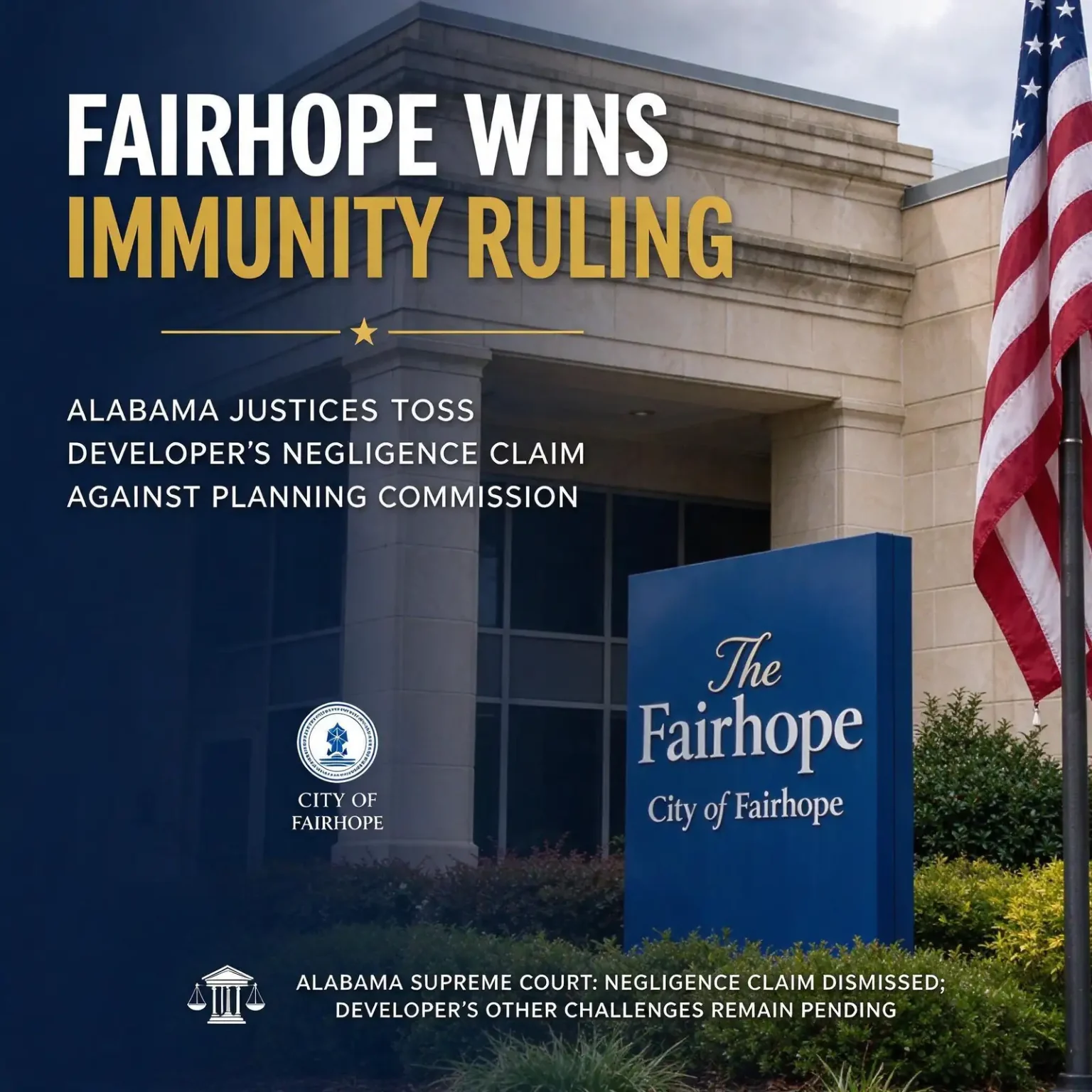
FAIRHOPE, Ala. — The Alabama Supreme Court has ruled that Fairhope and its Planning Commission cannot be sued for negligence over the rejection of two proposed townhome apartment developments, directing a Baldwin County judge to dismiss that part of a developer’s lawsuit. The Fairhope immunity ruling, issued Friday, ends the developer’s bid for money damages on the negligence theory but leaves its other challenges to the city’s decisions alive in circuit court.
The decision also revealed a split among the justices over how far Alabama courts should go in shielding cities and planning commissions from lawsuits, with one justice warning that the majority’s reasoning could steer an important legal doctrine “down the wrong path.”
Two projects, two denials
The case was brought by 68V BTR Holdings, which sought approval to build two developments in Fairhope known as Skyline Village and Gables on Lawrence. According to project records submitted to the city, 68V BTR Holdings is owned by 68 Ventures, a Daphne-based development and investment company founded by Nathan Cox.
The Fairhope Planning Commission rejected both proposals. According to commission meeting minutes cited by the Supreme Court:
- Gables on Lawrence was denied over concerns about drainage, green space requirements, inconsistency with Fairhope’s comprehensive plan and traffic.
- Skyline Village was denied over concerns about drainage, traffic and public health, safety and general welfare.
The developer first took the dispute to federal court. After the federal court ruled against the company on its federal claims and declined to consider the remaining state-law claims, 68V refiled in Baldwin County Circuit Court.
In the state case, the company accused the city and the commission of negligence in how they reviewed and rejected the projects. It also asked the court to throw out the denials as arbitrary and capricious and claimed that Fairhope deprived it of property without substantive due process in violation of the Alabama Constitution.
Fairhope and the Planning Commission asked the circuit court for summary judgment on the negligence claim, arguing that several forms of governmental immunity protected them. When the circuit judge denied that request, the city and commission turned to the Alabama Supreme Court for relief.
In Alabama, a government defendant that is denied immunity at the trial level does not have to wait until the end of a case to have that question reviewed. Because immunity is meant to protect public bodies from the burden of litigation itself, not just from an eventual judgment, the state Supreme Court can step in early and, if it agrees immunity applies, direct the lower court to dismiss the affected claim. That is what happened here: rather than deciding whether Fairhope acted properly, the justices answered the narrower question of whether the city could be sued for negligence at all.
Volunteer immunity for planning commissioners
Writing for the court, Justice Will Parker agreed that both the city and the Planning Commission are immune from the negligence claim.
Parker first addressed the conduct of the commission’s nine members. Alabama law requires municipal planning commissioners to serve without pay, and the state’s Volunteer Service Act protects municipal volunteers who act in good faith within the scope of their official duties, unless their conduct is willful or wanton. Because 68V alleged negligence, not willful or wanton misconduct, Parker concluded that “the planning commissioners are immune from any alleged negligence in declining to approve 68V’s applications.”
The developer argued that the commissioners had acted in bad faith. Parker wrote that this argument did not open a path around immunity, because Alabama’s municipal liability law separately bars claims against a city based on that kind of conduct. Under state law, cities can generally be held liable for injuries caused by the neglect, carelessness or unskillfulness of their agents, but not for intentional or bad-faith conduct.
“If the planning commissioners acted negligently, then volunteer immunity prevents this suit,” Parker wrote. “If the planning commissioners acted in bad faith, then municipal immunity prevents this suit.”
“Either way,” he continued, “68V’s suit against the City and the Planning Commission for negligence cannot proceed based on the actions or inactions of the planning commissioners.”
Substantive immunity for city staff
The court also examined allegations against paid city employees, who are not covered by volunteer immunity.
68V alleged that Fairhope’s planning director relied on improper factors when recommending denial of one of the projects and did not properly advise commissioners. The company also alleged that the city attorney failed to tell the commission that the comprehensive plan could not be used as a basis to reject the Gables project. In addition, the developer claimed that Mayor Sherry Sullivan had assured it that following the city utility department’s plan should prevent problems, but later did nothing to correct what the company viewed as improper conduct. Those claims are the developer’s allegations; the court did not make findings on whether they were true.
Parker concluded that those employees were shielded by a separate legal doctrine known as substantive immunity. Citing earlier Alabama decisions, he described it as protection for governmental activities “so laden with the public interest as to outweigh the incidental duty to individual citizens.”
When public officials are carrying out general duties owed to the public at large, Parker wrote, “accountability should come at the ballot box rather than from judges usurping the roles of elected local officials.” The court held that zoning and land-use decisions, including the review of development applications, involve policy choices tied to a city’s responsibility for public safety, health and general welfare.
Not a blank check, the court says
Parker emphasized that the decision does not give planning commissions free rein over development.
“Our holding today does not leave municipal planning commissions free to grant or deny development applications arbitrarily,” Parker wrote.
The ruling did not resolve 68V’s remaining claims in Baldwin County, including the challenge to the denials as arbitrary and capricious and the substantive due process claim. Nor did it prevent developers from using other legal tools to contest planning commission decisions. In practical terms, the developer’s effort to overturn the denials can continue, but it can no longer seek money damages from the city on a negligence theory.
A divided court on the reasoning
All nine justices agreed with the outcome, but they did not all sign on to Parker’s explanation. Justices Kelli Wise, William Sellers and Greg Cook joined Parker’s opinion in full. Chief Justice Sarah Stewart and Justices Chris McCool, Greg Shaw and Tommy Bryan concurred in the result only, meaning they agreed the negligence claim should be dismissed without endorsing all of the main opinion’s reasoning.
Justice Brady Mendheim Jr. also concurred in the result but wrote a separate opinion questioning part of the immunity analysis. He began by calling it “unfortunate that the concept of immunity must be broached at all” in the dispute.
In Mendheim’s view, the core of the case is 68V’s contention that the Planning Commission arbitrarily and capriciously rejected its developments. That kind of complaint, he noted, is typically brought through a petition asking a court to order a planning commission to act, rather than through a negligence lawsuit.
Mendheim said the negligence claim could have been resolved under Alabama’s existing municipal liability statute without deciding whether substantive immunity covers the Planning Commission. He was especially critical of applying the doctrine to the circumstances of Fairhope’s decisions.
“I believe the application of substantive immunity to the Planning Commission in this instance sends that doctrine down the wrong path,” Mendheim wrote.
He also referred to allegations made in 68V’s earlier federal lawsuit, including claims that commissioners acknowledged there was no legitimate reason to reject the developments and that some of the opposition stemmed from not wanting lower-rent complexes built. Those allegations have not been proven. Mendheim wrote that substantive immunity “deserves more caution and scrutiny than the main opinion provides.”
Why the ruling matters
Fairhope, like much of Baldwin County, has wrestled for years with how to manage rapid growth, and decisions by its Planning Commission on new housing developments frequently draw strong public interest. Drainage, traffic and the city’s comprehensive plan, all cited in the denials at issue here, are recurring concerns in local debates over development on the Eastern Shore.
For cities across Alabama, the decision affirms that volunteer planning commissioners and city staff who review development applications have significant protection from negligence lawsuits seeking money damages. For developers, it signals that the more promising route to challenge a denial is a direct legal attack on the decision itself, such as a claim that it was arbitrary and capricious, rather than a damages suit.
The disagreement among the justices also suggests that the scope of substantive immunity in land-use cases may continue to be debated in future disputes.
What happens next
The case now returns to Baldwin County Circuit Court, where the trial judge has been directed to dismiss the negligence claim. 68V’s claims that the denials were arbitrary and capricious and that the city violated its substantive due process rights remain pending and will proceed separately. No date for further proceedings was included in the court’s ruling.
Residents who want to follow Fairhope Planning Commission business can find meeting agendas, minutes and schedules on the City of Fairhope’s website, fairhopeal.gov. Alabama Supreme Court opinions are published by the state’s Unified Judicial System.