Bentley Names Malone Chief Justice, Setting Up a Statewide Contest
Gov. Robert Bentley appointed his chief of staff, Chuck Malone, to lead the state Supreme Court, but Mobile County's Charlie Graddick and Baldwin native Lyn Stuart set up a potentially bruising 2012 campaign.
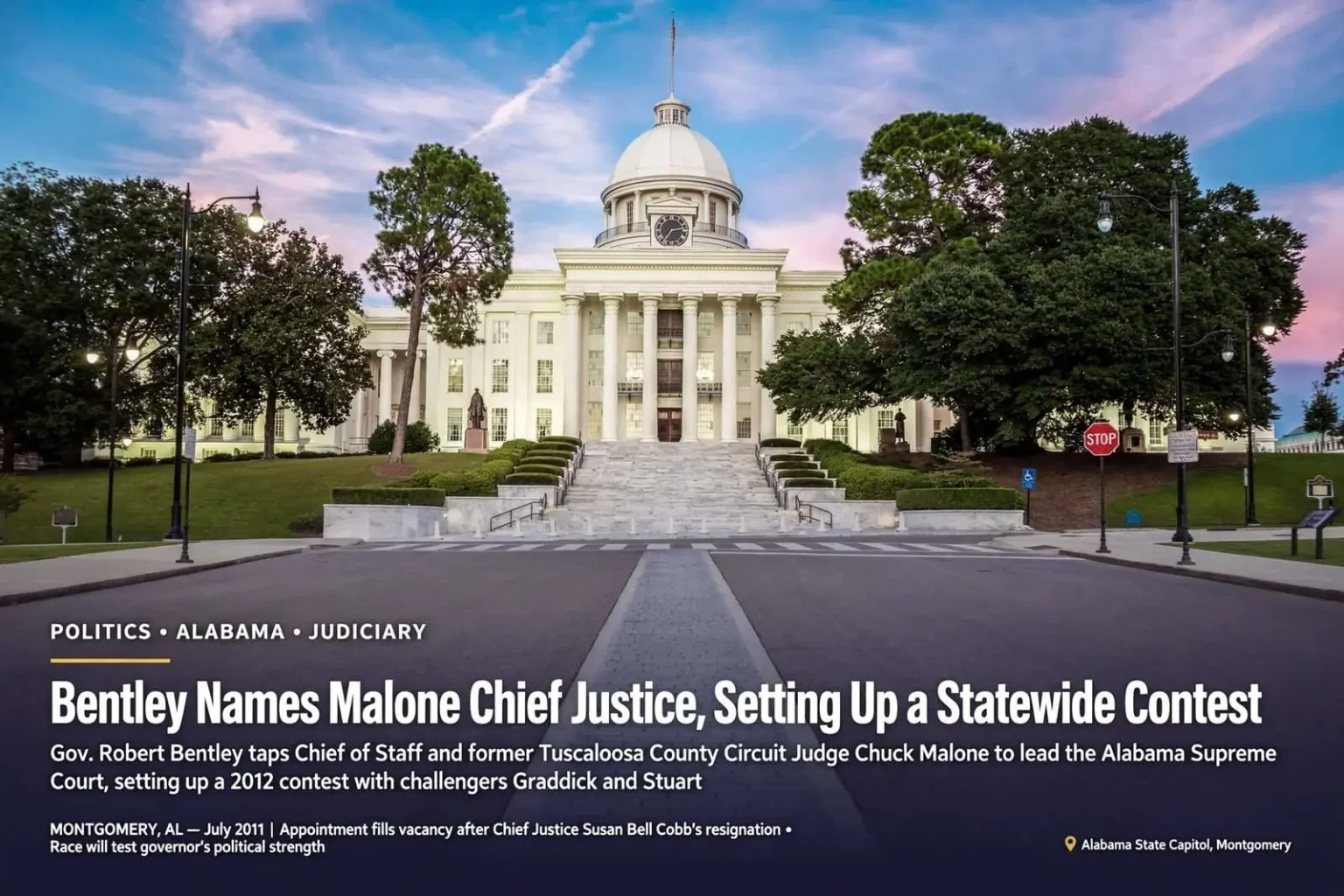
Gov. Robert Bentley, as widely expected, tapped his chief of staff and former Tuscaloosa County Circuit Judge Chuck Malone to serve as chief justice of the Alabama Supreme Court, filling the vacancy left when Chief Justice Sue Bell Cobb resigned with more than a year remaining on her term. The appointment settled the immediate question of who would lead the state’s highest court, but it did little to quiet the political maneuvering already under way, since Malone would have to run the following year to win a full term.
The vacancy itself was unusual. Cobb, the first woman to serve as Alabama’s chief justice, stepped down mid-term, citing in part the deep budget cuts then squeezing the court system and her inability to protect the judiciary from them. That left Bentley — a Republican who had made job creation and government efficiency the centerpieces of his young administration — with a rare chance to place his own stamp on a court whose nine seats had been swept by the GOP in recent cycles. Malone, a former presiding circuit judge in Tuscaloosa County who had left the bench to run Bentley’s office, was the governor’s closest legal adviser and, by all accounts, a personal friend.
A Mobile challenger was already in the field. Mobile County Circuit Judge Charlie Graddick had announced his 2012 campaign for chief justice, and he had made clear he would run regardless of Bentley’s appointment. Graddick, 66, brought a formidable political history to the contest, having won election as attorney general and, in an earlier era, come to the brink of the governorship before political machinations denied him the office. His 1986 run for governor remains one of the most talked-about episodes in modern Alabama politics, a Democratic primary he won at the ballot box only to see the nomination redirected by the state party over a rule dispute — an outcome his supporters never forgot and one that still carries emotional weight with older voters across the state.
Current Supreme Court Justice Lyn Stuart, formerly of Baldwin County and a native of Atmore, was also reported to be weighing a run. Stuart had built a reputation on the court as a capable, polished jurist with deep ties to the legal community in South Alabama, and her entry would have given the contest a distinctly Gulf Coast flavor, with two of the three leading figures — Graddick and Stuart — rooted in the southern half of the state and Malone carrying the banner of the governor’s office in Montgomery.
Experience Against Organization
Both Graddick and Stuart, unlike Malone, had already run and won statewide campaigns, an advantage in a race that would require assembling a statewide organization quickly. Graddick’s statewide victories dated back decades, but his name identification among Alabama’s rural, older and heavily Democratic-leaning electorate — the voters who turn out in low-key judicial races — remained unusually strong for a Republican convert. Stuart had won election to the Supreme Court on her own merits, proving she could raise money, travel the state and survive a ballot contest.
Malone, by contrast, had never sought office beyond Tuscaloosa County. His path to statewide recognition ran entirely through his service in the Bentley administration, where he had managed the governor’s office, shepherded ethics and governmental reform proposals that Bentley made a signature of his first year, and appeared regularly as the administration’s point man on judicial matters. The appointment gave him instant credibility — the title of sitting chief justice — but no inherited donor network or grassroots list, and his rivals would have a full year to argue that he was a political appointee rather than an elected jurist.
Judicial races in Alabama are expensive by any measure. The state’s Supreme Court contests have historically drawn heavy spending from trial lawyers, business groups and party committees, and the chief justice’s race — the top of the judicial ticket — reliably attracts the most. The Business Council of Alabama and allied groups weigh candidate endorsements carefully, and their financial backing can decide a primary. That reality hung over every calculation in the months after the appointment.
The Math of the Race
Observers in Montgomery noted that Bentley had set himself up for potential embarrassment with the pick of a friend and ally. Stuart was regarded as a favorite of the Business Council of Alabama, a powerful lobby, and if she claimed much of that financial backing while Graddick drew support as a proven campaigner, Malone might be left leaning heavily on the Bentley political operation. A chief justice running essentially as the governor’s candidate would tie the two men’s fortunes together — for better or worse.
A weak showing by a sitting chief justice who failed even to reach a runoff would not bode well for Bentley’s own re-election prospects in 2014, some analysts suggested. A primary defeat for the governor’s hand-picked incumbent, at the hands of a rival the governor could have blocked with a different appointment, would be a story the political world in Alabama would not soon drop. Conversely, a strong Malone campaign would demonstrate that the governor’s 2010 victory had not been a fluke and that he had established genuine political machinery capable of moving a loyalist through a statewide electorate. The chief justice’s race thus became a proxy test of Bentley’s strength a full two years before he would face voters himself.
For Malone personally, the calculation was starker. Appointed chief justices who seek election hold the most visible judicial office in the state, and history offered mixed lessons about whether incumbency by appointment translates into electoral security. A loss would end a judicial career that had already included more than two decades on the Tuscaloosa County bench; a win would give him a full six-year term and a platform that in Alabama has often led to higher ambitions.
What the Court Does, and Why the Job Matters
The stakes of the contest went beyond politics. The Alabama Supreme Court is the state’s court of last resort, hearing civil and criminal appeals that shape everything from tort law — a perennial battleground in a state long courted by both trial lawyers and business interests — to property disputes, family law and the death penalty review process. The chief justice also administers the entire judicial branch, overseeing the Administrative Office of Courts, the unified court budget and the state’s trial judges, a management burden that became especially visible during the budget crises of the period. Cobb’s own decision to resign was intertwined with those administrative strains, and every candidate for the office faced questions about how they would manage a court system absorbing successive rounds of cuts.
The office carries additional weight because of Alabama’s history of activism at the top of the judicial ticket. The ten Commandments controversy involving Roy Moore, the Ten Commandments monument and the legal and political storm it produced a decade earlier had made the chief justice’s chair one of the most closely watched judicial posts in America, and candidates for the office ran not merely as administrators but as statements about the direction of the court.
That history shaped the 2012 field as well. Conservative activists aligned with Moore — who had been removed from the same office years earlier after defying a federal court order — were watching the race, and the possibility of his return to statewide politics hovered over any discussion of the Republican primary. In a state where judicial elections are decided almost entirely in the Republican primary, the contenders’ conservative credentials, and their ability to claim the mantle of the court’s right flank, mattered as much as administrative experience.
Whoever emerged would inherit a court in transition: a new chief justice, a budget under sustained pressure, and a docket that touches every county in Alabama. The appointment had given Chuck Malone the first year in the chair. Whether he would keep it depended on an electorate that, twelve months later, would render the only verdict that counted.
South Alabama’s Stake
For Mobile and the surrounding region, the race carried particular interest. Graddick’s candidacy made Mobile County the political base of one of the two best-known challengers, and Stuart’s years in Baldwin County gave the coast a second claim on the contest. Local bar associations, civic clubs and party organizations along the Gulf Coast could expect a steady stream of visits, forums and fundraisers as the candidates worked the southern counties that had delivered decisive margins in past statewide races.
The geography of the contest also echoed older political divisions in the state. South Alabama’s judicial bench has produced a long line of statewide candidates, and a coast-versus-Montgomery dynamic — with a Tuscaloosa judge representing the incumbent administration in the middle — gave party activists in each region someone to champion. Mobile County’s Republican executive committee, one of the largest local party organizations in the state, would be a prize endorsement for any of the contenders.
Whatever the outcome, the appointment had already reshaped the state’s political calendar. A race that might otherwise have developed quietly over the summer was suddenly a test of the governor’s strength, the business lobby’s influence and the durability of old names in Alabama politics — all crowded onto a judicial ballot that most voters would face with little guidance beyond name recognition and the endorsements that follow it.