As Alabama Picks a Chief Justice, Mobile Lawyers Weigh Vance’s Long-Shot Bid
With Election Day near, Mobile attorneys and political veterans weighed whether Democrat Robert Vance could overcome Roy Moore’s name recognition in the 2012 race for Alabama chief justice.
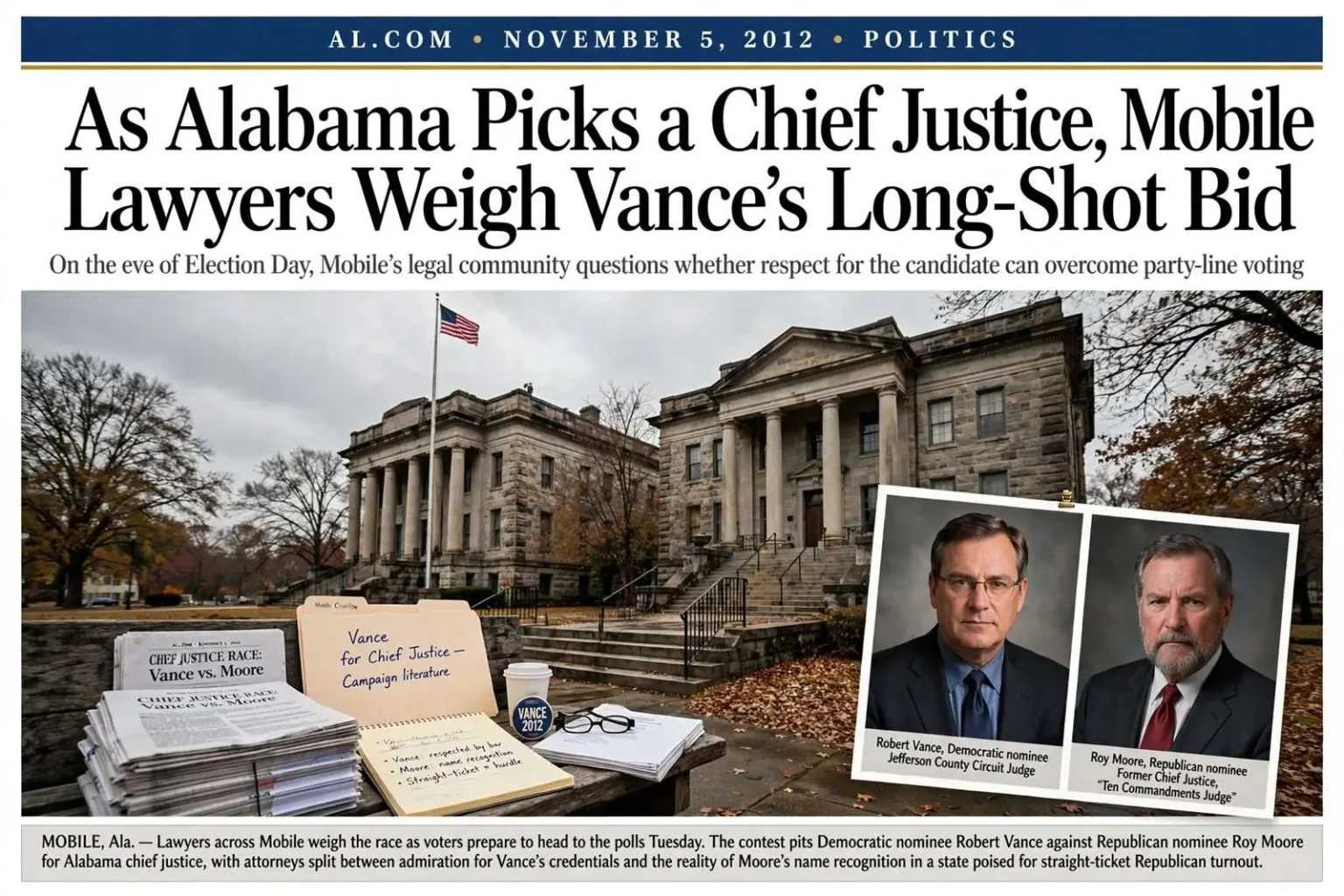
With Election Day only hours away, the contest at the top of Alabama’s 2012 judicial ballot drew intense interest across the Mobile legal community. Robert Vance, a Jefferson County circuit judge and the son of a legendary Alabama Democrat, had stepped from relative obscurity to become his party’s nominee for chief justice of the Alabama Supreme Court. His opponent was one of the most recognizable and polarizing figures in state politics: Roy Moore, the “Ten Commandments judge” seeking to reclaim the office from which he had once been removed.
Moore’s return bid carried nearly a decade of history behind it. He had won the chief justiceship in 2000, defied federal court orders by installing a granite Ten Commandments monument in the state judicial building in 2003, and was removed from office by Alabama’s Court of the Judiciary after refusing to take the monument down. To his critics, that episode made him uniquely unfit for the bench; to his supporters, it made him a martyr for religious conviction who had been punished for honoring God in a state that prized exactly that. Either way, the name recognition was a weapon no ordinary challenger could match.
Vance had entered the race under unusual circumstances, replacing Harry Lyon as the Democratic standard-bearer after party leaders soured on Lyon’s candidacy. The swap left Vance with the nomination but little time to build a statewide profile — a Jefferson County circuit judge running against a man whose name was known in every household in Alabama, in a year when the top of the ticket was trending badly against his party.
By nearly every conventional measure, Vance faced steep odds. Moore commanded name recognition rivaling that of the state’s most prominent officeholders, and Alabama appeared poised to hand Mitt Romney a landslide at the top of the ticket, a result expected to pull straight-ticket Republican voters down the ballot. In Alabama, straight-ticket voting is a one-pull affair — a single mark that runs down an entire party column — and in presidential years it routinely sweeps judicial races that never received a fraction of the attention or the advertising of the contest above them on the ballot.
A survey of the Mobile bar
Asked whether Vance stood any real chance, area attorneys, judges and political veterans returned a chorus that was overwhelmingly, though not unanimously, pessimistic. Many admired Vance while doubting the electorate would reward him. The responses, collected from across the Mobile legal community in the race’s final days, ranged from cautious hope to blunt fatalism — and nearly all of them separated the question of who should win from the question of who would.
Douglas Johnstone, a former justice of the Alabama Supreme Court, allowed that Vance “has a chance,” even as he acknowledged that Moore’s strategy of tying his opponent to President Barack Obama was shrewd politics. In a state where Obama’s approval ran far below the national average, linking a judicial candidate to the president required no evidence and no nuance — only repetition. Johnstone, who had seen judicial campaigns from the inside, knew how rarely such tactics missed their target in Alabama.
Ginger Poynter, a Mobile attorney, was more optimistic still, arguing that Vance had “a very good chance,” and pointing to Republican former justices who had crossed party lines to endorse him. That element of the race was genuinely unusual: prominent Republicans, including members of the court’s own recent history, publicly concluded that Moore’s return would damage a judicial system they had served. Their endorsements gave Vance’s campaign a credibility his party registration alone could not supply, and they offered wavering Republicans a respectable path to splitting their ticket.
Jeff Deen, a criminal defense attorney, called Vance’s prospects “excellent,” praising a candidate “well respected by the bench and the bar.” Among Alabama lawyers, Vance’s reputation as a trial judge was the core of his case — a Democrat who could not be painted as unqualified, only as outnumbered.
Others saw the same qualities but a different verdict. A recurring theme among the skeptics was the sheer force of straight-ticket voting in a presidential year. One Mobile lawyer, a self-described contributor to Vance’s campaign, still predicted defeat, describing Moore’s nomination as a missed Republican opportunity. In that view, Alabama Republicans had put forward the one candidate whose baggage made a Democratic judicial victory theoretically possible — and then guaranteed the theoretical possibility never materialized by voting the party line anyway.
Several respondents invoked the specter of Obama’s presence on the same ballot, arguing that Romney’s coattails in Alabama would be, as one put it, “long and strong.” The presidential contest hovered over every down-ballot race that November, and judicial candidates — who run statewide but campaign on shoestring budgets — felt its pull more than most. No amount of bar-association respect could outweigh a single straight-party mark made at the top of the ballot.
The weight of name recognition
Al Pennington, a Democratic attorney, offered perhaps the bluntest assessment, predicting that Moore would prevail because too many voters embraced his message. That was a harder truth than the coattail argument: it did not blame the electorate’s top line for Moore’s strength but credited Moore’s own appeal — religious conviction worn openly, defiance of federal courts recast as fidelity to Alabama — with genuine and durable support across the state. Pennington’s point was that the race was not being stolen from Vance; it was being won by Moore.
Ed Kahalley Sr., a fixture in local Democratic circles, took the opposite view, suggesting Vance could win “not because of who Vance is, but because of who Roy Moore is.” That paradox ran through the responses: the same voters who found Moore unqualified were, many feared, precisely the voters unlikely to turn out for a Democrat. Kahalley’s scenario required Moore to generate his own opposition — Republicans so troubled by their party’s nominee that they crossed over or stayed home — rather than requiring Vance to build a coalition of his own. It was a path to victory, but it ran entirely through the opponent’s weaknesses rather than the candidate’s strengths.
Bradley Byrne, a Republican attorney and former gubernatorial candidate, framed the stakes in historical terms, observing that a Vance defeat would likely leave no Democrat holding statewide office in Alabama. He noted the irony that the last such officeholder standing bore the name Baxley, a reference to Public Service Commission president Lucy Baxley, whose own re-election bid appeared imperiled. The Baxley name had been synonymous with Alabama Democratic politics for a generation — from George Wallace-era governors to Jim Folsom Jr.’s allies — and the possibility that it would disappear from statewide office alongside Vance’s candidacy marked the end of an era rather than a single bad night.
Among the political professionals surveyed, the mechanical realities of the race loomed large. Consultants pointed to the absence of active down-ballot Democratic campaigns to drive turnout in the black community, contrasting 2012 with the congressional contests that had energized straight-ticket voting four years earlier. In 2008, competitive congressional races in the Black Belt had given Democratic voters reasons to pull the lever all the way down the column; in 2012, with no comparable machinery in motion, the party’s most reliable constituency had fewer cues and fewer reasons to turn out at all.
Respect without confidence
What united nearly all of the responses was a striking consensus about Vance the candidate. Attorneys of both parties described him as competent, thoughtful and well qualified, a contrast, in their telling, to the controversy that had long trailed Moore. The legal profession’s assessment was as close to unanimous as Alabama politics allows: a serious judge, from a serious judicial family, running a serious campaign against a candidate whose first tenure had ended in removal from office.
Yet respect did not translate into confidence. Time and again, respondents said they wished Vance well while bracing for his loss. The distinction matters because it describes the particular frustration of Alabama judicial elections: the voters with the most information about judicial candidates — the lawyers who appear before them — constitute a tiny fraction of the electorate, and their judgment of quality has repeatedly proven irrelevant to outcomes decided by party label and name familiarity.
A few held out hope that enough thoughtful Republicans would decline to vote a straight ticket, or that the buzz surrounding the race signaled a late surge. Others dismissed such talk as fantasy in the hard arithmetic of Alabama politics. Splitting a ticket requires a voter to know there is a race below the presidential line, to form an independent judgment about it, and to deliberately depart from the party column — three acts of effort that judicial elections, conducted with minimal advertising and little coverage, rarely inspire.
The weekend’s conversations in Mobile’s courthouses and firm offices captured the race’s essential asymmetry. Vance had the endorsement of the people who actually worked in the court system; Moore had the recognition of everyone else. One side held the respect of the courthouse, the other the memory of the electorate — and in an Alabama November, memory votes in far greater numbers.
As the polls prepared to open, the Mobile bar had rendered its collective judgment: Vance was the choice of the courthouse, but the courthouse did not choose chief justices. That verdict would rest with the voters on Tuesday, in a race that measured not only two candidates but the distance between professional consensus and electoral reality in a one-party state.
Whatever the result, the survey made one thing plain: Alabama’s judicial elections have a way of separating the state’s legal community from its political one. The lawyers of Mobile could agree on which candidate understood the bench. The question that remained, on the eve of the election, was whether that agreement counted for anything at all once the straight-ticket columns were counted.