Gyms Reopen and Restaurants Expand Capacity as Florida Enters Full Phase One — But Bars Stay Restricted
Pensacola gyms reopened and restaurants expanded to 50% capacity under Florida's full Phase One, while bars remained limited to to-go orders.
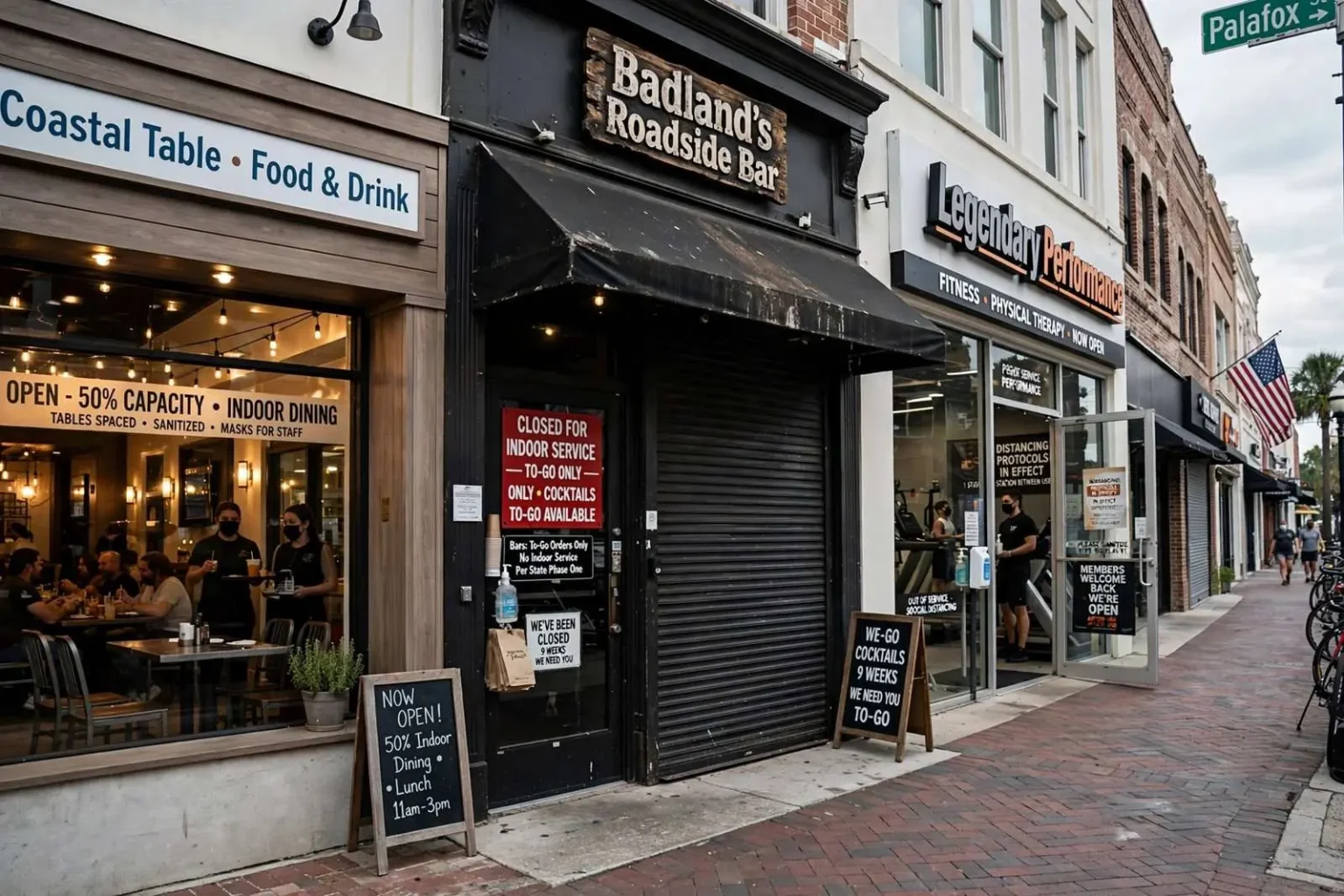
Pensacola-area businesses crossed different thresholds as Florida moved into full Phase One of its reopening: gyms unlocked their doors for the first time in weeks, restaurants and retailers doubled their indoor capacity, and bars remained limited to to-go orders only.
The uneven rollout of Florida’s reopening created a strange patchwork along a single street. Businesses separated by a few storefronts found themselves operating under materially different rules — a restaurant allowed to seat half its dining room, a bar next door still shut out of indoor service entirely, and a gym welcoming members back for the first time since the state’s lockdown order took effect.
For bar owners, the uneven rules stung. “We’ve been closed for nine weeks,” said Nick Zangari, owner of Badland’s Roadside Bar. “That’s pretty much the threshold. One more full month, and you’ll see places that will not survive.”
Zangari said his revenue was down 92 percent in April despite offering to-go drinks. The figure captured the fundamental problem for drinking establishments under the reopening rules: bar economics depend on patrons gathering and lingering, not on carrying cocktails out the door. Unlike restaurants, which could pivot to takeout and delivery meals and salvage a meaningful share of revenue, bars found that packaged sales covered only a sliver of what a full house used to bring in.
Zangari noted many customers were simply treating restaurants as quasi-bars, a workaround that left stand-alone bars and nightclubs at a competitive disadvantage. Patrons who wanted a drink in a social setting could order one at any establishment serving food, while dedicated bars — by definition, places where alcohol rather than food is the draw — remained locked out of the activity that had shifted next door. “It would be one thing if we were all closed,” he said.
The complaint echoed through the bar industry across Florida and beyond during the pandemic’s first months. Bar and tavern owners argued that if the danger of indoor drinking justified closing them, the same activity happening in restaurant dining rooms should be subject to the same rules — and that the state had effectively picked winners and losers among neighboring businesses selling the same product. Industry groups warned that stand-alone bars, typically smaller operations with thinner margins than restaurant groups, would absorb disproportionate permanent closures if the restrictions persisted into the summer.
Fitness centers get their reopening
Fitness centers like Legendary Performance on Palafox Street opened for the first time in about two months. Owner Reggie Williams said the gym had just moved to its new location when closures hit, but survived financially by continuing physical therapy services through the shutdown.
That hybrid model proved to be a lifeline for a small gym caught at the worst possible moment. Having just taken on the costs of a new space, Williams faced a shutdown before the business could establish itself, but the physical therapy side of the operation — classified as an essential health service — kept revenue flowing and kept clients connected to the facility while group fitness was prohibited.
Inside the gym, staff directed clients to keep their distance and stocked plenty of sanitizer for the machines. The protocols reflected the guidance health officials issued to gyms nationwide as they reopened: disinfecting equipment between uses, spacing out workout stations, and rethinking layouts to reduce crowding in the areas where members linger longest.
“Most of our equipment is not very tight together so we’re able to do that with the exception of our treadmills and we basically turn off every other treadmill,” Williams said. The every-other-treadmill approach — deactivating adjacent machines to force separation between users — became a common sight in reopening gyms across the country, a low-tech solution that allowed facilities to operate at partial capacity without expensive rearrangement.
Gym owners faced particular scrutiny during reopening because of the nature of the environment: heavy shared breathing, shared surfaces touched by dozens of people an hour, and the difficulty of wearing a mask through an intense workout. Facilities that reopened under Phase One leaned on the spacing of their existing floor plans, and owners whose equipment happened to be spread out found themselves with an unexpected advantage over cramped gyms that had to close off large portions of their floor.
What full Phase One changed
Florida’s move into full Phase One marked the state’s most significant easing of restrictions since the lockdown began. Under the previous partial phase, restaurants and retail establishments were capped at 25 percent of indoor capacity, a ceiling so low that many operators concluded it was not worth opening their doors at all. Doubling the allowance to 50 percent changed that calculation for a large share of businesses, bringing indoor dining and shopping back to levels that could meaningfully support payroll.
The reopening applied across most of the state, with Miami-Dade, Broward and Palm Beach counties — then the state’s outbreak epicenter — kept on stricter rules. For the Pensacola area in the western Panhandle, far from the South Florida hot spots, the move to full Phase One represented the community’s most substantial return toward normal commerce since the spring shutdown began.
The timing was significant for the Panhandle’s tourism economy as well. Northwest Florida’s beach communities depend heavily on the summer season, and the region had already endured a shortened spring break season before losing the opening of the summer trade to lockdowns. Reopening restaurants at 50 percent capacity as summer approached gave the coastal economy at least a partial window to capture what remained of the travel season.
Still, the rules left clear losers, and none more prominent than the bars. While restaurants and retailers doubled their allowed capacity and gyms reopened outright, bars remained restricted to to-go service with no indoor consumption allowed — a continuation of the status quo that had already stretched their finances to the breaking point. Owners like Zangari made clear the reprieve would not last indefinitely: nine weeks of closure had brought the industry to its threshold, and each additional month of to-go-only rules, in his estimation, would claim businesses outright.
For Pensacola’s business districts, the weeks ahead became a test of whether 50 percent capacity — with distancing, sanitation and customers still wary — could carry restaurants, retailers and gyms through until the next phase of reopening, whenever the state determined conditions allowed it.
The reopening also forced a reckoning with how differently the shutdown had treated businesses depending on their category. Essential retailers had remained open throughout, restaurants had toggled between takeout-only and limited seating, and close-contact services had cycled through closures as state guidance evolved. By the time full Phase One arrived, business owners had learned to treat each new executive order as a fresh set of rules to decode — capacity percentages, seating restrictions, mask expectations and sanitation requirements that could vary by industry and county.
For restaurant operators, 50 percent indoor capacity arrived with strings attached. Tables had to be spaced to maintain separation between parties, bar counter seating faced restrictions, and employees were expected to follow sanitation protocols that added cost and complexity to every shift. Some operators chose to remain closed despite the new allowance, calculating that operating at half capacity with added expenses and thin demand was worse than staying dark — a decision that made the official reopening numbers look better than the reality on the street.
Palafox Street, the spine of downtown Pensacola’s dining and nightlife district, offered a compressed view of the whole situation. The brick-paved corridor and its surrounding blocks hold a dense concentration of restaurants, bars and shops that together form the center of the city’s social life. On any given evening under normal conditions, the street draws crowds from across the Panhandle; during the shutdown it stood largely empty, and the reopening phase meant some of its storefronts lit up while others — the stand-alone bars — stayed dark beside them.
The gym reopening carried its own psychological weight beyond economics. Fitness facilities serve, for many members, as both a health resource and a social anchor, and two months of closure had disrupted routines for people managing their own physical and mental health through the pandemic. Owners reopening in Phase One reported members returning quickly, eager to resume training, while others stayed away out of caution — a split that kept early capacity well below the theoretical 50 percent ceiling in many facilities.
Williams’s path through the shutdown illustrated the improvisation the period demanded of small business owners. A gym that had just signed a new lease, taken on a move and was still establishing its membership base suddenly lost its core revenue stream overnight. The physical therapy services offered alongside training at Legendary Performance became the bridge — the one part of the business the state’s essential-services rules allowed to continue — and the difference between a business that emerged from the shutdown and one that did not.
Sanitation economics also changed for reopening facilities. Bottles of sanitizer, disinfectant for machines wiped down between every use, signage, staff time spent directing traffic through the floor plan — all of it became a recurring cost that gyms had never budgeted for. Small facilities absorbed those costs against revenue reduced by distancing requirements, another squeeze that pushed marginal operators toward the edge.
The bar industry’s warnings about permanent closures proved to be among the most consequential forecasts of the reopening period. Stand-alone bars tend to be owner-operated businesses with narrow financial cushions, and the nine-week closure Zangari described came without any realistic prospect of making up the lost revenue later — a lost month of bar sales in a college town or a beach community does not return when the doors reopen. Owners who survived did so on savings, loans or pivots to food service, and the ones who could not pivot faced the math Zangari laid out plainly.
As Pensacola settled into full Phase One, the community’s experience tracked a pattern playing out across the Sun Belt: restaurants and retailers grateful for doubled capacity, gyms restarting with careful protocols, and bars left to hold on through a summer that their industry could least afford. The next shift in the state’s rules — and whether bars would finally be included in it — remained the question hanging over every dark doorway along the street.