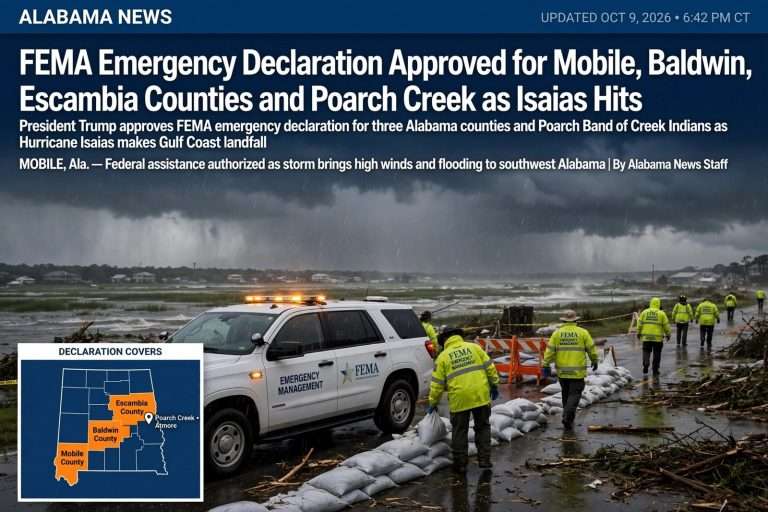
Officer-involved shooting near Atmore tied to multi-county carjackings
Poarch Creek Tribal Police and Escambia County investigators are probing an officer-involved shooting at Atmore's Creek Travel Plaza tied to carjackings.
ATMORE, Ala. — The Poarch Creek Tribal Police and the Escambia County Sheriff’s Office are investigating an officer-involved shooting that occurred Friday morning at the Creek Travel Plaza on Jack Springs Road in Atmore. According to a statement from Escambia County Sheriff Heath Jackson, tribal police officers made contact with a suspect wanted in connection with multiple car thefts and armed carjackings that spanned several Alabama counties. The encounter ended with officers firing their weapons and the suspect wounded, and it has now been turned over to an outside agency for the investigation that state and county procedure requires.
After officers in marked patrol vehicles approached the suspect, an altercation occurred and officers discharged their weapons. The suspect was injured and taken by EMS to a hospital for treatment. No officers were hurt in the encounter. The Creek Travel Plaza sits along Jack Springs Road near the interchange area that serves Atmore’s travel corridor, a busy commercial stop where interstate traffic and local traffic converge, and the Friday morning timing meant the incident unfolded as the plaza was conducting its regular business.
A Suspect Sought Across Several Counties
The suspect had been wanted in connection with multiple car thefts and armed carjackings across several Alabama counties, a crime pattern that typically involves coordination among multiple law enforcement agencies. Stolen vehicle cases that cross county lines are worked through warrants entered into statewide and national databases, and officers who encounter a wanted suspect are trained on the risks such individuals may pose. Armed carjacking carries severe penalties under Alabama law, and suspects facing those charges have a strong incentive to avoid arrest, which is precisely the scenario officers prepare for when making a stop on a wanted person.
The presence of the Poarch Creek Tribal Police in the case reflects the unique law enforcement landscape in Atmore. The city sits within and adjacent to the Poarch Band of Creek Indians’ reservation lands, and the tribe operates its own police department with authority on tribal property, including the tribe’s substantial commercial holdings in the area. The Creek Travel Plaza is one of the tribal enterprises along that corridor, which placed tribal officers at the scene of the initial contact and made the incident a joint matter between the tribal department and the county sheriff’s office from the outset.
Who Investigates an Officer-Involved Shooting
The Alabama Law Enforcement Agency has been asked to lead the investigation, which is standard procedure for officer-involved shootings in Escambia County. Turning the investigation over to ALEA serves a basic purpose: the officers involved in a shooting should not investigate their own use of force, and an outside state agency has neither local ties to the departments involved nor a role in the patrol actions under review. ALEA’s State Bureau of Investigation handles this role across Alabama, collecting evidence, interviewing witnesses and documenting the scene before preparing findings for prosecutors.
Once the investigation is complete, the findings will be turned over to the Escambia County District Attorney’s Office, which will determine whether the use of force was legally justified under Alabama law. That review examines whether the officers reasonably believed deadly force was necessary to protect themselves or others at the moment it was used. The process typically takes weeks or months, and until it concludes, the agencies involved generally release few additional details about the altercation or the number of shots fired.
Sheriff Jackson thanked the officers involved for their “professional and quick response to such a dangerous situation.” His statement underscored the circumstances officers believed they were facing: a suspect wanted for armed carjackings in several counties, encountered at a busy travel plaza during morning business hours, with civilians present in the area. Encounters with suspects wanted for violent felonies are among the highest-risk calls in patrol work, and departments train officers to expect resistance when approaching individuals with that kind of warrant history.
The investigation remains ongoing, and both the tribal police department and the sheriff’s office have directed questions to the ALEA inquiry. Standard practice in these cases keeps the officers who fired their weapons on administrative leave or restricted duty pending the outcome, and the suspect’s medical condition after transport to the hospital becomes a central fact in any subsequent charges. Authorities have not released the suspect’s name or detailed the sequence of events inside the altercation, consistent with the practice of withholding those details while an independent investigation is underway.
Atmore and the Poarch Creek Presence
Atmore, in Escambia County near the Alabama-Florida line, has been shaped economically by the growth of the Poarch Band of Creek Indians, the only federally recognized Indian tribe in Alabama. The tribe’s enterprises in the Atmore area, including its gaming facilities, travel plaza and related businesses, are major employers in the region, and the tribal police department provides law enforcement coverage on tribal lands and properties. Cooperation between tribal officers and county agencies is routine here, as it was in this case, where a wanted suspect moved through a corridor that both departments cover.
Jack Springs Road itself is a main commercial artery on the western side of Atmore, lined with travel-related businesses that serve traffic moving between Interstate 65 and the surrounding region. Incidents at travel plazas draw particular attention because of the volume of strangers passing through: vehicles stolen in one county can surface at a stop like this in another, which is how multi-county crime sprees often end with a chance encounter between a wanted suspect and alert officers.
What Comes Next
In the weeks ahead, the key developments to watch are the completion of the ALEA investigation, the district attorney’s determination on whether the shooting was justified, and any criminal charges filed against the suspect arising from the carjackings and thefts already under investigation across several counties. Those two tracks, the review of the officers’ use of force and the prosecution of the underlying crimes, proceed separately, and both depend on evidence gathered at the travel plaza and on the suspect’s recovery from his injuries.
For residents of Atmore and Escambia County, the case illustrates how the area’s layered law enforcement structure works in practice: tribal police making contact, the sheriff’s office responding and confirming the outcome, a state agency taking over the investigation, and the district attorney ultimately deciding what the law requires. Sheriff Jackson’s office has committed to the standard process, and the findings, once complete, will be made part of the public record through the district attorney’s review. Until then, the Friday morning scene at the Creek Travel Plaza stands as the latest example of how quickly a routine encounter with a wanted suspect can become a use-of-force case requiring an independent investigation.
Officer-involved shootings follow a well-defined legal framework in Alabama, and the Atmore case will be measured against it. Under Alabama law and constitutional standards that apply nationwide, officers may use deadly force when they reasonably believe it is necessary to protect themselves or another person from an imminent threat of death or serious physical injury. The review that ALEA conducts and the district attorney evaluates turns on what the officers knew at the moment: the suspect’s wanted status, any display of a weapon, the movements of the suspect during the altercation and the presence of bystanders at the travel plaza. The fact that officers approached in marked patrol vehicles, in uniform, is part of that record, as is the altercation that preceded the shots.
Multi-county carjacking sprees are prosecuted aggressively in Alabama. Armed carjacking is a Class A felony, carrying the longest prison terms the state imposes short of capital offenses, and a suspect wanted across several counties typically faces stacks of charges that prosecutors consolidate or sequence. The investigation of the Friday morning shooting does not pause that prosecution track; it runs in parallel, and the suspect’s hospitalization for his injuries simply determines when he can be formally booked and brought before a judge.
The Role of EMS and Hospital Care
The prompt transport of the wounded suspect by EMS to a hospital reflects the medical protocol that governs all officer-involved shootings. Regardless of the circumstances, injured individuals at a shooting scene receive immediate medical attention, both because it is a duty of care and because the suspect’s condition is legally significant, a death transforms the case into a potential homicide review, while survival keeps it a use-of-force review. Hospital treatment also preserves the physical evidence of the wounds, which investigators document as part of reconstructing the positions and distances involved.
The Friday morning scene itself would have been processed with the full toolkit of a serious incident: the plaza and its surroundings secured, witnesses identified among customers and employees, surveillance footage collected from the business, and the vehicles involved held for examination. Investigators from a state agency bring independence to that work, but they rely on the same careful scene management that the responding officers and local agencies provided in the first minutes.
Public Communication in Use-of-Force Cases
The handling of public information in this case followed the pattern that Alabama agencies have settled into after years of experience with officer-involved shootings. The local sheriff’s statement came quickly, confirming the essential facts, the location, the wanted status of the suspect, the altercation, the injuries and the transfer of the investigation to ALEA, while declining to speculate about details still under investigation. Sheriff Jackson’s public thanks to the officers signaled the sheriff’s view of their performance while the formal review proceeds independently of his office.
That structure protects everyone involved: the officers, who receive an impartial review rather than a judgment from their own chain of command; the suspect, whose account becomes part of an independent investigation rather than a one-sided narrative; and the public, which receives verified facts on a defined timeline instead of conflicting early reports. Residents of Atmore and the surrounding county have seen this framework operate in previous cases, and its consistent application is what allows agencies to share jurisdiction on tribal lands and county roads without confusion about who answers for what.
A Regional Pattern
Car thefts and carjackings that span several counties are an ongoing challenge for rural Alabama law enforcement, where a stolen vehicle can cross three county lines in less time than it takes to enter the theft report. Agencies respond with shared databases, mutual aid and informal networks among investigators, and suspects eventually surface at travel corridors like the one through Atmore, where interstates and commercial plazas concentrate movement. The Friday morning encounter at the Creek Travel Plaza ended a multi-county search, and the ALEA investigation now underway will determine how the officers’ actions in ending it measure against the law.