Mobile Man Sentenced to Probation for Rigging Foreclosure Auctions
A federal judge in Mobile sentenced Steven J. Cox to probation and fines for his role in a scheme that rigged real estate foreclosure auctions at Government Plaza.
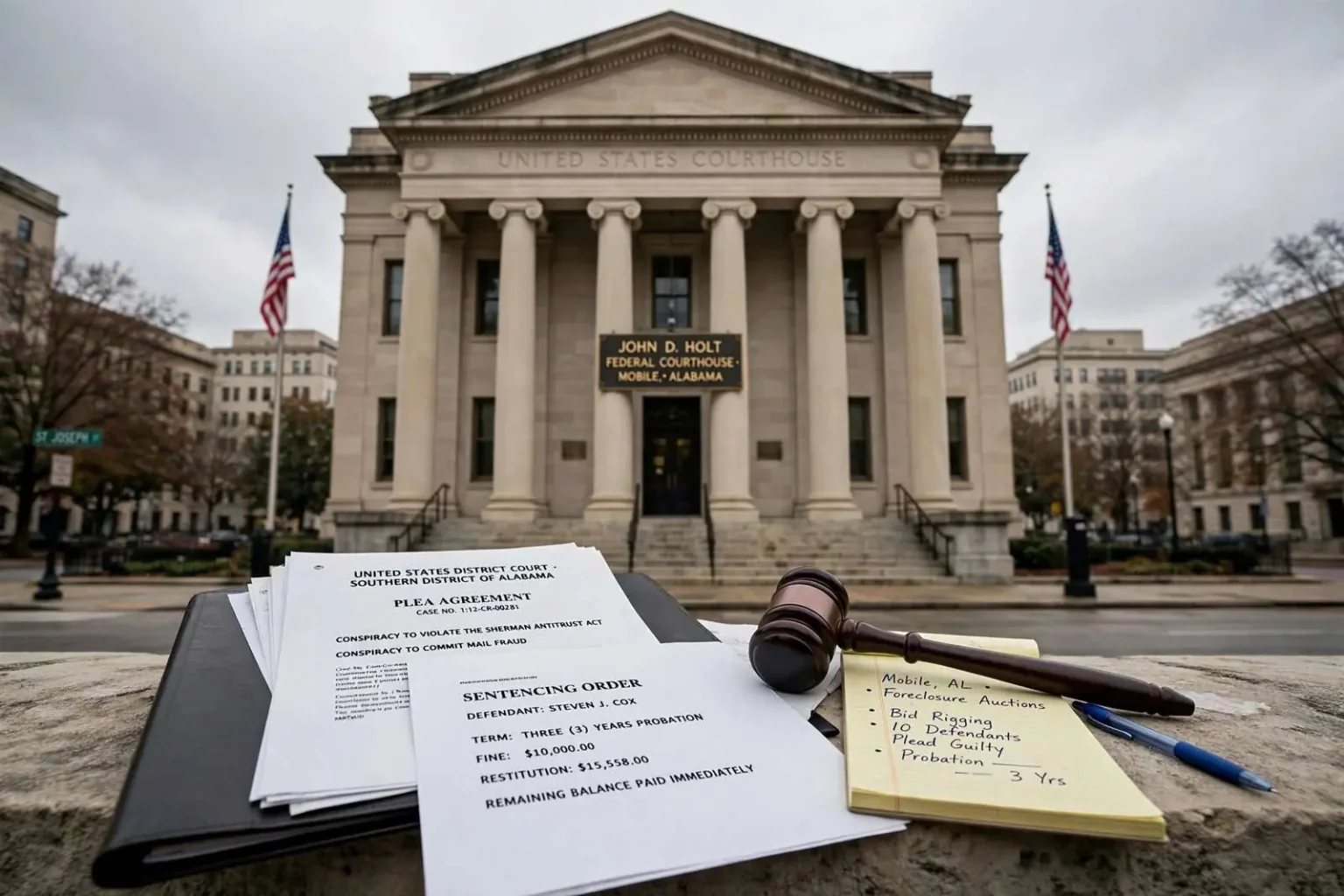
A federal judge in Mobile has sentenced a local man to probation for his role in a years-long conspiracy that rigged real estate foreclosure auctions, cheating banks and other lienholders out of tens of thousands of dollars across the Gulf Coast. Chief U.S. District Judge William Steele sentenced Steven J. Cox to three years of probation after Cox pleaded guilty to conspiracy to violate the Sherman Antitrust Act and conspiracy to commit mail fraud. In addition to the term of supervision, Steele fined Cox $10,000 and ordered him to immediately pay $15,558, the remaining balance of the $82,101 he owed to lienholders who were cheated through the rigged auctions.
The sentencing closed a chapter in a case that has moved through the federal courthouse in downtown Mobile for the better part of a decade. Cox pleaded guilty to the charges back in 2012, but federal prosecutors requested that his sentencing be postponed eight separate times over the following years. Those repeated delays are unusual in federal court, where defendants who cooperate typically hope for a resolution that reflects their assistance, and they signaled to observers that Cox’s role in the investigation was far from finished.
Court filings indicate prosecutors delayed the sentencing because Cox was helping build cases against other people and businesses involved in the broader scheme. In white-collar investigations of this kind, prosecutors frequently hold off on sentencing a cooperating witness so that the person remains available to testify before grand juries, review documents, and provide context about how a conspiracy operated from the inside. Each postponement kept Cox in that posture while investigators worked outward from the conduct he described.
The result of that long-running effort is now visible in the case ledger. Ten individuals and two businesses have pleaded guilty in connection with the conspiracy, a scope that makes it one of the more significant bid-rigging prosecutions undertaken in southern Alabama in recent memory. Among those still awaiting sentencing is Chad E. Foster, whose sentencing was scheduled for late September. Prosecutors have treated the string of guilty pleas as proof that the cooperation-first strategy attached to Cox paid off.
How the Auction Scheme Worked
According to court records, Cox and other conspirators would designate a single bidder to win properties at public foreclosure auctions held at Mobile Government Plaza. Those auctions, held in a public meeting space in the plaza complex that houses Mobile County’s courthouses and city and county offices, are supposed to function as open competitions where any bidder can drive up the price of a foreclosed property on behalf of the lender or lienholder being repaid. The higher the winning bid, the more money flows back to the bank or other lienholder whose loan went unpaid.
The conspiracy subverted that process from the start. Instead of bidding against one another, participants agreed in advance on who would bid at the public sale. Everyone else in the group held back, suppressing competition and keeping prices artificially low. A property that might have drawn spirited bidding from several investors instead sold to one bidder for a fraction of its competitive value, and the lienholder absorbed the difference as a loss.
After the designated bidder won a property cheaply, participants would then hold a secret second auction among themselves. That private auction, conducted away from the public record and away from the eyes of the lenders whose money was at stake, determined which member of the group would actually take the property. The winning bidder in that private auction would pay off the others for staying out of the public bidding, with proceeds distributed according to a predetermined formula that accounted for each participant’s role in the arrangement.
An attorney representing one of the earliest defendants charged in the scheme, back in 2011, described the arrangement as a “complicated formula” rooted in an informal “gentlemen’s agreement” that grew more structured as more people became involved. That description captures how bid-rigging rings typically evolve: what begins as a loose understanding among a handful of familiar bidders hardens over time into a system with settled rules, settled shares, and settled expectations, until it resembles a private marketplace operating inside a public one.
Why the Conduct Is a Federal Crime
The charges in the case reflect the two separate harms the scheme produced. The Sherman Antitrust Act, the foundational federal antitrust statute enacted in 1890, prohibits contracts and conspiracies in restraint of trade. Bid-rigging at public auctions is treated by the Department of Justice’s Antitrust Division as one of the most serious forms of that violation, because the deception is directed not just at a counterparty but at the competitive process itself. Prosecutors pursuing such cases do not need to prove harm to consumers in the ordinary sense; agreement among competitors to suppress bidding is enough.
The mail fraud count addressed the other half of the scheme. Because the conspirators used the mail and interstate communications in furtherance of the arrangement, their conduct fell under the federal mail fraud statute, which criminalizes schemes to defraud that rely on the mails to carry them out. In auction-rigging prosecutions, that typically covers the paperwork trail surrounding foreclosure sales, from notices and settlement documents to correspondence with lenders about the proceeds of a sale.
Federal authorities have long treated collusion at foreclosure auctions as a priority in markets across the country, and the Mobile-area prosecutions fit a familiar pattern. When the housing market stumbled and foreclosures rose, the volume of properties moving through trustee sales increased, and so did the temptation for a small circle of regular bidders to stop competing with one another. Investigators and prosecutors responded with the tools available to them: grand jury subpoenas for bidder records, cooperation agreements like the one Cox entered, and a steady series of guilty pleas that built a public record of how the arrangement functioned.
The Cost to Lienholders and the Local Market
Because the scheme subverted the competitive nature of public auctions, it depressed sale prices and left banks and other lienholders with less money than a fair auction would have produced. In a foreclosure sale, the lender is typically the party most exposed to a low bid: whatever the property fails to bring at auction becomes a deficiency the lender must absorb, and in the case of smaller community banks and credit unions, those losses translate directly into reduced capital available for new lending in the community.
The losses also ripple outward in less visible ways. Homeowners’ associations and municipal lienholders that are repaid from foreclosure proceeds receive less than they are owed. Neighborhood property values can suffer when foreclosed homes are picked up at suppressed prices and resold for a quick profit rather than maintained and returned to productive use. And honest investors who show up to bid in good faith find themselves competing against a rigged field, which discourages participation and further suppresses prices over time.
The $82,101 in restitution attached to Cox’s case represents only his share of the harm, tied to the specific auctions in which prosecutors concluded he participated. With the full cast of defendants now resolved through guilty pleas, the aggregate restitution ordered across the conspiracy gives some measure of how much money was diverted from lenders over the years the scheme operated. Restitution in federal criminal cases is mandatory under the Mandatory Victims Restitution Act when the victims are banks and other institutions, which is why Steele ordered the remaining balance paid immediately rather than leaving it to civil collection.
What Probation Means in a Case Like This
A sentence of three years of probation, rather than incarceration, places Cox under the supervision of the federal probation office for the Middle and Southern Districts of Alabama’s standard conditions and any additional terms Steele imposed. During that period, he must report as directed, remain law-abiding, maintain or seek employment, and submit to searches of his person and property if his supervising officer has reasonable cause. Financial crimes that result in probation rather than prison typically involve defendants whose cooperation was substantial and whose continued liberty serves the interests of justice.
The $10,000 fine sits alongside the restitution order as a separate punishment, paid to the court rather than to victims. Combined with the eight postponements Cox experienced before finally standing for judgment, the sentence reflects the balance federal judges weigh in cooperation cases: recognizing assistance that helped dismantle a broader conspiracy while still imposing consequences that deter others who might see foreclosure auctions as an easy target.
A Warning That Outlives the Case
For residents of Mobile and the surrounding counties, the case offers a plain-language lesson in how public auctions are supposed to work. A foreclosure auction conducted at Mobile Government Plaza is open to any registered bidder, and the price a property brings should reflect genuine competition among strangers with no side arrangements. When a small group of regular bidders knows in advance who will win, every lender in the region is quietly subsidizing the ring.
Prosecutors in the Antitrust Division and the local U.S. Attorney’s office have signaled through this string of convictions that they will keep watching the county’s auction calendars. The plea agreements reached by ten individuals and two businesses, the cooperation that Cox provided across eight postponed sentencing dates, and the sentences now being handed down one by one all serve the same purpose: restoring confidence that a public auction in Mobile County is, in fact, public. As Foster and any remaining defendants come before the court, the bidding records of south Alabama’s foreclosure sales will continue to draw scrutiny from the same investigators who spent years unraveling this one.