University of South Alabama Mobile
South Alabama Greek Organizations Honored for Service, Scholarship at Annual Awards
University of South Alabama recognized fraternity and sorority members for logging more than 25,000 volunteer hours and raising over $60,000.
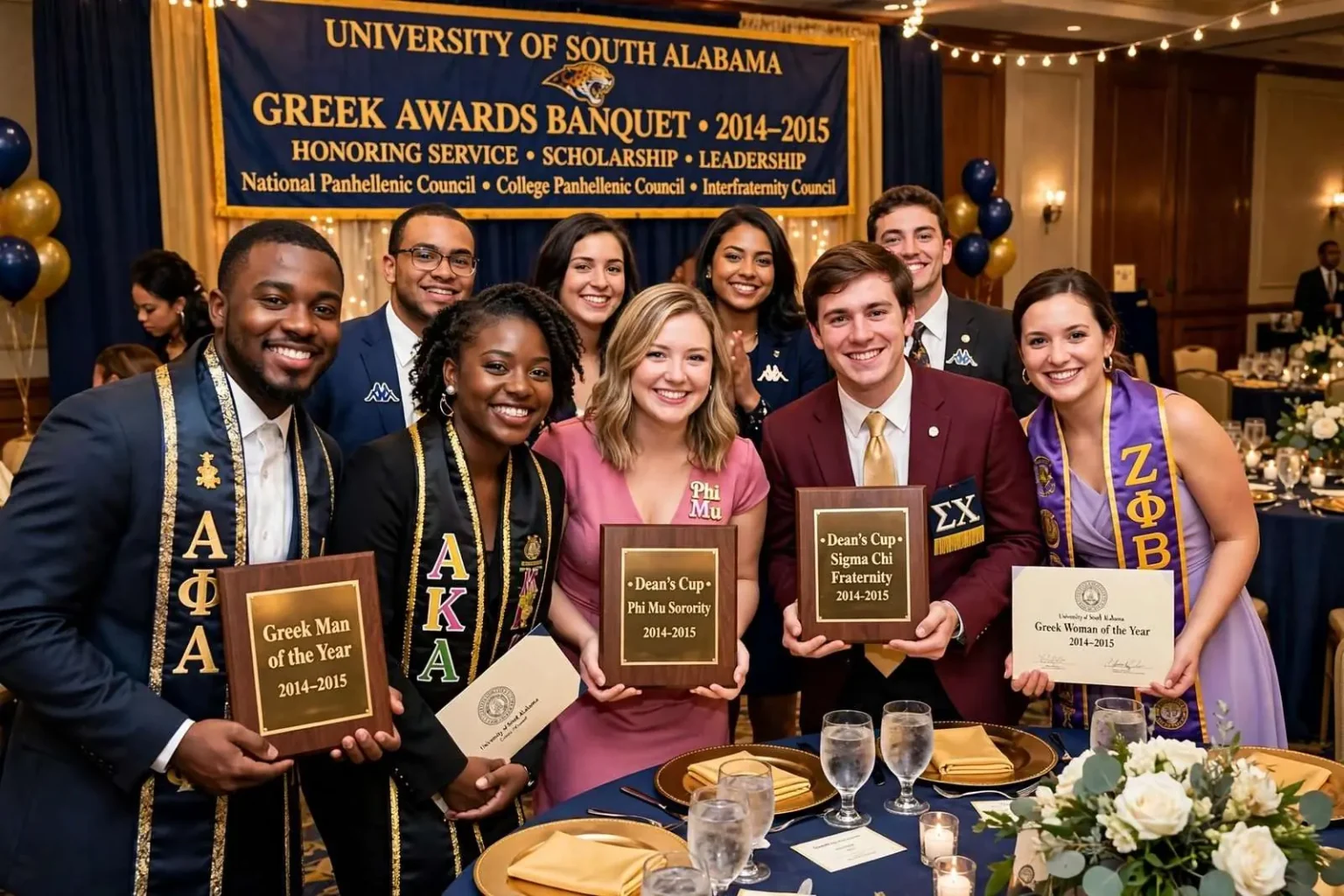
The University of South Alabama recognized fraternity and sorority members from across its Greek community during the school’s annual Greek Awards banquet, honoring students for community service, academics and leadership during the 2014-2015 school year. The banquet brought together members of chapters from all three of the university’s governing councils for an evening dedicated to the year’s accomplishments, from scholarship to philanthropy. Students representing the National Panhellenic Council, College Panhellenic Council and Interfraternity Council collectively logged more than 25,000 hours of community service and raised over $60,000 for people in need during the academic year, according to the university’s Office of Greek Life. The totals represent an extraordinary commitment of time and money from a student community that balances coursework, jobs and campus involvement alongside its service obligations.
The office’s coordinator said the achievements reflect national recognition many of the chapters have received from their respective fraternity and sorority headquarters, along with the organizations’ deep engagement in both campus life and the broader Mobile community. Many of South Alabama’s chapters have earned awards from their national organizations for operations, scholarship and service, a sign that the local chapters are performing at a level their national leaderships consider exemplary. The recognition also underscores the two-way relationship between the Greek community and the city, whose neighborhoods and nonprofits benefit directly from thousands of student volunteer hours each year.
Sigma Chi Fraternity and Phi Mu Sorority received the Dean’s Cup, the highest honor given to Greek-letter organizations at South Alabama. The Dean’s Cup recognizes chapters that demonstrate excellence across the full range of Greek life standards, including academics, service, leadership, campus involvement and chapter management, making it the most coveted award presented at the banquet. Winning the cup places a chapter at the top of its peers for the academic year and is typically the product of sustained performance across every category rather than a standout effort in a single area.
Individual honorees for Greek Woman of the Year and Greek Man of the Year were recognized from Zeta Phi Beta Sorority, Phi Mu Sorority, Alpha Phi Alpha Fraternity and Pi Kappa Phi Fraternity. The individual awards honor graduating or rising leaders whose contributions stand out even within chapters full of active members, recognizing students who led service projects, held campus-wide offices and represented the Greek community to the broader university. Honorees drawn from four different organizations reflected the breadth of leadership across the councils, spanning historically Black fraternities and sororities as well as the College Panhellenic and Interfraternity chapters.
Scholarship and service honors across the chapters
Scholarship and academic awards went to numerous chapters including Alpha Gamma Delta, Alpha Kappa Alpha, Alpha Omicron Pi, Chi Omega, Kappa Delta, Phi Mu, Pi Kappa Phi, Sigma Chi and Tau Kappa Epsilon. Academic performance is the first expectation universities place on Greek organizations, and the number of chapters honored for scholarship suggests that grade standards are being met or exceeded across the system. Greek chapters at South Alabama maintain academic requirements for membership and often operate study programs, peer mentoring and grade incentives to keep members on track toward graduation.
Public service honors went to chapters of Delta Sigma Theta Sorority and Pi Kappa Phi Fraternity, while campus involvement awards recognized members of Phi Mu, Alpha Kappa Alpha, Alpha Phi Alpha and Tau Kappa Epsilon. The public service awards highlight chapters whose members devoted particular effort to community outreach, while the campus involvement category recognizes students whose leadership extends into student government, honor societies and other university organizations. Together, the categories paint a picture of a Greek community engaged on every front the university measures.
Philanthropy occupies a central place in Greek life nationally, with each chapter typically supporting a designated national charity through fundraising events and awareness campaigns. The more than $60,000 raised across South Alabama’s chapters during the year supports causes both national and local, and the 25,000 hours of service translate into thousands of hands-on volunteer shifts with Mobile-area organizations. University officials view those figures as a measure of the Greek community’s value to the campus and the city alike.
How Greek life is organized at South Alabama
The university’s Office of Greek Life oversees 19 sororities and fraternities organized under three governing councils. The structure mirrors the national Greek system, in which historically Black fraternities and sororities operate under the National Panhellenic Council, traditional women’s sororities under the College Panhellenic Council, and men’s fraternities under the Interfraternity Council. Each council sets its own recruitment rules, disciplines its member chapters and coordinates programs, while the Office of Greek Life provides staff support, policy oversight and university resources for the entire community.
National Panhellenic Council organizations typically hold interest meetings each fall and spring, while College Panhellenic Council chapters conduct formal recruitment the week before fall classes begin and Interfraternity Council chapters recruit during the third week of the fall semester. The different recruitment calendars reflect the distinct traditions of each council community, and they give prospective members multiple entry points into Greek life throughout the academic year. Students interested in joining are encouraged to attend the meetings and events for the council that fits their interests, where they can meet chapter members and learn about each organization’s values and expectations.
The recruitment periods are among the most visible moments of the fall semester on campus, bringing hundreds of new students into contact with the Greek community each year. Chapters invest significant effort in recruitment, since membership size directly shapes a chapter’s ability to fund programs, fill service shifts and sustain operations. The Office of Greek Life supports the process with orientation sessions, academic requirements and conduct standards that apply to every chapter regardless of council.
Looking ahead to the coming year
University officials said the Greek community’s fundraising and volunteer totals reflect a broader push among South Alabama’s student organizations to extend their reach into the greater Mobile area, from local food banks to youth mentoring programs. Student volunteers have become a fixture in community organizations across the city, and Greek chapters often organize their service around recurring partnerships that persist from one academic year to the next. Those relationships give Mobile-area nonprofits a reliable stream of young volunteers, and they give students sustained exposure to the community beyond the campus boundaries.
The Office of Greek Life said it expects next year’s chapters to build on the momentum, citing continued growth in both membership and philanthropic outreach across the university’s fraternity and sorority system. With the 2014-2015 awards now recorded, chapter leaders turn to the incoming academic year, when new members recruited in the fall will take up the service projects, scholarship programs and leadership roles that earned their organizations recognition at the banquet. For the Dean’s Cup winners and individual honorees, the awards serve both as recognition of a year’s work and as a standard for the chapters that follow.
The role of the Office of Greek Life
The Office of Greek Life serves as the university’s hub for every aspect of fraternity and sorority operations, from advising the three councils to enforcing university standards for conduct, academics and risk management. Staff members work with chapter presidents and advisors throughout the year on recruitment planning, community service tracking and leadership development, and they coordinate the annual awards banquet that closed out the 2014-2015 year. The office also serves as the point of contact for parents, prospective members and community organizations looking to partner with chapters on volunteer projects.
University oversight of Greek organizations has grown more structured in recent years across the country, and South Alabama’s system reflects that trend, with requirements for chapter grade point averages, service hours and adherence to national risk management policies. Chapters that fall short on those standards work through remediation plans with the office, while chapters that excel are recognized at events like the Greek Awards. The balance of accountability and recognition is designed to keep the community healthy as it grows in membership and visibility on campus.
Greek life’s footprint in the Mobile community
The relationship between South Alabama’s Greek community and the city of Mobile extends well beyond the 25,000 service hours logged this year. Chapter members tutor students in Mobile-area schools, participate in neighborhood cleanup efforts, support food distribution programs and turn out in force for community fundraising events across the city. For many students, those experiences are the deepest engagement they have with Mobile outside the campus bubble, and community organizations have come to count on the manpower the chapters provide each semester.
The $60,000 raised by the chapters flows to a mix of national philanthropies and local causes, reflecting the way Greek fundraising has evolved to address needs close to campus as well as the national charities each organization champions. Fundraising events, from percentage nights at local restaurants to larger campus-wide drives, also bring non-Greek students into contact with the causes, multiplying the reach of each chapter’s effort. University officials have pointed to that ripple effect as one of the strongest arguments for sustaining a vibrant Greek system.
As the university’s enrollment has grown, so has the visibility of its Greek community, and the awards banquet has become a showcase for the system’s contributions to campus life. The 2014-2015 honorees now carry those recognitions forward, and the standards they set will shape what the community aims for when the next round of awards is presented at the end of the coming academic year.