United Way of Southwest Alabama Chief Departs After Four Years Leading Local Giving
United Way of Southwest Alabama's president is leaving after four years to lead a Florida affiliate, capping a tenure of major restructuring.
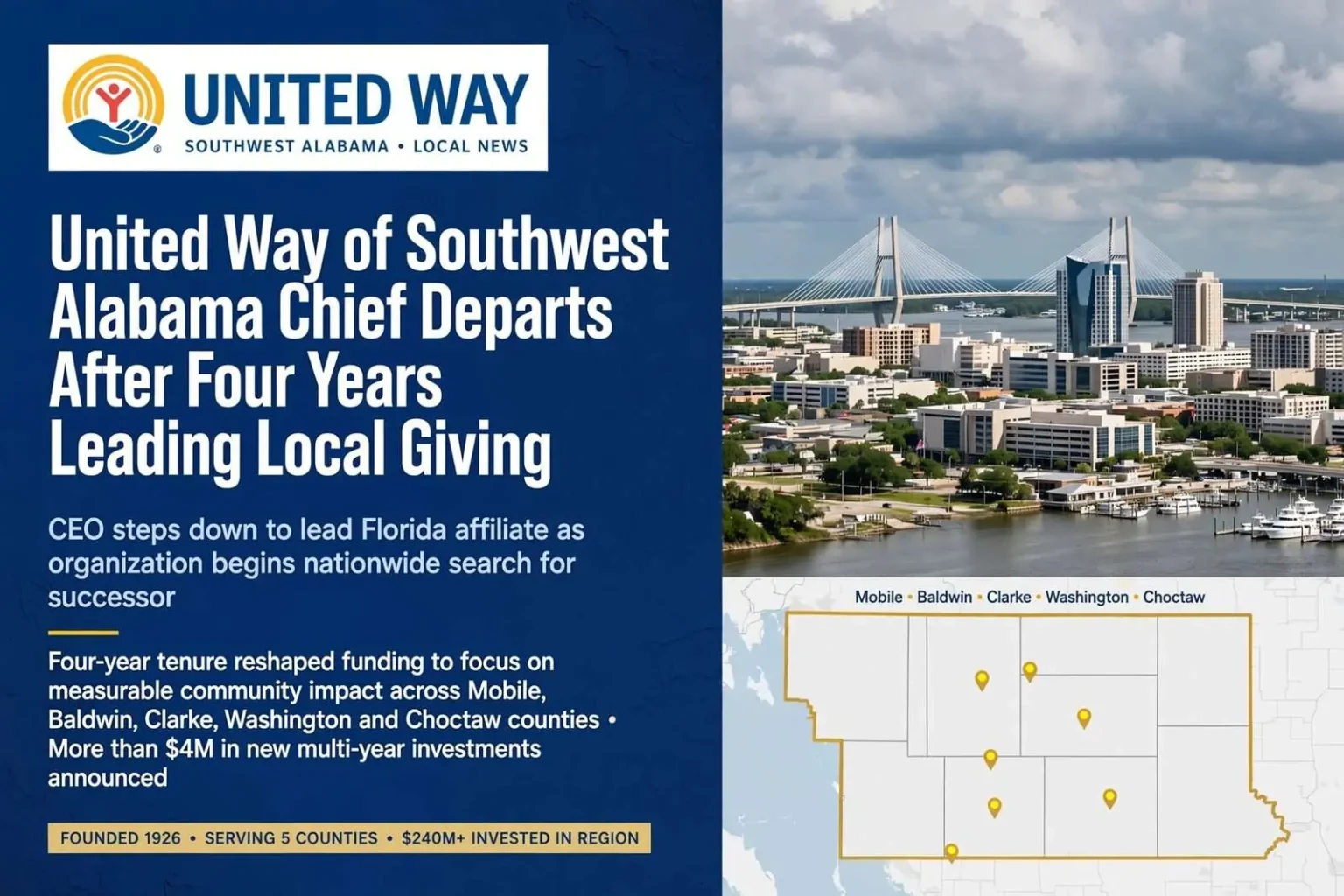
The president and chief executive officer of United Way of Southwest Alabama is stepping down after four years leading the Mobile-based nonprofit and taking a new position with a Florida affiliate of the organization. The move sets in motion a nationwide search for a successor at one of the Gulf Coast’s oldest charitable institutions, an organization founded in 1926 that today serves Mobile, Baldwin, Clarke, Washington and Choctaw counties. Organizational leaders say the transition comes at a pivotal moment, with a modernized funding approach taking hold and new multi-year investments in local programs already announced.
During his tenure, which began in 2011, the outgoing leader is credited with reshaping how the organization allocates donor dollars, moving away from simply funding a fixed list of member agencies each year and toward a community impact model that targets specific programs addressing education, financial stability, health and other basic needs across the region. Under the older approach, workplace contributions were divided among agencies that held permanent places on the roster, regardless of how community needs shifted from year to year. The impact model instead directs money toward specific initiatives that can show results.
From a fixed agency list to measurable impact
The community impact approach mirrors a broader evolution across the United Way network nationwide. Rather than operating mainly as a pass-through that collects payroll deductions and splits them among partner agencies, local United Ways increasingly study community data, identify service gaps, and fund programs that can demonstrate measurable outcomes. In southwest Alabama, that has meant concentrating support on work that moves the needle on classroom success, household financial security, health access and basic needs such as food and shelter for families across the five-county service area.
For donors, the shift is intended to make the connection between a contribution and a community result easier to see. United Way campaigns in the Mobile area have long relied on workplace giving from major employers, including the region’s hospitals, shipyards, schools and port-related industries, and donors increasingly ask how their dollars are used. Funding decisions under the impact model are grounded in whether a program can report progress on the outcomes it promises, giving volunteer reviewers and staff a consistent yardstick for deciding where money goes.
The model also changes the relationship with the nonprofits that receive funding. Agencies compete for investment based on proposals that describe the problem they will address, the population they will serve and the results they expect to achieve, and they report back on those results during the grant period. That structure rewards organizations that track their work closely and encourages collaboration among groups serving the same neighborhoods.
Cutting costs while campaigns grew
A board leader for the organization, who also serves in human resources for Mobile-based shipbuilder Austal USA, praised the outgoing CEO’s work restructuring the nonprofit’s board and staff, updating its mission, and cutting administrative and fundraising costs by more than half during his time in charge. For a nonprofit that depends on public trust to sustain workplace giving, keeping overhead low is more than an accounting exercise, because donors routinely compare how much of each dollar reaches the community. Trimming the cost of raising and administering funds allows a larger share of every campaign contribution to flow through to the programs the organization funds.
The financial discipline coincided with growth on the revenue side. Campaign contributions grew for three consecutive years under his leadership, rising a combined 10 percent over that period. Sustained growth matters for a community-based fundraiser because annual campaigns must rebuild from zero each year, and a fundraising base that expands even modestly gives the organization room to fund more programs without cutting existing commitments.
The tenure also produced structural changes inside the organization itself. Restructuring the board and staff realigned the nonprofit’s internal operations with its new funding philosophy, and updating the mission statement gave the organization a clearer public identity as it shifted from a general-purpose fundraiser to a targeted investor in community outcomes.
A regional footprint built since 1926
Beyond fundraising changes, the organization incorporated a regional volunteer arm to boost community service participation and expanded its service area to include Choctaw County alongside Mobile, Baldwin, Clarke and Washington counties, which it has served since being founded as a Community Chest organization in 1926. The Community Chest model that took root in Mobile in the 1920s was part of a national movement that began in Denver in the late nineteenth century, in which local businesses and residents pooled contributions once a year to support a curated group of charities. That movement eventually consolidated under the United Way name, but the core idea of a single trusted community fundraiser remains the foundation of the organization’s annual campaign.
Adding Choctaw County extended the organization’s reach into one of the state’s most rural corners, a sparsely populated county near the Mississippi line whose seat is Linden. Rural counties in southwest Alabama often have thin nonprofit infrastructures of their own, and residents there can face long drives to reach medical care, social services and charitable assistance that urban Mobile residents find nearby. Bringing those communities into the service area ties them to the same funding network and volunteer programs available in the region’s population centers.
Over its long history, United Way of Southwest Alabama says it has raised and invested more than $240 million in the region, and its programs reach an estimated 600,000 people across the four-county service area each year. That scale makes the organization one of the largest private channels for charitable giving in southwest Alabama, and it means the leader at the top influences how millions of dollars in annual giving are distributed across everything from early childhood education to emergency assistance.
The search for a successor
A search committee is being organized to conduct a nationwide search for a successor, with organizational leaders hoping to have a new CEO in place by the fall. Nationwide searches are the norm for United Way affiliates of this size because the role blends nonprofit management, corporate fundraising and community leadership, and boards typically look for candidates who have run campaigns or led nonprofits in comparable markets. The fall timeline would allow the new leader to be in place as the annual campaign season, the organization’s busiest fundraising stretch, moves into high gear.
The departing executive, an upstate New York native, arrived in Mobile after leading a similar United Way affiliate in West Tennessee. He will now lead a United Way chapter based in central Florida that serves a multi-county area with a considerably larger annual budget. Moving from a five-county Alabama service area to a larger Florida operation is a common career progression within the United Way system, where experience building community impact models and steadying campaign revenue is transferable from one market to the next.
For the local organization, the change comes while its strategy is still being implemented at full speed. Local nonprofit leaders say the transition comes at a pivotal moment, with the organization continuing to expand the community impact funding model that was rolled out under the departing leader’s watch. The organization recently announced plans to invest more than $4 million in dozens of local programs over the next two years, a sign that the funding approach put in place during the past four years is expected to continue regardless of who takes the helm next.
What the transition means for the region
For the hundreds of nonprofits that depend on United Way funding, the leadership change will be watched closely but is not expected to upend existing commitments. Grant decisions are made through volunteer-led review processes that are already in motion, and the announced $4 million investment in local programs over the next two years gives funded organizations a measure of stability through the search period. Agencies that receive support will be more concerned with the new CEO’s approach to funding priorities once the search concludes.
For donors and workplace campaign volunteers, the fall arrival of a new leader would coincide with the heart of the giving season, when companies across Mobile and Baldwin counties run their employee campaigns. A smooth handoff matters because workplace giving depends on volunteers in local businesses who organize events and encourage colleagues to pledge, and those volunteers take their cues from the organization’s leadership and its sense of direction.
The broader takeaway for southwest Alabama is continuity. The organization that began in 1926 as a Community Chest has now navigated nearly a century of leadership changes, economic downturns and shifts in charitable habits, and it enters this transition with a defined strategy, a growing footprint that stretches from downtown Mobile to the Choctaw County line, and a funding model that its board appears committed to carrying forward. The nationwide search for the next chief executive will determine who leads that strategy into its next chapter, and organizational leaders say they intend to have that person in place by the fall.