Four Mobile Graduates Credit Community Center Program for Shaping Their Paths
Four Mobile high school graduates say years in a community center's youth outreach program prepared them for college, the military and careers.
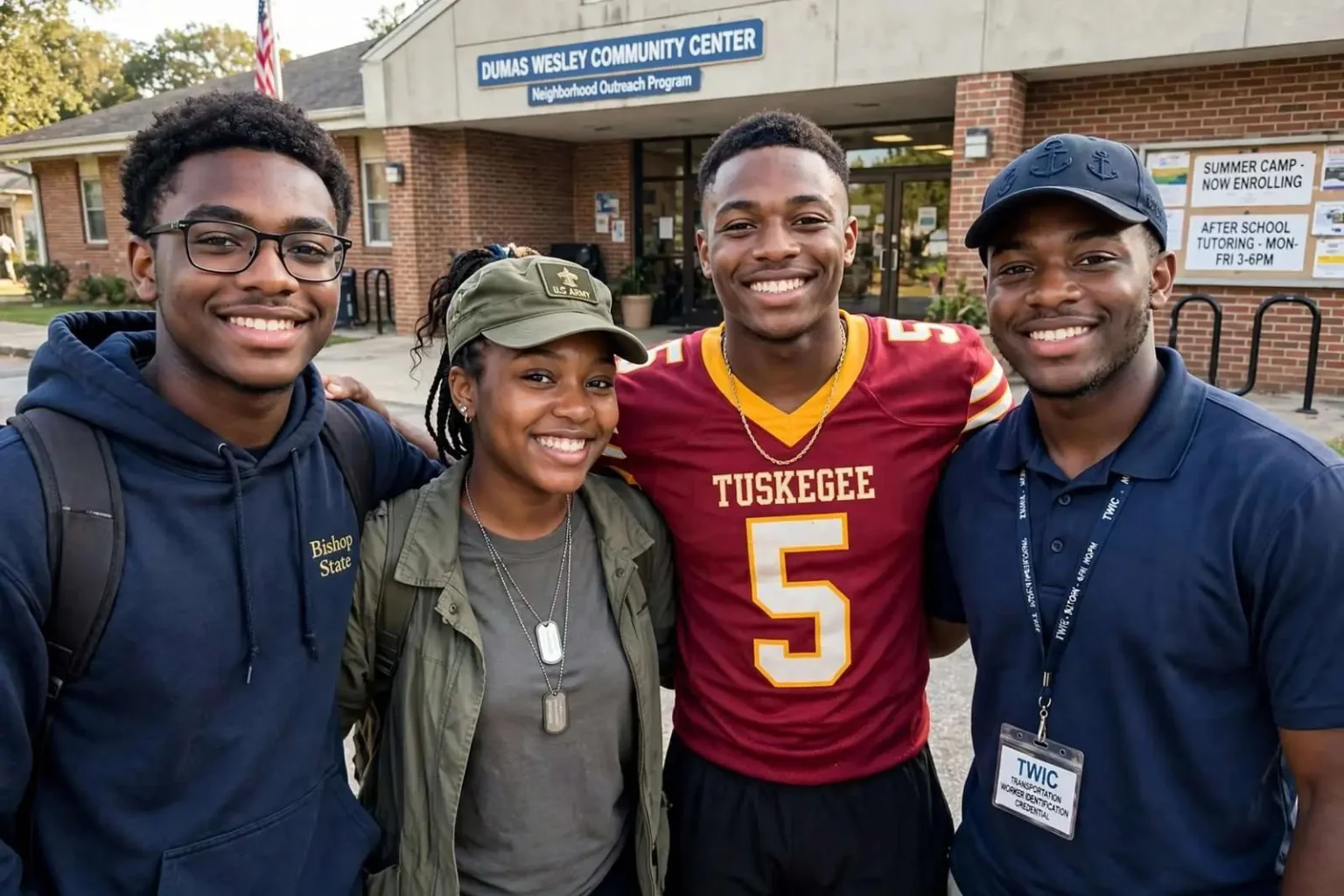
Four newly minted Mobile high school graduates gathered recently at Dumas Wesley Community Center, trading good-natured jabs like siblings before heading off in four very different directions this summer. One is bound for a community college campus downtown, one for a university in the Black Belt, one for Army basic training, and one for a credential that will put him to work along the Mobile waterfront. What ties them together is years spent in the center’s Neighborhood Outreach Program, which each of the four credits with keeping them focused and on track through childhood and adolescence.
The send-off had the feel of a family gathering rather than a formal ceremony. The four graduates grew up within a few miles of one another in east Mobile, and their paths crossed for years in the same gymnasiums, computer labs and summer camps operated by the center. Staff members treated the occasion as a milestone for the program itself, whose results are usually measured one child at a time rather than in headlines.
A Long-Running Pipeline in East Mobile
The Neighborhood Outreach Program is the backbone of the center’s work with school-age children. It pairs after-school tutoring and enrichment during the school year with a full schedule of summer recreation, giving children in the surrounding neighborhoods a safe and structured place to go from elementary school through high school graduation. Older students who age out of regular attendance are encouraged to return as volunteers, keeping the program staffed largely by young people who grew up in it.
Thomas Kidd II, who graduated from LeFlore High School in late May, plans to start at Bishop State Community College before transferring to the University of North Alabama to study sports management. Kidd began attending Dumas Wesley’s summer recreation and after-school programs at age 10 and says staff encouraged him to volunteer as he got older, giving him a chance to mentor younger kids while learning responsibility himself.
That volunteer-to-leader progression is deliberate. Students who spend a decade in the program know its routines, its rules and its families, and staff treat them as the natural next generation of coaches and counselors. For Kidd, the years spent helping run activities and supervise younger children doubled as practical experience for a sports management career, where organizing people and events is the core of the work.
Bishop State Community College, a two-year institution with its main campus in downtown Mobile, has long been a common first stop for Mobile County graduates planning to transfer to a four-year university. The University of North Alabama, where Kidd intends to finish his degree, sits in Florence in the state’s northwest corner, a drive of more than four hours from Mobile. For a graduate who has rarely left the county, the move is as much a step into independence as an academic one, and it is the kind of leap program staff say children rehearse for years without realizing it.
Kendra Weems, also a LeFlore graduate, is preparing to leave for U.S. Army boot camp this summer. She started at the center at age 8, playing volleyball and soccer, attending summer camp and volunteering in the computer lab. She said the structure the program provided taught her she needed to stay active and pursue a path outside the traditional classroom setting.
Weems’ route reflects a reality youth workers across Mobile see regularly: not every capable graduate is best served by heading straight into a four-year classroom program. Military service offers pay, training and educational benefits on a timetable that appeals to graduates who want momentum right away. For a student who thrived on the schedule of after-school practices and summer camps, the regimented structure of Army life is less a shock than a continuation of what already worked.
The timing also places her among a steady stream of Gulf Coast enlistees. South Alabama has historically sent a meaningful share of its graduates into the armed forces, and recruiters from all branches maintain a regular presence at Mobile County high schools. Weems’ plan to leave within weeks of graduation, rather than waiting out a semester, mirrors the fast-track path many local enlistees take.
A Full Ride to Tuskegee
Shun Abrams, a Blount High School graduate, is headed to Tuskegee University on a full football scholarship. He began at Dumas Wesley’s summer program at age 5 and later moved into its basketball program, crediting the center with keeping him busy and out of trouble through his teenage years.
A full athletic scholarship is the rarest outcome in neighborhood youth work, and it underscores how much of athletic development happens long before a varsity roster spot. The organized competition, coaching and accountability Abrams found at the community center gave him years of structured activity in the window when unsupervised afternoons pull many teenagers off course. His own framing — that the center kept him busy and out of trouble — is the same explanation veteran youth workers give for why recreation programming matters as much as tutoring.
His destination carries its own weight in Alabama history. Tuskegee University, founded in 1881 by Booker T. Washington, is one of the nation’s best-known historically black universities, and its football program competes in the Southern Intercollegiate Athletic Conference. Generations of Alabama athletes have passed through its program, and a full scholarship represents a pathway that can carry a student from a Prichard-adjacent neighborhood gym to a degree with no debt attached.
Blount High School, which serves communities north of downtown Mobile, has produced its share of collegiate athletes over the years, and staff at Dumas Wesley followed Abrams’ recruitment closely. For the younger children still in the center’s gym each afternoon, a graduate leaving for a university campus on scholarship is the kind of visible proof point that no flyer or pep talk can match. Program leaders say those examples tend to echo for years, with younger participants asking directly what it takes to follow the same route.
Preparing for Work on the Waterfront
J.C. Holder, also a Blount graduate, worked closely with staff to obtain his Transportation Worker Identification Credential, a requirement for jobs along Mobile’s busy shipyards and the Alabama State Docks. Holder started in the center’s basketball program at age 6, and said staff helped him write his first resume and cover letter years earlier, which led to a summer job at Pizza Hut.
The credential, issued by the Transportation Security Administration after a security threat assessment and background check, is the basic gate for unescorted access to secure areas of maritime facilities. In a port city, it is often the first real hurdle for a young worker seeking a job that does not require a college degree, and applications can stall for weeks when a first-time applicant navigates the process alone. Walking Holder through it was an extension of the workforce help the center had already provided, from that first resume to the summer job that gave him an employment history to put on it.
Mobile’s working waterfront, from the Alabama State Docks to the shipyards that line the Mobile River and Mobile Bay, remains one of the region’s largest concentrations of skilled, well-paying jobs open to workers without a four-year degree. For a graduate headed straight into that workforce, the combination of a credential, a clean record and a mentor who made calls on his behalf is the local equivalent of a scholarship letter.
A spokeswoman for the community center, which has worked with the four students for years, said the organization serves children and families year-round and points to graduates like these four as the clearest measure of its work. The center has operated in east Mobile for generations, and its staff span the years between its oldest participants and its newest enrollees — a continuity that shows up in moments like the recent send-off, where former campers returned as adults to see four more graduates out the door.
What Four Roads Say About One Program
Taken together, the four destinations sketch the range of outcomes a neighborhood program can realistically aim for. One graduate is transferring through a community college toward a bachelor’s degree, one is reporting for military duty, one is enrolling at a university on scholarship, and one is entering the port workforce with a federal credential in hand. None of the four paths required the program to be extraordinary in any single moment; they required it to be there, consistently, for ten or more years of afternoons and summers.
The four also illustrate how youth development compounds quietly. The volleyball and soccer games, computer lab shifts and basketball practices that filled their childhoods look like recreation from the outside. From inside, they were the setting where each graduate learned the habits — showing up, working with coaches and staff, mentoring someone younger — that each now credits for the direction they are headed.
For the younger children still filing into Dumas Wesley this summer, the four graduates leave behind something concrete: proof that the road out of the neighborhood runs through the same doors they walk through each afternoon. Staff say they expect at least a few of this year’s campers to ask how Kidd, Weems, Abrams and Holder managed it, and the four have been invited back to answer that question themselves once their next chapters begin.