Notice Dispute Forces Bayou La Batre Council to Reschedule Meeting
An improperly posted notice forced the Bayou La Batre City Council to delay its regular meeting amid ongoing tension with the mayor's office.
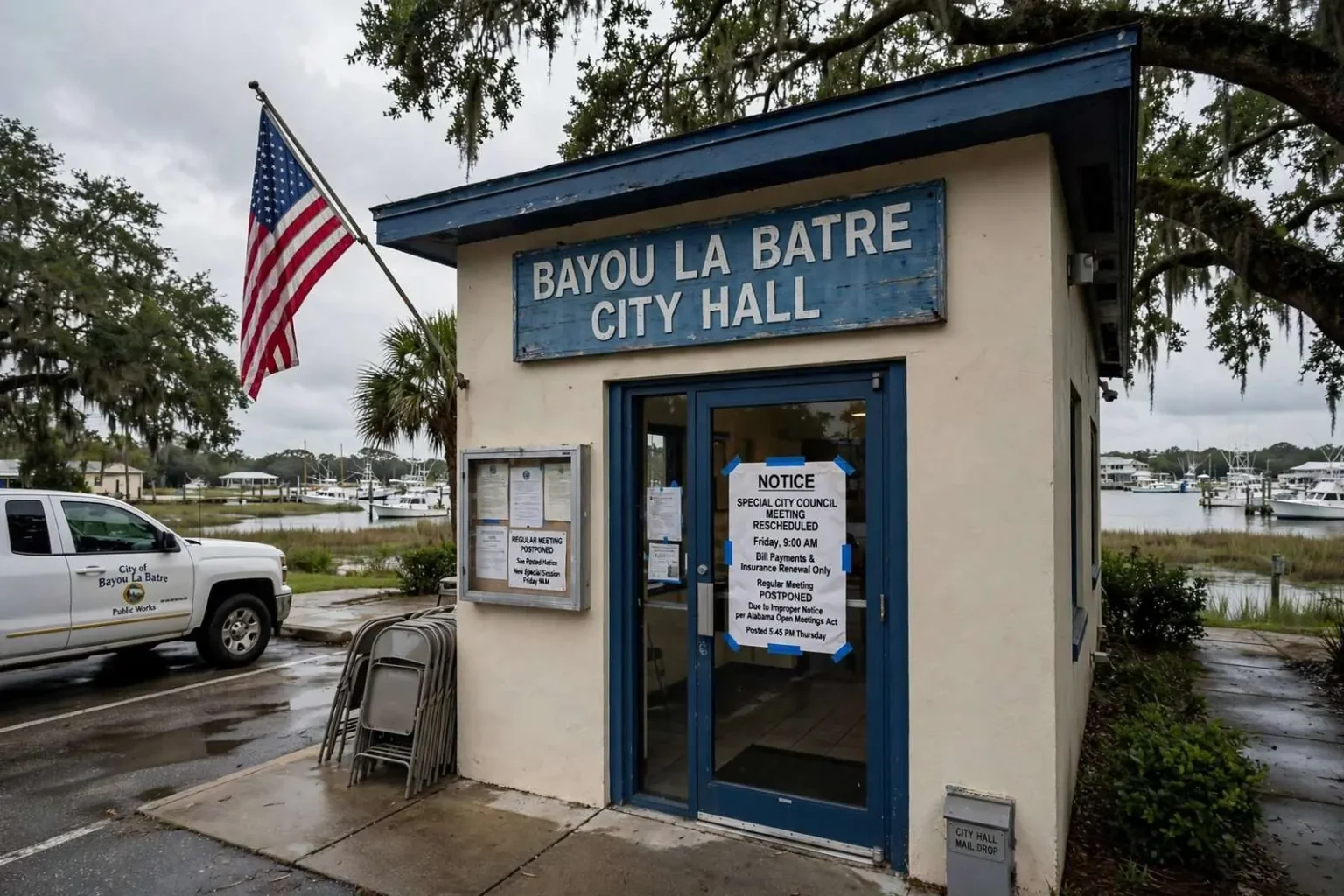
BAYOU LA BATRE, Alabama – The Bayou La Batre City Council skipped its regular Thursday meeting this week after officials determined that a workshop session normally held beforehand had not been properly advertised to the public, forcing lawmakers to reschedule a special meeting for Friday instead. The rare cancellation of a regular session in a city that operates on a tight municipal calendar underscored how even procedural missteps can ripple through daily government in one of Alabama’s smallest incorporated cities.
According to Councilwoman Annette Johnson, the work session was not posted in a public location with enough advance notice to satisfy the requirements of Alabama’s Open Meetings Act. After consulting with the city’s attorney, council members decided the safest course was to postpone the meeting rather than risk holding a session that could later be challenged in court as improperly noticed. The Open Meetings Act, which the Alabama Legislature strengthened in 2005, requires that public bodies give reasonable advance notice of meetings, post notice in a location accessible to the public, and refrain from conducting city business in private gatherings that function as de facto meetings.
The law’s notice requirements exist to guarantee that residents have a genuine opportunity to observe and participate in the decisions of their local government. In small cities like Bayou La Batre, where a single city hall serves as the meeting place, the posting of a notice on a door or window can be the difference between a legally valid meeting and one vulnerable to challenge. Council members concluded that the shortfall left them with little choice but to start over with proper notice, even though the delay pushed pressing financial business back by a day.
A notice taped to a window at city hall indicated that Friday’s session would focus narrowly on bill payments and other pressing business matters, with everything else on the agenda pushed to the next regularly scheduled meeting. Among the items requiring immediate attention were a payment on the city’s line of credit and the renewal of an insurance policy, both of which city officials said could not wait for the normal meeting cycle. Missing a payment deadline on borrowed funds or allowing insurance coverage to lapse can carry consequences far heavier than a one-day delay, so the council carved out only the items that time demanded.
Mayor blames legal counsel for the disruption
Mayor Brett Dungan, who arrived at city hall after 5:30 p.m. Thursday, placed responsibility for the delay on the city’s legal counsel, saying the attorney had determined the meeting was not properly noticed and could not proceed as scheduled. He voiced frustration over the disruption, arguing that questions over posting requirements were making it difficult to manage city business efficiently when there is only one venue available for holding public meetings. With a single meeting space serving as the city’s only forum, rescheduling is not as simple as moving to another room; it means calling residents back for a new session and re-noticing the event under the law.
The mayor’s frustration reflects a challenge familiar to officials in Alabama’s smaller municipalities. Bayou La Batre operates with a small paid staff, a volunteer-heavy government structure, and limited administrative capacity, which means notice requirements, agenda preparation and records duties all compete for the attention of a handful of people. When a posting question arises, the practical options narrow quickly: cancel, postpone, or risk a violation that could void actions taken at the meeting.
The postponed meeting would have marked the first regular council session since a tense May 14 exchange between the mayor and Johnson during a debate over a federal grant application, an incident that led Johnson to file a harassment complaint and resulted in Dungan turning himself in to the Mobile County Sheriff’s Office the following week. The episode has hung over city business in the weeks since, and every subsequent meeting has unfolded against the backdrop of the unresolved conflict between two of the city’s most prominent elected officials.
The dispute over the federal grant application at the center of the May 14 exchange touches on matters of real consequence for the waterfront city. Federal grants play an outsized role in the budgets of small coastal municipalities like Bayou La Batre, funding infrastructure repairs, public safety equipment and community programs that local tax revenues alone could not support. Decisions about which grants to pursue and how to match local funds carry lasting implications, which is one reason grant debates have proven so contentious in the city’s council chambers.
A deeper legal fight underneath
The scheduling dispute adds another layer to an already strained relationship between the mayor’s office and several council members. Dungan has separately filed a lawsuit against four council members, arguing that a vote stripping him of authority to sign contracts and manage the city’s financial accounts was unconstitutional. That legal fight remains unresolved as the two sides continue to navigate day-to-day city business amid the broader conflict, and it has effectively frozen parts of the city’s administrative machinery while the courts sort out where the mayor’s authority ends and the council’s begins.
Questions about the division of power between mayors and councils are a recurring feature of Alabama municipal government, particularly in communities operating under the mayor-council form authorized by state law. State statutes assign the mayor a role in the day-to-day administration of the city while reserving budgetary and legislative power to the council, and when the two branches disagree about the boundary, the resulting standoff can paralyze routine functions such as signing contracts, paying vendors and managing bank accounts. Bayou La Batre’s lawsuit is a local expression of that structural tension.
For residents, the immediate stakes of the rescheduling were mundane but meaningful: bills that had to be paid, an insurance policy that had to be renewed, and a council calendar that had to be rebuilt around a special session. In a city of roughly 2,500 residents perched on the edge of the Mississippi Sound, where the seafood industry remains the economic engine and city government touches daily life through harbor operations, utilities and public safety, even a delayed meeting can be felt at the fish houses and storefronts along the bayou.
Bayou La Batre has weathered far larger disruptions in its history. The working-waterfront community, widely known as Alabama’s seafood capital, was devastated by Hurricane Katrina in 2005 and rebuilt with substantial federal aid, an experience that made the city acutely dependent on outside funding and on the steady functioning of local government to administer it. That history is part of why grant decisions and financial management have become such charged subjects in council chambers.
What the Open Meetings Act requires
The episode also served as a public refresher on the rules that govern meetings in every Alabama municipality. The Open Meetings Act requires that public bodies provide notice of meetings, permit the public to attend, and limit the discussions that can lawfully occur outside a noticed session. A quorum of a council that gathers and deliberates on city business without proper notice can run afoul of the law even if no vote is taken, which is why the status of the workshop session – a gathering held ahead of the regular meeting to hash out agenda items – mattered enough to force the cancellation.
The consequences for violations are not hypothetical. Courts can void actions taken at improperly noticed meetings, and the law authorizes penalties and the award of attorney’s fees to citizens who successfully challenge closed or unnoticed sessions. For a city operating with the modest budget of a small fishing community, the potential cost of a legal challenge easily outweighs the inconvenience of postponing a meeting, which is the calculation the city attorney’s advice reflected.
Government transparency advocates have long described Alabama’s law as an important safeguard, particularly in small towns where personal relationships among officials can blur the line between informal conversation and public business. The act’s notice provisions are the mechanism that keeps residents informed enough to show up, speak during public comment periods and hold their representatives accountable, and Thursday’s cancellation demonstrated a council treating those requirements as binding rather than optional.
For a small coastal city that depends on a single meeting space and a tight council calendar to keep basic operations running, even a procedural notice issue has proven capable of disrupting routine business, underscoring how deeply the ongoing tension between the mayor’s office and the council has begun to affect the mechanics of local government in Bayou La Batre. Whether Friday’s special session eases the immediate financial pressure is one question; whether the mayor and council can find a working relationship that keeps future meetings on schedule remains the larger one facing the seafood capital of Alabama.
Residents who want to follow the city’s next steps can expect the postponed business – beyond the bill payments and insurance renewal handled Friday – to resurface at the next regularly scheduled meeting, when the full agenda returns under properly posted notice. In the meantime, the episode stands as a reminder that in Alabama municipal government, the fine print of meeting notices is not bureaucratic trivia; it is the legal foundation on which every vote the council takes must rest.