Two Years After Corruption Scandal, Bayou La Batre Still Rebuilding Trust
Two years after ex-mayor Stan Wright's corruption conviction, Bayou La Batre's council and residents are still rebuilding trust in city government.
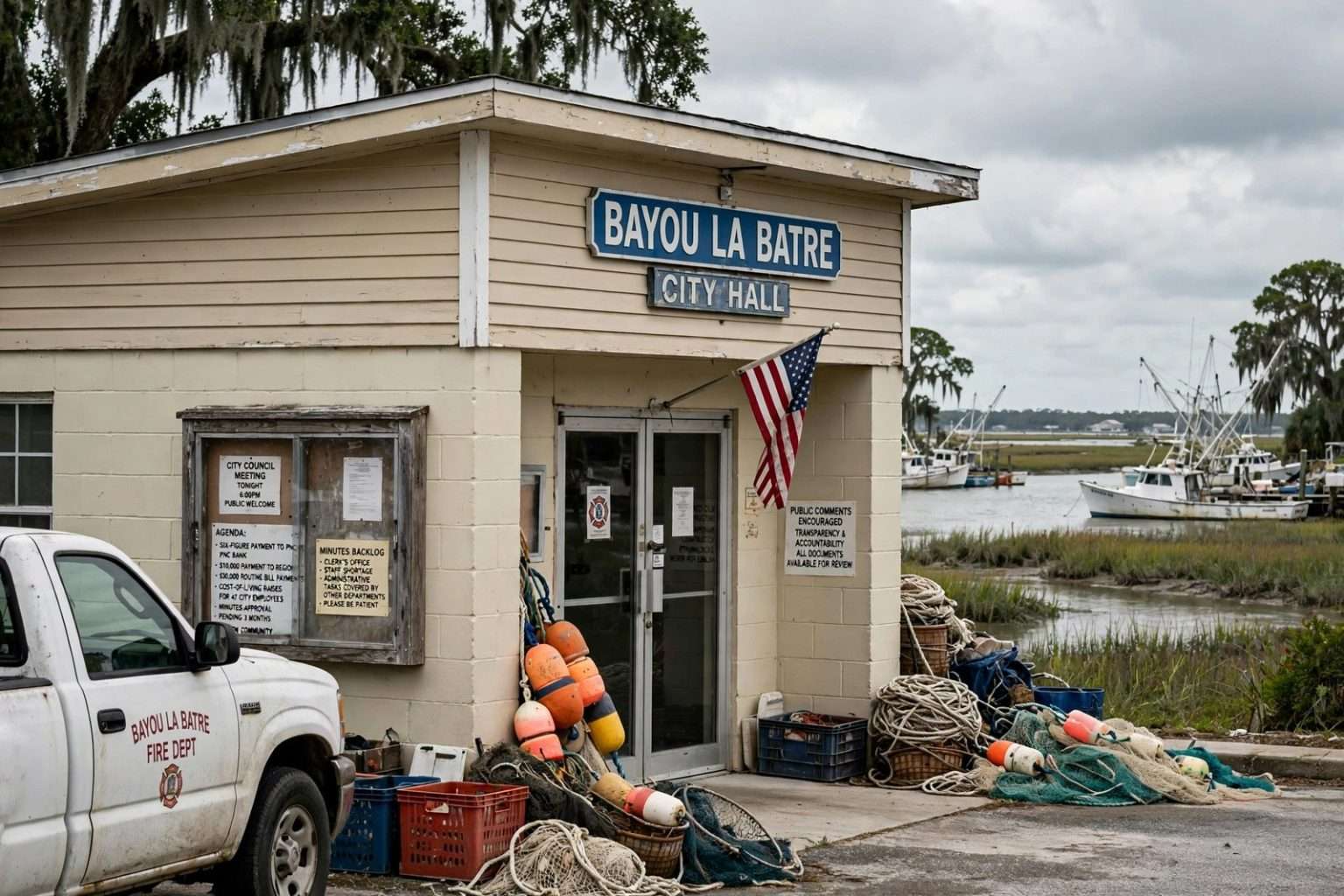
BAYOU LA BATRE – More than two years after a public corruption conviction toppled its longtime mayor, Bayou La Batre is still working to restore trust in City Hall, according to residents and council members who describe an administration navigating staffing shortages, tense meetings and lingering suspicion.
The fishing town of roughly 2,600 people on Alabama’s Gulf Coast has lived through more than its share of hardship – hurricanes, the BP oil spill’s blow to its seafood industry and, most recently, the fall of a mayor who had run City Hall for two decades. Rebuilding the machinery of local government, residents say, has proven slower than rebuilding anything the storms took.
A city council under strain
A recent city council meeting in the fishing town of roughly 2,600 people illustrated the strain. The packed agenda included a six-figure payment to PNC Bank, a $10,000 payment to Regions Bank, $30,000 in routine bill payments, cost-of-living raises for the city’s 47 employees, an annexation request in the Coden community, and the proposed purchase of a used pickup truck for the fire department.
Council members also had to catch up on approving minutes from meetings dating back three months, after two key employees left the city clerk’s office and workers from other departments stepped in to handle basic administrative tasks like stuffing envelopes and recording meetings.
For a city of Bayou La Batre’s size, the loss of two clerk’s office employees is not a hiring problem but a structural one. Small municipalities run on a handful of people who know where every file is, and when that knowledge walks out the door, the most basic functions of government – recording votes, paying bills, keeping minutes – fall behind. The backlog of unapproved minutes stretched across an entire quarter, and other departments filled envelopes and took minutes while their own work waited.
The agenda itself reflected the budgets of a small Alabama fishing town: six-figure loan payments that dominate the calendar, fire department purchases measured in thousands, and an annexation request from Coden, the neighboring community along the bay whose residents look to Bayou La Batre for some services. Every item drew scrutiny in a town where trust in City Hall had been badly damaged.
The scandal that shadows City Hall
The scandal that continues to shadow city government centers on former mayor Stan Wright, who was convicted of public corruption and is now serving time in federal prison. Prosecutors said Wright engineered a deal for the city to purchase property owned by his daughter and tried to damage the career of a police investigator who reported the transaction to the FBI.
Wright, described by former colleagues as a domineering and combative figure at the dais, was succeeded by current Mayor Brett Dungan, who was elected in September 2013.
The Wright conviction marked an ugly turn in a leadership era that had begun with the town’s recovery from Hurricane Katrina, when Bayou La Batre’s shrimp fleet and waterfront homes had been shattered and Wright stood at the center of the rebuilding. The years that followed produced the property deal that sent him to federal prison and left the town’s finances and reputation scarred together.
His successor inherited the aftermath. Dungan, who came to the mayor’s office after decades running a private shipbuilding company, campaigned as an outsider who would bring professional habits to a government that had lost the public’s confidence – promises of transparency that residents have since measured against his administration’s every move.
Lingering suspicion
Residents who have taken on clerical duties at City Hall say the corruption era left a mark on how people view local government. One community center manager, who has been helping with office work, said she doesn’t fully understand the level of distrust some residents carry toward the current administration, noting that questions were rarely raised of the previous mayor.
The observation captures the strange inversion of the town’s civic culture. Under a mayor who was quietly arranging corrupt deals, few questioned anything; under an administration that came to office promising openness, every expenditure and process is now examined for signs of the old ways. The distrust, council members acknowledge, is not a verdict on Dungan personally – it is the residue of learning, the hard way, that questions are worth asking.
Tensions surfaced again at a recent meeting that included audience outbursts and accusations of financial mismanagement. The friction that once might have stayed inside the council chamber now spills into public comment, social media and a local blog devoted to town affairs.
Much of the friction traces back to the resignation of a council member from the Place 5 seat after her restaurant received a city contract to cater a December dinner; although she did not vote on the contract, she stepped down amid rumors and speculation.
The departure left the council short a member and left a question that residents continue to argue: whether the catering contract represented a genuine conflict requiring resignation, or a small item inflated by the town’s post-scandal sensitivity. In a city still learning to distinguish ordinary administration from corruption, even a dinner contract can become a test case.
The mayor adjusts to public office
A local blog focused on town affairs has also kept scrutiny on the council and mayor, who campaigned on promises of transparency. Council members describe a mayor still adjusting to public office after decades running a private shipbuilding company.
The habits that served Dungan in private business – moving quickly, making decisions on his own authority – have repeatedly collided with the procedures of municipal government, where a mayor acts under a council’s oversight and every expenditure follows a paper trail the public can read.
He faced criticism in January over a proposal to renovate a conference room attached to his office, and more recently over roughly $1,800 in mileage and meal reimbursements tied to regional meetings.
The finance committee chair said she tabled that item after an itemized breakdown showed the town would also be covering meals and other incidental expenses, adding that she wants the administration to follow proper procedures rather than act first and seek council ratification afterward.
The reimbursements were modest by any standard, but in Bayou La Batre they are read as tests of process. A councilwoman tabling a $1,800 expense until the paperwork is complete is not, in this town’s post-Wright arithmetic, obstruction – it is the oversight that residents were told to expect, applied at whatever the dollar amount.
The mayor has also drawn scrutiny for arranging a $50,000 line of credit from Regions Bank on his own last year to keep the town running during a seasonal revenue lull, a step council members say should have gone through the same process used for a similar loan arranged with council involvement in 2013.
The line of credit illustrated the structural squeeze on the town’s finances. Bayou La Batre’s revenues rise and fall with the seasons and the fortunes of its seafood industry, and a lull can leave a small city short of cash between collections. Keeping the government funded through those dips is a legitimate necessity – the dispute is over who decides, and whether the council’s role in borrowing, established the year before, applies to every loan.
Learning to govern in public
The running disputes between the mayor’s office and the council trace a learning curve familiar to small towns emerging from scandal: an executive used to private authority, a council learning to exercise the oversight it previously deferred, and a public watching both for any repeat of the past.
Council members say they are hopeful the city can move past the friction as new financial controls take hold, even as some residents continue pressing for greater transparency from town leadership.
The controls – itemized reimbursement requests, council sign-off on borrowing, minutes approved on schedule rather than months late – are the unglamorous mechanics of restored trust. None of them will make headlines, but together they are the difference between a City Hall that explains itself and one that expects to be believed.
The staffing shortages complicate that work. Procedures exist on paper only when someone has the time and training to follow them, and the clerk’s office vacancies that stretched meeting approvals across three months showed how thin the town’s administrative margin remains. Restoring the office staff, council members say, is as important to accountability as any ordinance.
A town defined by resilience
Bayou La Batre has never had an easy civic history. The town rebuilt from Hurricane Georges, then Katrina, then the Deepwater Horizon spill that shut down the waters its shrimp boats work – each recovery accomplished by a community that has always been small, close-knit and suspicious of outsiders telling it what to do.
The corruption conviction added a wound of a different kind, one inflicted from inside City Hall rather than by wind or water. That is why its aftermath lingers in ways that storms’ damage never did: residents can rebuild a fleet, but trusting a mayor again is a slower project.
The meetings will remain tense for a while yet. The council will keep tabling items that arrive without paperwork, the blog will keep watching, and residents will keep asking the questions they never asked before. That, more than any single vote, is what recovery looks like in Bayou La Batre – a town that has learned, at last, that vigilance at City Hall is not an insult to its government but the price of keeping it honest.