Mobile County Third-Graders Kick Off Eight-Week Civics and Citizenship Program
More than 400 Mobile County third-graders began an eight-week civics program teaching history, government and community citizenship.
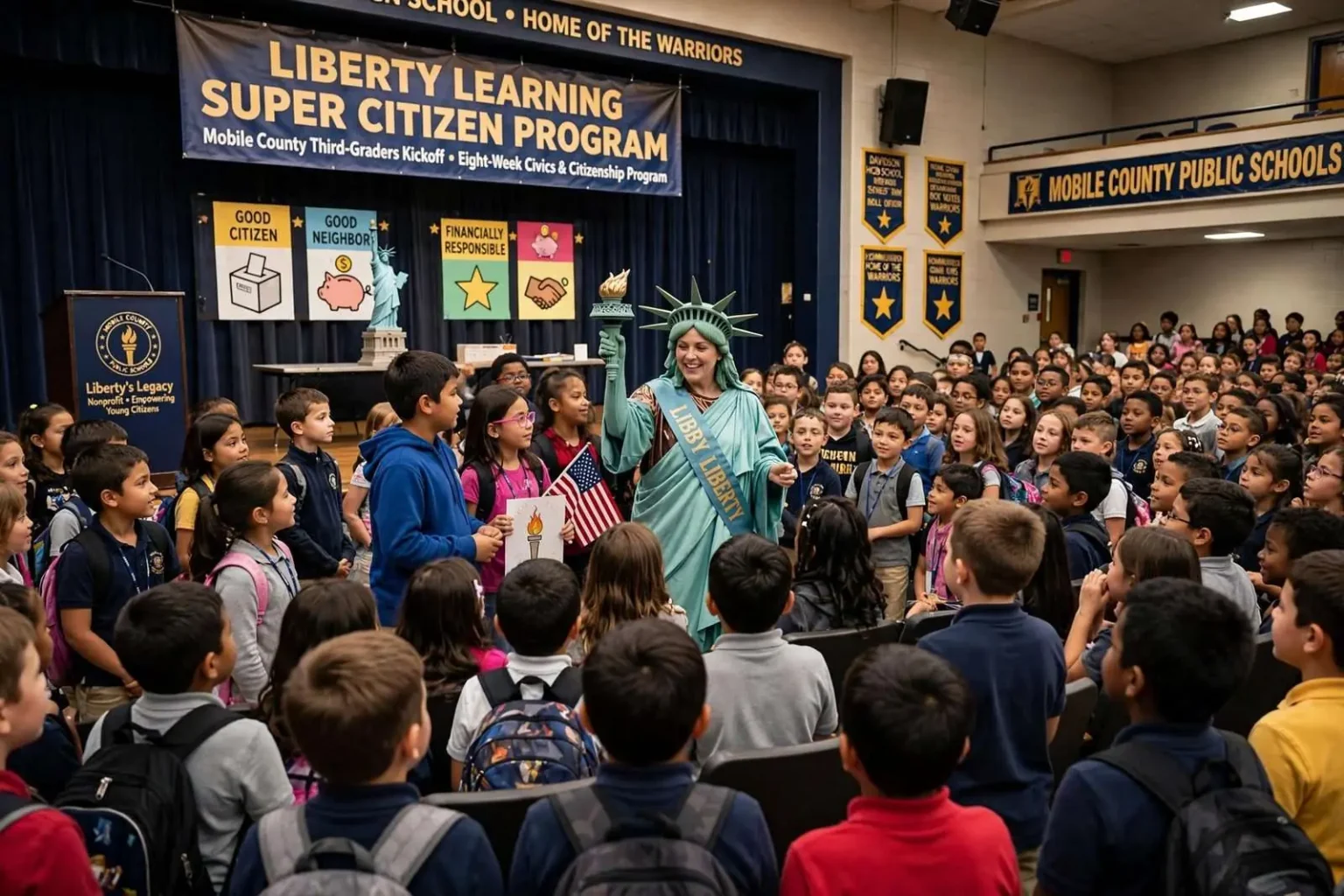
More than 400 third-graders from five Mobile-area schools gathered at Davidson High School this week to launch an eight-week civics and history program aimed at teaching young students what it means to be a good citizen, a good neighbor and a financially responsible adult. The kickoff event filled the high school auditorium with some of the youngest students in the district, gathered to begin a curriculum that will carry through the spring.
The program, known as the Liberty Learning Super Citizen program, is run by the nonprofit Liberty’s Legacy and is now in its second year in Alabama classrooms. According to the organization’s president, the initiative reached roughly 40,000 students across 328 schools during its first full year, and organizers say this year’s participation is on pace to top 50,000 students statewide — growth that has made the program one of the largest civics efforts aimed at elementary students in Alabama.
Libby Liberty Opens the Show
The kickoff event featured a costumed “Libby Liberty” character leading students through songs and lessons about the history of the Statue of Liberty, with several students invited on stage to help illustrate the statue’s scale and symbolism. The theatrical approach is deliberate: organizers have found that eight-year-olds absorb big ideas — freedom, opportunity, immigration, responsibility — more readily through characters and music than through lectures.
The Statue of Liberty serves as the program’s anchor symbol, a monument every student recognizes and a story that connects American history to the values the curriculum wants to instill. By the end of the kickoff, the students in the Davidson auditorium had sung the songs, heard the story and met the character who will follow them through the next eight weeks.
What the Eight Weeks Cover
Over the coming weeks, third-graders will study U.S. history, government structure and the basics of financial literacy, aided by volunteer readers who visit classrooms with lesson materials supplied by the program. The volunteer component brings community members into the schools as living examples of the citizenship the lessons describe — professionals, retirees and parents who give an hour to read and discuss with students.
The financial literacy piece is aimed at the foundations: saving, spending wisely and understanding that resources are finite. Combined with the history and government units, the curriculum is designed to show students that citizenship operates at every scale — in a classroom, in a checkbook, in a community and in a country.
Torch Teams and Community Heroes
A signature feature of the program asks each class to identify a “hero” from their own community — someone like a school janitor, crossing guard or nursing home worker — whom students believe exemplifies good citizenship. Classrooms organize into small “Torch Teams” where students research and make the case for their nominee before the rest of the group votes on a winner.
The exercise teaches more than research skills. Students must define what makes someone heroic, listen to arguments for candidates they did not choose, and accept the outcome of a vote — a miniature civics lesson embedded inside a larger one. The nominees, meanwhile, are often people who have never been recognized publicly for the work they do every day.
Students also work throughout the eight weeks to collectively raise $30 per class, money that goes toward a small replica of the Statue of Liberty presented to the chosen community hero. The fundraising goal is small by design — reachable through chores, change jars and small donations — so that every child can participate in earning the gift their class will give.
The Celebration in May
All of the honorees from participating schools will be recognized together at a culminating “celebration graduation” ceremony set for early May, where the students who selected them will present the replicas and tell the audience why they chose them.
Organizers say the exercise is designed to have an emotional impact on both the students and the adults they choose to honor. Past honorees have included cafeteria staff and support workers who rarely receive public recognition, and organizers describe the reveal moments as often surprising and moving for everyone involved — custodians and crossing guards handed a statue and a round of applause by children who decided, on their own, that they were heroes.
For the schools, the ceremony doubles as a community event, drawing parents, grandparents and the honorees’ families into an auditorium to celebrate people who ordinarily work in the background of school life.
Lessons Students Are Already Using
Beyond the community-hero project, the curriculum touches on core concepts of freedom and responsibility. Students taking part in the kickoff said they were already absorbing some of the program’s central lessons, describing good citizenship in terms of treating others fairly, respecting rules and taking care of the community around them.
Those definitions — offered by eight- and nine-year-olds in their own words — are the outcome organizers point to when they describe the program’s purpose. The vocabulary of civics can sound abstract in a textbook; in the mouth of a third-grader explaining why the crossing guard deserves a statue, it becomes concrete.
Funded So Schools Pay Nothing
The program is funded through the Alabama Power Foundation and is offered at no cost to participating schools. The funding model removes the barrier that keeps many enrichment programs out of classrooms — the cost of materials, training and coordination — and allows principals to say yes without finding room in stretched school budgets.
Corporate and foundation support has been central to the program’s rapid growth from its first year to its second, and the statewide scale — tens of thousands of students across hundreds of schools — depends on that continuing backing. For the foundation, the investment fits a longstanding pattern of support for education initiatives across Alabama.
Why Start in Third Grade
Organizers say the goal is not just to teach facts about American history and government, but to give young students an early, hands-on framework for recognizing civic responsibility in their everyday lives — lessons they hope will stick with the students well beyond the third grade.
The timing is deliberate, too. Third grade sits at the point where students are old enough to grasp concepts like voting and community service but young enough that habits formed now tend to endure. Research on civic development has long suggested that attitudes toward participation — voting, volunteering, community involvement — take root early, and programs like this one aim to reach students before those attitudes harden.
For the 400 students who filed into the Davidson High School auditorium this week, the next eight weeks will include history lessons, volunteer visits, fundraising, debates and a vote. In May, some of them will hand a small Statue of Liberty to someone they decided — after research, argument and a ballot — was a hero. That sequence, scaled across 328 schools and counting, is what the Super Citizen program means by hands-on civics.
Inside a Torch Team Meeting
The Torch Team structure is where the program’s lessons get their practice run. A classroom divides into small groups, each charged with nominating and building a case for a community hero. The students interview, take notes, compare candidates and eventually present to the full class — a sequence that mirrors, in miniature, how citizens evaluate and choose leaders at every level of public life.
Teachers who have run the exercise describe students discovering, often for the first time, what the adults around a school actually do all day. The janitor who arrives before dawn, the crossing guard who stands in the rain, the nursing home worker who spends shifts with residents who have no other visitors — all become subjects of genuine curiosity and, frequently, genuine admiration.
The vote at the end of the process carries its own lesson. Students whose nominee is not selected learn that persuasion matters, that losing a vote is survivable, and that the class moves forward together — a small experience with an outsized civic shadow.
The $30 That Teaches a Lesson
The class fundraising goal of $30 for the hero’s statue replica is deliberately modest, but the lesson behind it is not. Students plan how to raise the money, track their progress toward the goal and experience the connection between collective effort and a shared result — the same mechanics that fund community projects, churches and civic organizations across the Gulf Coast.
When the class presents the statue in May, the students can say they paid for it themselves, nickel by nickel. Organizers count that ownership as part of the emotional weight of the ceremony: the honoree receives a gift the children genuinely earned, and the children see that ordinary effort pooled together can produce something worthy of ceremony.
Volunteers as Living Lessons
The volunteer readers who carry the program’s materials into classrooms supply more than reading time. Each volunteer who walks in — a bank employee discussing saving, a veteran discussing service, a parent discussing neighborhood involvement — becomes a concrete example of the citizenship the curriculum describes, and students meet adults whose civic habits are visible in the ways the lessons describe.
The volunteer model also builds the bridge between schools and the communities around them. Businesses and organizations that send readers into classrooms often continue the relationship long after the eight weeks end, and the program’s growth across Alabama has created a network of schools, volunteers and sponsors who now share the work.