Airbus A320 Line in Mobile Opens New Round of Technician Jobs
Airbus is recruiting flightline avionics and mechanical technicians for its Mobile Aeroplex A320 assembly line, with training pay starting near $16.50 an hour.
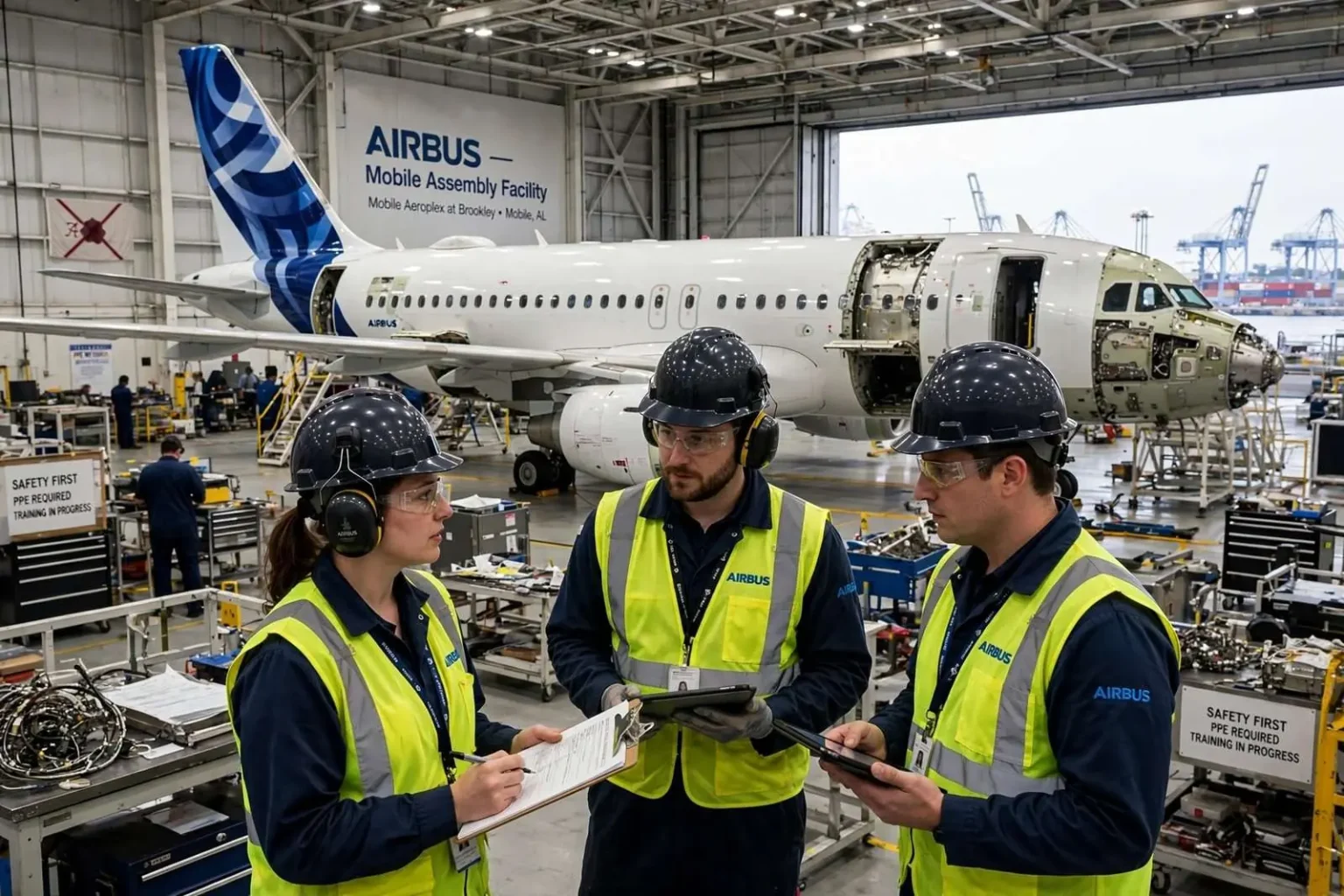
Airbus is opening a fresh round of hiring for its A320 final assembly line taking shape at Mobile Aeroplex at Brookley, with openings for both experienced and entry-level flightline technicians. The new postings mark one of the clearest signals yet that the European aircraft maker is moving from construction toward operation at its first U.S. production site, and they represent an opportunity for Gulf Coast workers with aerospace training to land a position with a global manufacturer without leaving the region. According to job postings managed through the Alabama Industrial Development Training program, the starting training rate for flightline avionics and mechanical technicians is $20.50 an hour, while entry-level flightline avionics and mechanical technician trainees start at $16.50 an hour. Both tracks require six to nine months of training abroad before technicians report to work in Mobile, a reflection of how closely Airbus guards its production methods and how much hands-on instruction the company believes each technician needs before touching an aircraft on the Mobile line.
The requirement to train overseas is a hallmark of the way Airbus has staffed its assembly plants around the world. Rather than simply posting a job and expecting a new hire to learn on the fly, the company sends its incoming technicians to established facilities, where they work alongside veteran crews, absorb the company’s production culture, and return home ready to replicate those processes on a new line. For Mobile-area candidates, that means a hiring cycle measured in months rather than weeks, but it also means that the people who eventually staff the local flightline will have been trained to the same standard as their counterparts in Europe. Local workforce officials have pointed to that model as a reason for confidence that the Mobile line will produce aircraft to the same quality expectations as the company’s existing plants.
What the Flightline Jobs Involve
Flightline avionics technicians will handle installation, testing and maintenance of electrical and electronic aircraft systems. That work sits at the heart of modern aircraft assembly, since a contemporary airliner is as much a flying network of computers, sensors and wiring as it is an airframe and engines. Candidates for the experienced avionics positions need at least a high school diploma, specialized aeronautical training, and either a valid FCC license or an FAA Airframe and Powerplant certification. The certification requirement is a familiar one to anyone who has worked in general aviation or commercial maintenance in the United States, and it signals that Airbus is looking for technicians who can be trusted with safety-critical systems from their first day on the floor.
Flightline mechanical technicians will take on similar duties for mechanical, hydraulic, sheet metal and composite systems. Those roles call for a high school diploma, aeronautical training and a valid A&P license, the combination that has long served as the standard credential for aircraft mechanics across the country. Mechanical technicians on a final assembly line do the physically demanding work of joining major aircraft sections, routing hydraulic lines, fitting panels and making sure every mechanical system functions as designed before an aircraft is certified for flight. Both experienced positions also require at least five years of commercial, vocational or military training in an aeronautical field, including at least three years working in production or repair for the A320 family of aircraft, a bar that narrows the field considerably and points toward candidates already steeped in the product line.
Entry-level flightline avionics and mechanical technicians will assist with those same duties under the supervision of more experienced crew members. A high school diploma and specialized aeronautical training are required, though an FCC or A&P license and prior A320 experience are considered a plus rather than a requirement. That distinction matters for local job seekers: the entry-level track is designed to be a doorway into aerospace manufacturing for workers who have the aptitude and the basic training but have not yet accumulated years of certified experience. For graduates of Alabama’s community college aviation programs and for veterans transitioning out of military aircraft maintenance, the entry-level postings may be the most realistic path into the Mobile plant.
A Landmark Project for Mobile
The hiring push is part of the ongoing buildout of Airbus’s first U.S. final assembly line, a roughly $600 million facility at the former Brookley Air Force Base site in Mobile. The plant was on track to come online in the summer of 2015, with the first Mobile-built aircraft expected to roll out in 2016. The choice of Mobile for the company’s American production beachhead capped a competitive process and returned heavy aviation manufacturing to a site that had been synonymous with military aviation for decades before the base closed. Once fully ramped up, the line is projected to employ around 1,000 workers and produce 40 to 50 aircraft annually by 2018, volumes that would place the Mobile operation among the significant aerospace production sites in the country.
Since the project was announced, the A320 program has become one of the most closely watched economic development projects on the Gulf Coast, drawing suppliers and support businesses to the Mobile area as the assembly line has moved from construction to operation. Aerospace recruiters and economic developers across the region have used the Airbus announcement as a calling card, arguing that a company of its stature validated south Alabama as a serious location for advanced manufacturing. Each round of hiring also ripples outward beyond the plant itself, as new technicians and their families settle in the area, spend their paychecks locally and add to the demand for housing, services and schools in Mobile and Baldwin counties.
Training the Local Workforce
Local workforce officials have coordinated with Airbus and AIDT to recruit and train residents of Mobile and Baldwin counties for the specialized aerospace roles, aiming to fill many of the positions with homegrown talent rather than relocated workers. The Alabama Industrial Development Training program has built its reputation over decades by preparing Alabama workers for the demands of new manufacturing employers, and the Airbus project is among the most prominent engagements in the agency’s history. Training delivered through the program is typically provided at no cost to accepted candidates, which removes a significant barrier for workers who have the mechanical aptitude but not the means to pay for specialized instruction on their own.
For the flightline positions, that preparation goes well beyond the classroom. Candidates who clear the selection process can expect coursework and hands-on practice designed to mirror the conditions they will face on the assembly line, followed by the six to nine months of training abroad that both the experienced and entry-level tracks require. Workforce planners in the region have described the staggered training schedule as a necessity given the scale of the eventual workforce, and the fresh round of postings suggests that recruiters are continuing to work through the pipeline of candidates needed to meet the line’s projected employment targets.
Job seekers interested in the flightline technician openings or other positions tied to the Mobile assembly line are directed to apply through the AIDT jobs portal, which lists current postings as they become available throughout the hiring process. Officials involved in the recruiting effort have consistently advised applicants to apply even if they are unsure whether their background fits, because the screening and training process is designed to identify promise as well as credentials. As the Mobile line moves closer to producing its first aircraft, the coming rounds of hiring will determine how many of the roughly 1,000 projected jobs end up in the hands of Gulf Coast residents, and each posting cycle brings that milestone a step closer.
The Aircraft Behind the Line
The A320 family sits at the center of the global market for single-aisle airliners, the workhorse aircraft that carriers around the world rely on for short and medium-haul routes. Airlines value the family for its operating economics and its flexibility across route lengths, and the product line has been in continuous development since it entered service decades ago. That sustained demand is the underlying reason Airbus chose to build a final assembly line in the United States at all: the company needed additional capacity close to one of its largest customer bases, and assembling aircraft on American soil shortens the distance between the factory floor and airline delivery centers across the country. For the technicians being hired in Mobile, the strength of the product line translates directly into job security, because the skills they are developing apply to an aircraft family that will be in production and in service for many years to come.
The A320 hiring also lands in a region working deliberately to diversify its industrial base beyond the shipbuilding, paper and port activity that has historically anchored the local economy. Community leaders have described aerospace as a natural fit for the area, pointing to the skilled trade talent already present among the local workforce and the region’s long familiarity with heavy industry. The flightline technician roles fit squarely into that vision, offering pay and training pathways that have traditionally required workers to leave the Gulf Coast to find. Every experienced technician hired locally is also a mentor for the entry-level trainees who follow, which is how a manufacturing workforce compounds its knowledge over time.
What Comes Next for Applicants
The cadence of hiring is expected to continue as the line moves toward its production targets, with additional postings in other job categories likely to follow the flightline announcements. Applicants selected for the current round should plan for a significant personal commitment, since the six to nine months of training abroad will mean an extended stay in Europe, typically with relocation and training support provided through the company and the state training program. Workforce officials have urged candidates to keep their contact information current in the application system, because selections are made as training cohorts are assembled rather than all at once. For workers who complete the process, the payoff is a position on the ground floor of an operation intended to be a fixture of the regional economy for decades, building aircraft that will carry passengers around the world with a Mobile stamp on the fuselage.